Jungle Review

8.0/10

Turn slides, PDFs, notes, and videos into flashcards and quizzes in seconds.

Review updated May 2026 By The AI Way Editorial Tested 133+ tools across the site 5 min read
Jungle Note-Taking Summarization Web-Based Freemium

Our Verdict

Jungle is strongest when you already have study material and need to turn it into flashcards or quizzes fast enough that you will actually review it. Its edge is not fancy note storage, but faster conversion from source content into active recall practice. But if your learning process depends on crafting every card by hand, the convenience layer can reduce the value instead of increasing it.

Try it
Free to start, then pay when the limits stop you.
open_in_new Try Jungle
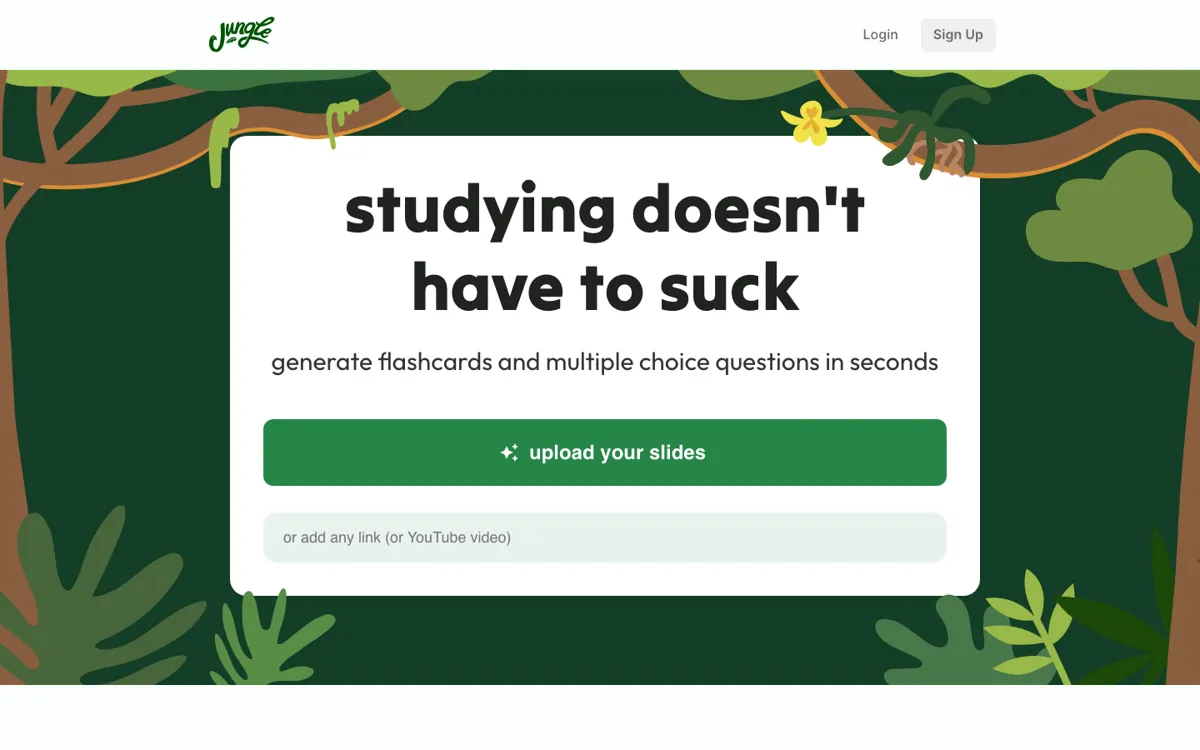
Official Website Snapshot Visit Site ↗

check_circle Pros

  • It starts from the real study bottleneck, which is converting messy material into something reviewable before motivation disappears.
  • Support for slides, notes, PDFs, and videos makes it easier to use across real coursework instead of one narrow format.
  • Flashcards and quiz generation are practical outputs for students who need retrieval practice, not just summaries.

cancel Cons

  • The product is less useful if you do not rely on flashcards or quiz-based review in your study process.
  • AI-generated study material can save time, but some learners retain less when they skip manual card creation entirely.
  • Because the free entry is clearer than the paid edge from the outside, it is harder to estimate long-term fit before you actually test the workflow.

Should you use it?

Best for: Best for turning lecture slides, class notes, PDFs, and educational videos into flashcards and quiz material fast enough to support regular study sessions.

Skip it if: Skip this if you rarely use flashcards, or if manual card writing is part of how you learn best. Also skip it if you mainly need a general note app rather than active recall study output.

Is it worth the price?

Freemium

The value here depends less on raw feature count than on whether faster card generation actually gets you to review more often. If auto-generated flashcards only pile up untouched, the convenience does not buy you much.

The Free Tier

Public pricing clearly signals a free entry path, but exact free-tier limits were not extracted reliably enough in this run to state more without guessing.

Paid Upgrade
Contact for pricing

Paid access appears to expand card and quiz generation capacity beyond basic entry usage.

One thing to know before you start

Test Jungle with one real lecture deck or one dense PDF you already need to study this week. The best signal is not whether it generates cards, but whether those cards are good enough that you actually start reviewing sooner.

What people actually use it for

Turn lecture slides into flashcards before an exam crunch

When the material already exists but the review set does not, Jungle can shorten the most annoying step. It is especially useful when exam prep is blocked by the time it takes to convert slides into something drillable. The benefit is weaker if your course material is so small that manual card writing is already manageable.

Convert PDFs and notes into quiz practice instead of rereading passively

A lot of students reread notes because turning them into retrieval practice feels like too much work. Jungle is more useful when that conversion delay is the real study problem. It is less compelling if your study process already depends on handwritten summaries and you are not trying to shift toward flashcards or quizzes.

Reuse videos and mixed study sources inside one revision workflow

Classes and self-study often spread across YouTube explainers, teacher slides, uploaded notes, and PDFs. Jungle makes sense when you want one system to turn all of that into practice material instead of using separate tools for every source. It is a weaker fit if your study material comes from one clean format and is already easy to review.

What does Jungle actually do?

A lot of students already have enough material. The real problem is that the material stays trapped in lecture decks, PDFs, notes, and videos long after it should have become something reviewable. That is the gap Jungle is built around. The official site does not pitch the product as abstract AI learning magic. It keeps the promise specific: take source material you already have and turn it into flashcards and quizzes quickly enough that studying can actually begin. That matters because the biggest blocker is often not understanding a topic, but never converting the source material into an active recall format in time.

The product becomes stronger once you look at how many source types it accepts. Slides, notes, PDFs, and videos are all part of the current Jungle story, which makes it more practical than a study tool that assumes every learner starts from one neat text input. That flexibility matters in real coursework, where revision material is messy and scattered. The old Wisdolia identity on TAAFT still points in the same direction, but the live Jungle site shows a broader current workflow built around turning mixed study inputs into flashcards and quiz practice without forcing everything through a single source format first.

The limitation is that speed only matters if the output changes behavior. If auto-generated flashcards still sit untouched, the product has not solved much. It is also a weaker fit for learners who rely on writing every card manually because that act of writing is part of how they memorize. So Jungle looks strongest for students who already believe in flashcards or quiz drills and mainly need to remove the setup friction, not for people who want a general study companion with no clear practice method behind it.

What you can do with it

Turn notes, slides, PDFs, and videos into flashcards without building every card manually.
Generate quiz-style review material from existing study sources in seconds.
Reuse one study workflow across lecture files, documents, and educational videos.
Move from raw class material to active recall practice faster than manual flashcard writing.

Technical details

platform
Web app
deployment
Cloud
api_available

Top Alternatives to Jungle

If Jungle is close but still misses the job, try one of these instead.

Key Questions

Is Jungle only for flashcards?
No, but flashcards are still a central outcome. The official site also positions it around quiz generation from notes, slides, PDFs, and videos, so the product is broader than a single card editor.
Who gets the most value from Jungle?
Students who already have lots of study material but struggle to turn it into active recall practice get the clearest value. It matters most when setup friction is blocking regular review.
When is Jungle the wrong tool to open?
It is the wrong fit when you rarely study with flashcards or quiz drills, or when writing cards manually is a core part of how you learn. In those cases, the speed advantage matters less.
Why use Jungle instead of rereading notes and slides?
Because rereading is easy to start and easy to forget. Jungle is aimed at turning passive source material into something you can actively test yourself on, which usually makes revision more deliberate than just skimming the same pages again.