Simulacrum Review

7.3/10

Add an AI chat assistant that answers from your documents, captures leads, and routes harder cases into tickets.

Review updated May 2026 By The AI Way Editorial Tested 133+ tools across the site 6 min read
Simulacrum AI CRM Integration Customer Support No Credit Card Required Web-Based Freemium from $19.00/mo

Our Verdict

Simulacrum is most useful when you want a website chat assistant that answers from your own business material instead of hallucinating from a blank model. Its value is not only the chat widget, but the fact that lead capture, ticket creation, CRM handoff, and analytics sit close to the conversation. But the product still looks geared toward practical website support coverage, so teams wanting a larger contact-center platform may find the token-based entry and lighter public detail too narrow.

Try it
Free to start, then pay when the limits stop you. Starts at $19.00 USD.
open_in_new Try Simulacrum
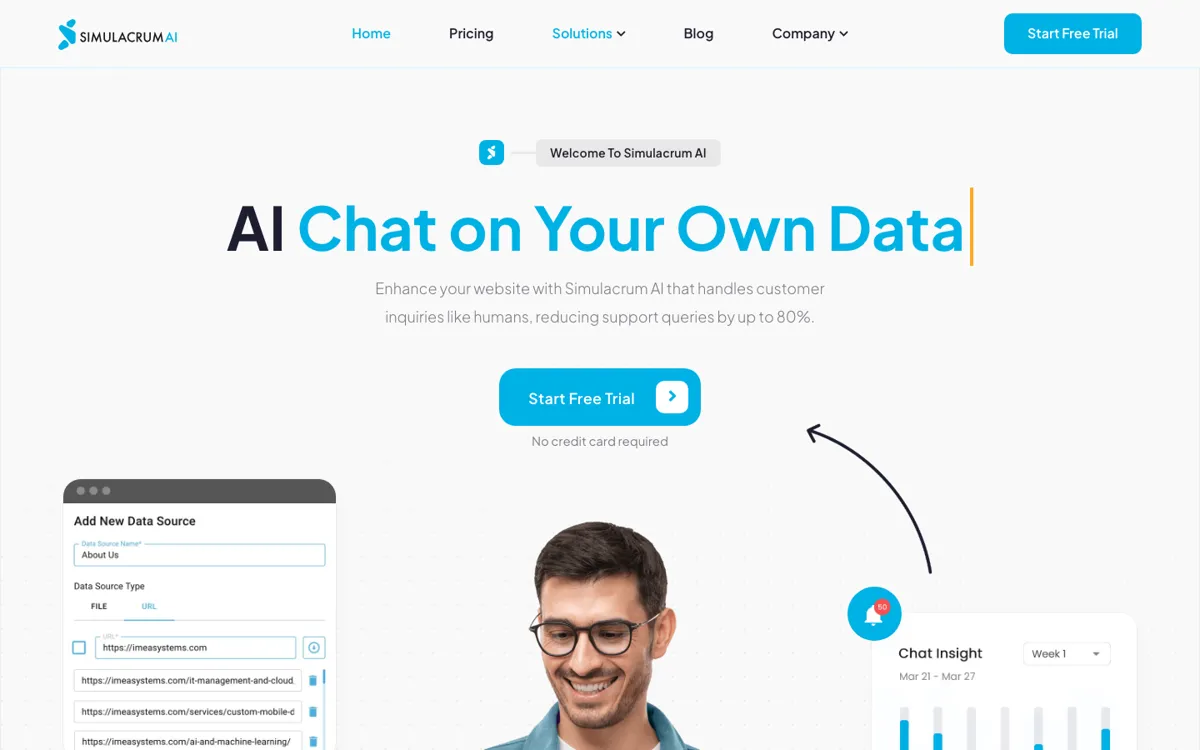
Official Website Snapshot Visit Site ↗

check_circle Pros

  • It lets you build answers from business documents and URLs, which is more grounded than dropping a generic chatbot onto a site with no source material behind it.
  • Lead capture, ticket creation, CRM integration, and conversation summaries give the product more operational value than a simple FAQ widget.
  • The setup flow is concrete and short: upload content, brand the widget, then paste the integration script into the site.

cancel Cons

  • The free trial is small at 50 messages, so a serious support team will outgrow it quickly during real testing.
  • Public product information focuses heavily on website chat and text knowledge-base workflows, which leaves less visible depth for broader enterprise channel coverage.
  • Token-based pricing can become harder to reason about than seat-based plans once conversation volume grows.

Should you use it?

Best for: Best for turning a help center, FAQ set, policy docs, or sales material into a customer-facing website assistant that can answer questions, capture leads, and escalate unresolved cases into tickets.

Skip it if: Skip this if you need a full enterprise contact-center rollout with richer public proof around voice, channel orchestration, and large-team admin controls. Also skip it if you want a general-purpose chatbot rather than one tied to your own uploaded business content.

Is it worth the price?

Freemium Starts at $19.00 USD

The free trial is enough to check whether your content imports cleanly and whether the widget answers obvious questions well. You will need to pay as soon as real customer traffic or support load starts hitting the token ceiling, so the important decision is not the $19 entry, it is whether the bot genuinely cuts ticket volume after the first setup.

The Free Tier

The free trial includes 50 tokens, and one token equals one answer.

Paid Upgrade
$19/month

Paid plans raise token limits beyond the small trial while keeping document upload, URL extraction, website integration, analytics, CRM integration, and conversation summarization in the workflow.

One thing to know before you start

Load cleaner source material before judging the assistant. This product is only as good as the PDFs, URLs, and help content you feed into its knowledge base, so messy source docs will look like weak AI even when the setup is technically correct.

What people actually use it for

Turn a help center into a first-line support widget

A small support team can feed Simulacrum its FAQs, docs, and policy files, then place the widget on the website to catch repetitive questions before they become tickets. That saves the most time when the question volume is predictable and document-backed. It is less effective if the business relies on highly custom case handling that rarely repeats.

Capture and qualify leads during pre-sales chats

Because Simulacrum combines lead generation with website chat, it can do more than answer support questions. A business can use it to respond to early buyer questions, collect contact details, and push context toward follow-up flows. The catch is that this only works well if the uploaded material actually reflects the offer, pricing logic, and qualification cues prospects ask about.

Escalate unresolved issues without leaving the chat dead-end

Many website chatbots fail exactly where a human team needs them most: when the bot runs out of confident answers. Simulacrum at least tries to bridge that gap by creating tickets and attaching status into CRM-style workflows. That makes it more useful for real support operations than a widget that simply apologizes and stops.

What does Simulacrum actually do?

A lot of website chat tools look useful right until a visitor asks a question that depends on real company information. Then the bot either guesses, loops, or dumps the person into a contact form. Simulacrum is aimed at that weak spot. Its homepage keeps the setup very concrete: create a knowledge base from PDFs, DOCX, TXT files, or a URL, then let the assistant answer from that material. That framing matters because the product is not pretending to know your business out of thin air. It is asking you to feed it the content your support or sales team already depends on.

The more useful part is what happens around the answer. Simulacrum does not stop at a branded website widget. Official pages also push lead generation, automatic ticket creation, CRM integration, analytics, and conversation summarization. In practice, that means the product is trying to reduce the gap between a chat session and the next business action. If the assistant can answer, great. If not, the conversation can still become a lead, a ticket, or a structured handoff instead of disappearing into chat history no one checks.

The limitation is that the public product story still feels focused on practical website support use rather than a giant enterprise AI stack. The free tier is only 50 messages, pricing is token-based, and most of the visible workflow centers on document-backed text assistance plus basic escalation paths. That is enough to make the product appealing for lean support and lead capture teams, but it is less convincing for buyers who need heavy multi-channel orchestration, deeper public proof around voice deployment, or very large-scale service operations from the first purchase.

What you can do with it

Build a knowledge base from PDFs, DOCX, TXT files, or extracted website URLs.
Embed a branded AI chat widget into a website with a copy-paste integration script.
Capture leads from conversations and notify admins by email.
Create tickets automatically when the assistant cannot resolve a customer question.
Push conversation context into CRM and analytics workflows with summaries and status handling.

Technical details

platform
Web app with embeddable website widget
deployment
Cloud
api_available
No public API docs surfaced on the official pages reviewed

Top Alternatives to Simulacrum

If Simulacrum is close but still misses the job, try one of these instead.

Key Questions

Can Simulacrum answer from my own support documents instead of generic AI knowledge?
Yes. The official setup flow is built around creating a knowledge base from PDFs, DOCX, TXT files, or extracted website URLs, so the assistant is meant to answer from your business material rather than from a blank chat prompt.
Is the free version enough to test the product properly?
Yes for a light proof of concept. The official pricing page gives every user 50 free messages with no credit card required, which is enough to test content import and basic website behavior, but not enough for sustained live support traffic.
What happens when the assistant cannot solve a question?
It does not have to end as a dead chat. Official pages say Simulacrum can suggest ticket creation and connect the unresolved case into CRM-style handling, which is one of the product's more practical support features.
Does Simulacrum rely on ChatGPT behind the scenes?
According to the official help-center content, no. The site explicitly says it does not use ChatGPT or other outside technologies for this and instead uses its own model, though the public pages do not go deep on model architecture.