Apollo Review

8.3/10

Sales intelligence, outreach, and workflow automation for pipeline generation.

Review updated May 2026 By The AI Way Editorial Tested 99+ tools across the site 5 min read
Apollo API Available App Integration Lead Enrichment Web-Based Workflow Builder Freemium from $49.00/mo

Our Verdict

Apollo makes the most sense for teams that want prospect data and outbound execution to live in one operating surface. Its real value is not just the size of the database, but the way it connects search, enrichment, sequencing, meetings, and workflow automation without forcing reps to rebuild the motion across separate tools. But the wider the platform gets, the more you need to trust one vendor with both data quality and execution, which is a bigger commitment than buying a list and plugging it into your existing stack.

Try it
Free to start, then pay when the limits stop you. Starts at $49.00 USD.
open_in_new Try Apollo
Official Website Snapshot Visit Site ↗

check_circle Pros

  • It combines data search, enrichment, outreach, and workflow automation, so teams can move from target selection to live outbound with fewer handoffs.
  • The platform is easier to test than enterprise-only sales tools because Apollo exposes a real free tier instead of hiding everything behind a demo call.
  • Apollo's workflow engine and integrations make the product more useful than a static contact export when records need to keep moving into CRM or follow-up steps.

cancel Cons

  • A broad all-in-one sales platform can make it harder to separate which part of the stack is actually driving results, because database, sequencing, and automation are bundled together.
  • Apollo still depends on teams caring about data quality and segmentation, so a large contact database alone will not save a weak outbound process.
  • The deeper value comes from using several layers of the platform together, which means teams that only want one narrow capability may end up paying for more surface area than they need.

Should you use it?

Best for: Best for finding leads, enriching them, launching outbound, and keeping CRM-linked prospecting workflows moving without stitching together several separate sales tools by hand.

Skip it if: Skip this if you already have a data source, sequencer, and CRM process you trust and only need one missing piece, because Apollo is easier to justify when you actually want a broader GTM operating layer.

Is it worth the price?

Freemium Starts at $49.00 USD

The free plan lowers the risk of getting started, but Apollo becomes truly useful when your team leans on the database plus sequencing plus workflow features together. If you only need occasional exports or one narrow enrichment step, the paid platform can feel broader than the job.

The Free Tier

Apollo has a free plan, but heavier prospecting and execution workflows require paid tiers with broader access.

Paid Upgrade
$49/month

Paid plans expand prospecting, enrichment, sequencing, and workflow capabilities beyond the free tier.

One thing to know before you start

Do not judge Apollo from one contact search. Test a full motion, from filtering to enrichment to sequence enrollment to CRM sync, because that is where the platform either saves time or creates extra overhead.

What people actually use it for

Build and launch outbound from one prospecting surface

A sales or growth team can use Apollo to search for target accounts and contacts, enrich the records, and move them directly into sequences without exporting lists between tools. That removes a lot of spreadsheet handling and reduces the lag between deciding who to contact and actually starting outreach. The payoff is strongest when outbound happens daily, but it matters less if your team only does occasional campaign bursts.

Keep CRM-linked pipeline generation moving

Apollo can make sense when the team wants prospecting activity, enrichment updates, and follow-up records to stay connected to the CRM instead of living in disconnected tools. You can find leads, score or enrich them, and push activity forward through integrations and workflow logic. That saves admin time, but only if the team already knows which fields and triggers actually matter to pipeline creation.

Replace fragmented prospecting tools with one broader GTM stack

If a team is tired of paying separately for a contact database, an enrichment layer, a sequencer, and lightweight automation, Apollo offers a way to consolidate more of that motion. You get more continuity from one step to the next, which can simplify operations for smaller teams. The tradeoff is that consolidation only feels like a win when the built-in pieces are good enough to replace the specialized tools you already know.

What does Apollo actually do?

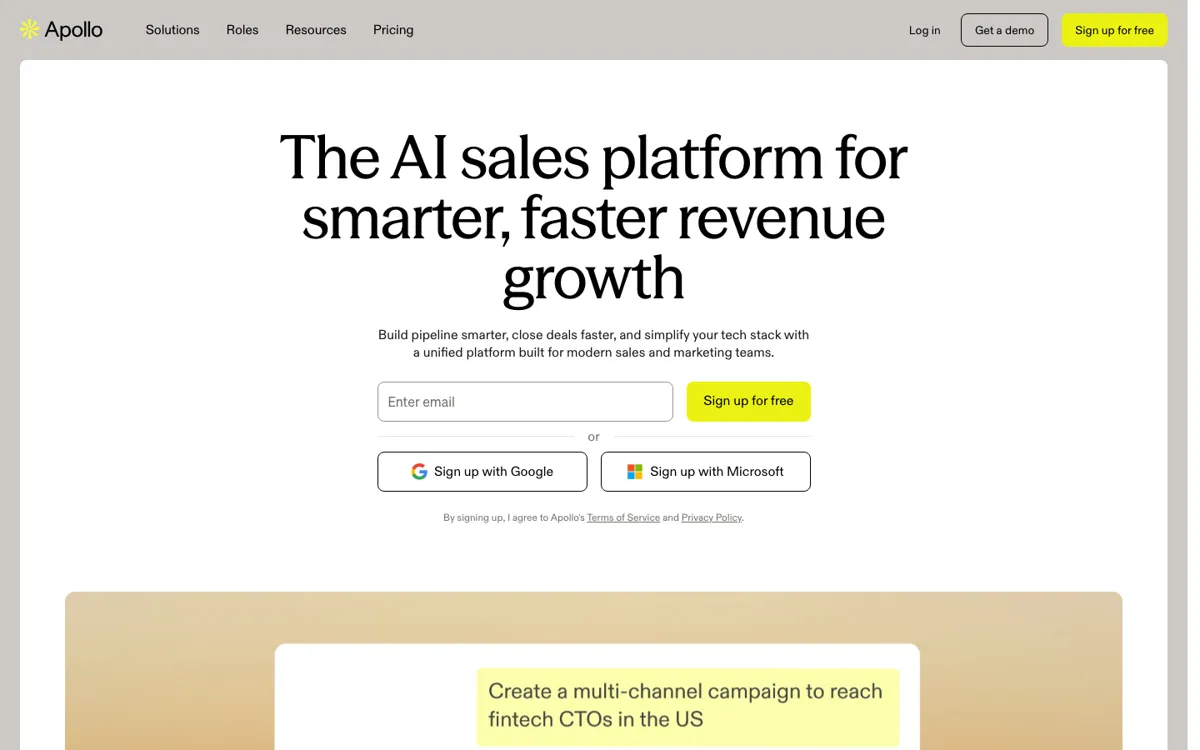
Many teams do not struggle to find leads because data does not exist. They struggle because every step after the search breaks into another tool. One system holds contact data, another runs sequences, another tracks meetings, and someone still has to clean fields and update the CRM by hand. Apollo's homepage is clearly aimed at that operational drag. It presents a combined sales workflow where prospecting, enrichment, outreach, and workflow automation sit close together instead of being treated as separate purchases. The practical promise is that a rep or ops owner can move from target selection to action without rebuilding the same motion across multiple tabs and exports.

Apollo's strongest move is the execution layer around its database. The fetched pages point to B2B data, sequencing, workflow engine logic, integrations, and free-to-paid plan progression rather than positioning the product as a simple lead list. In plain terms, the platform wants you to search for accounts and contacts, enrich them, push them into outbound, and then keep records in sync through integrations and automation. That is why Apollo can be more useful than a standalone data vendor. It covers the moment after the lead is found, which is often where teams lose time. The more your team wants database search and outbound execution to work as one motion, the more Apollo's shape starts to make sense.

The boundary is that all-in-one sales platforms always ask for a larger trust decision. If the database quality slips, if the sequencing layer is only adequate for your team, or if your workflow setup is sloppy, the problems stack inside one system instead of being isolated. Apollo does lower the first barrier with a free plan and a relatively accessible paid starting point, but that does not mean every team should standardize on it. The product is easiest to justify when you want to consolidate prospecting and outbound operations. If you already like your CRM motion, your sequencer, and your data vendor, Apollo can feel broader than necessary rather than clearly better.

What you can do with it

Search Apollo's B2B database for accounts and contacts with filters for prospecting.
Enrich lead and account records with additional data before outreach starts.
Run outbound sequences and manage follow-up work from the same platform.
Automate GTM steps with workflow engine logic instead of moving records by hand.
Sync records and activity through CRM and workflow integrations.

Technical details

platform
Web app
deployment
Cloud
api_available
Yes

Top Alternatives to Apollo

If Apollo is close but still misses the job, try one of these instead.

Key Questions

Is Apollo mainly a contact database or a sales workflow tool?
It is both, but the workflow side is what makes the product broader than a pure contact database. Apollo is trying to connect search, enrichment, outreach, and automation instead of stopping at lead export.
Can you try Apollo without paying first?
Yes. Apollo has a real free plan, which makes it easier to test the product before committing. The deeper value, though, shows up when you use more than just the most basic search functions.
When is Apollo more useful than a standalone data provider?
It becomes more useful when your team wants the step after lead discovery to stay in the same system. If enrichment, sequencing, and workflow handoffs matter as much as list building, Apollo has more room to help.
Does Apollo replace every sales tool in the stack?
Not automatically. It can consolidate several prospecting and outbound steps, but whether it should replace specialized tools depends on how much of your current motion you want under one vendor.