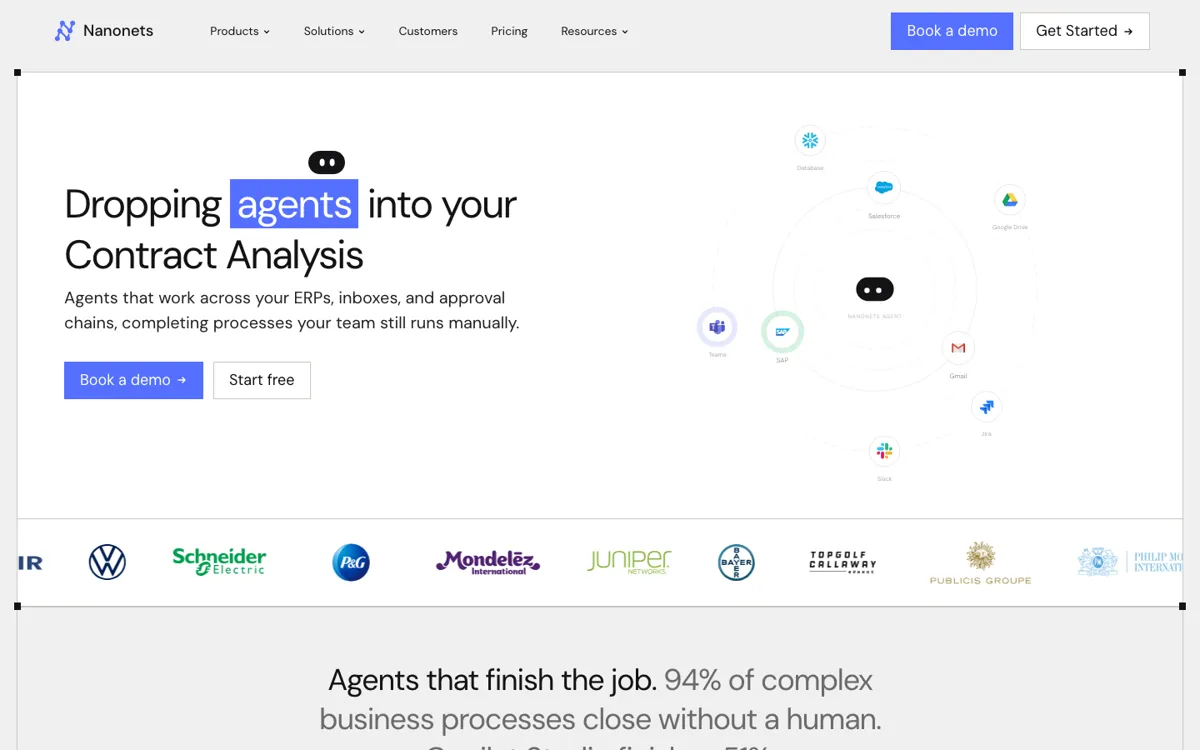
What does Nanonets actually do?
A lot of enterprise automation tools stop too early. They read a document, return extracted fields, and then hand the hard part back to the team. But most operational pain lives after extraction: matching an invoice to a PO, deciding whether something is valid, routing an approval, checking an exception, or posting the result into the right system. That is why document-heavy teams in finance, claims, healthcare, or logistics still end up with humans babysitting every step. Nanonets is built around this exact gap. It treats the document not as the end of the task, but as the beginning of a workflow that has to finish inside the systems the business already uses.
The site makes that positioning unusually explicit. Nanonets Agents is presented as a managed AI workforce that can read, validate, match, route, and post without requiring glue code. The examples stay close to operational reality: accounts payable, order management, reimbursement claims, contract analysis, and healthcare revenue processes. At the same time, Nanonets Agentic Data Extraction gives developers a separate path with APIs for parsing, extracting, splitting, and chunking documents into markdown and structured JSON. That two-product structure matters. It means buyers can use Nanonets either as an end-to-end workflow layer for business teams or as a document-understanding backend for their own LLM and agent systems.