Hoop Review

7.9/10

Automate subscription retention support for Shopify brands before cancel requests turn into churn.

Review updated May 2026 By The AI Way Editorial Tested 133+ tools across the site 5 min read
Hoop App Integration B2B CRM Integration Customer Support Web-Based Paid

Our Verdict

Hoop is valuable when your subscription brand is already losing money through repetitive cancellation conversations, not when you just want another AI chatbot on the help desk. Its strongest point is that it is built around one high-value workflow, retention actions on cancel intent, rather than broad but vague support automation. But that specialization is also the boundary: if your support load is not subscription-heavy, or if retention policy is still messy internally, Hoop will not magically fix the underlying business logic for you.

Try it
Paid product.
open_in_new Visit Hoop
Official Website Snapshot Visit Site ↗

check_circle Pros

  • It targets a revenue-critical support moment, cancel intent, instead of trying to automate every kind of customer message equally.
  • The integration story is practical because it connects to the actual subscription and support stack many Shopify brands already use.
  • Usage-based pricing around cancellations managed is easier to rationalize than paying for a broad AI support layer when you only care about retention flows.

cancel Cons

  • The product is narrow by design, so brands without a meaningful subscription retention workflow will get much less value from it.
  • Public pricing is directionally described but not transparently listed as a simple starter number, which adds buying friction.
  • If your save offers, pause rules, or cancellation logic are weak internally, automation can only expose that mess faster rather than solve it.

Should you use it?

Best for: Best for Shopify subscription brands that already handle enough cancellation or save-request volume for retention support to become a real operations problem. It is especially useful when CX and retention teams are spending too much time manually applying the same pause, skip, and save logic over and over.

Skip it if: Skip this if you are not a subscription business, or if most of your support work has nothing to do with churn prevention. Also skip it if your retention playbook is still unclear, because Hoop depends on solid business rules more than on fancy prompt writing.

Is it worth the price?

Paid

The pricing model sounds sensible because it scales with cancellations managed, but the lack of a simple public entry number means this is still more of a sales-evaluated purchase than a low-friction self-serve tool. That usually makes sense only when subscription retention already has measurable revenue weight inside the business.

Paid Upgrade
Contact for pricing

Pricing scales with cancellations managed and centers on automated retention resolution.

One thing to know before you start

Map your cancel, pause, skip, and save rules before rollout. Hoop will look much stronger when it plugs into a clean retention playbook instead of becoming the place where your team debates policy in real time.

What people actually use it for

Automate repetitive cancel-intent tickets

A subscription CX team may spend hours every week answering the same cancellation requests, offering the same pause or delay options, and checking the same account details before acting. Hoop is built for that exact repetitive loop. It can take that narrow class of tickets and keep many of them from becoming churn while also reducing manual support load. This is most valuable when cancel-intent volume is already high enough to be measurable, not when it is still occasional noise.

Run save offers inside existing support tools

Some brands already know which save offers work, such as skipping a shipment, delaying an order, or offering a smaller discount, but they still rely on agents to apply those moves one conversation at a time. Hoop is useful when the business logic already exists and the problem is operational drag. By sitting inside the support and subscription stack, it can turn proven save tactics into a faster default path. It is less useful if the brand still has no idea which save offer should appear in which scenario.

Keep CX teams focused on edge cases instead of boilerplate

A good subscription support team usually wants humans spending time on exceptions, not on every basic cancellation request. Hoop helps when a brand wants the AI layer to handle the repetitive retention flows while agents step in for nuanced cases, policy disputes, or unusual customer histories. That division of labor saves time and can protect revenue, but only when the edge between standard and non-standard cases is defined well enough for automation to follow.

What does Hoop actually do?

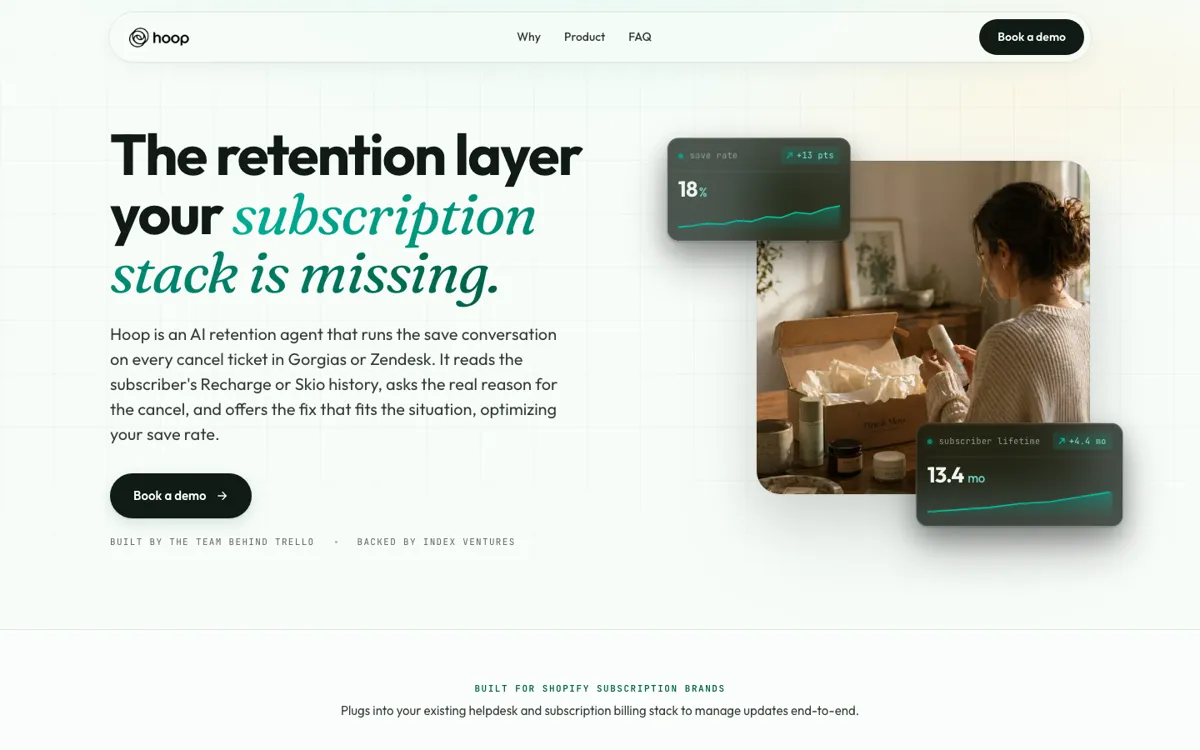
Subscription brands do not usually lose customers because one support agent forgot how to reply. They lose them because the same cancellation conversations keep happening at scale, and every one of those conversations sits right on the line between churn and retained revenue. Hoop is aimed squarely at that moment. Instead of marketing itself as a catch-all support bot, it frames itself as an AI retention agent for Shopify subscription brands, which immediately tells you this is about churn prevention inside support operations, not generic help desk automation.

That narrow framing is the product's biggest strength. The homepage and FAQ point to real subscription tooling, Shopify, Recharge, Skio, Gorgias, and Zendesk, and position Hoop as a layer that can respond to cancel-related messages with the right retention actions. In practice, that means skip, pause, delay, or save logic can move faster and hit more customers before they fully churn. For brands already running at subscription scale, this is easier to justify than a broad AI support tool because the business outcome is directly tied to retained subscribers rather than to vague efficiency language.

The limitation is that specialized automation only works if the underlying retention logic already exists. If a brand has weak save offers, inconsistent policies, or no clear understanding of which subscribers are worth saving and how, Hoop cannot invent a strong retention strategy on its own. The public pricing language also points to a more sales-led buying motion than a simple self-serve trial. So the product looks strongest for operators with established subscription playbooks who now need scale, not for teams still guessing at the basics of churn prevention.

What you can do with it

Handle subscription-related cancel and retention conversations automatically inside support workflows.
Connect with Shopify, Recharge, Skio, Gorgias, and Zendesk to act on real subscription data.
Offer skip, pause, delay, or save options instead of sending every churn request to a human queue.
Route only the harder edge cases to the CX team while the repetitive retention requests stay automated.
Scale pricing around cancellations managed rather than around a generic flat support-seat model.

Technical details

platform
Web app
deployment
Cloud
api_available
No public API mentioned

Top Alternatives to Hoop

If Hoop is close but still misses the job, try one of these instead.

Key Questions

What exactly does Hoop automate?
Hoop focuses on subscription retention conversations, especially cancel-intent workflows. It is not pitched as a general AI help desk for every customer message, but as a retention-specific layer for subscription brands.
Which tools does Hoop work with?
The homepage says it works with Shopify, Recharge, Skio, Gorgias, and Zendesk. That matters because the product only makes sense when it can act inside the same systems where subscription state and support conversations already live.
How does Hoop pricing work?
The FAQ says pricing scales with cancellations managed rather than forcing a fixed one-size-fits-all number. That can align better with retention value, but it also means the buying path is less transparent than a simple public starter tier.
Can Hoop work if our retention playbook is still fuzzy?
Not well. Automation helps most when your save offers and churn rules are already clear, because the tool is better at scaling decisions than inventing them from scratch.