Fin Review

8.1/10

Run an AI customer service agent across chat, email, and phone with Intercom's support stack.

Review updated May 2026 By The AI Way Editorial Tested 133+ tools across the site 6 min read
Intercom AI Agents B2B CRM Integration Customer Support Web-Based Paid from $0.99/mo

Our Verdict

Fin is for teams that want to buy real customer support automation, not just an FAQ bot with better copy. Its strongest point is that it is framed around resolved outcomes across multiple support channels, which makes the product easier to connect to actual support economics. But this is still a serious operations purchase, so if your workflow is messy, your policies are full of exceptions, or your team cannot measure resolution quality clearly, Fin will be harder to justify than the homepage makes it sound.

Try it
Paid product. Starts at $0.99 USD.
open_in_new Visit Fin
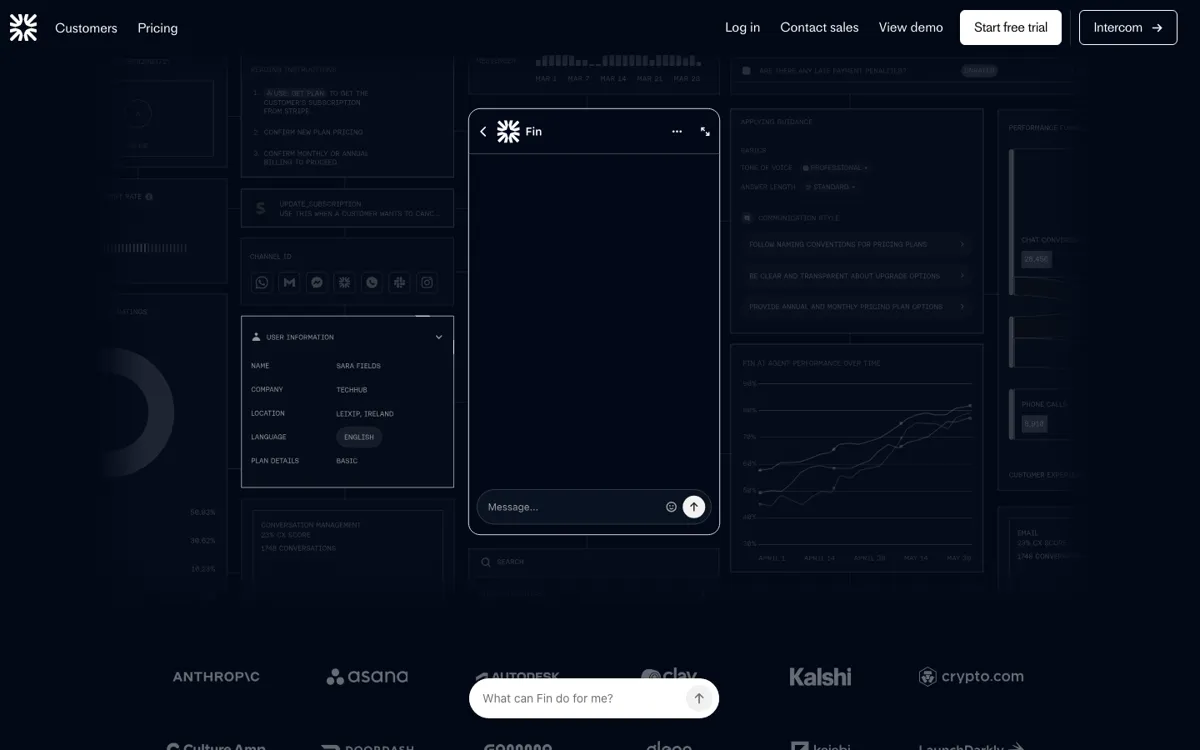
Official Website Snapshot Visit Site ↗

check_circle Pros

  • It is positioned around actual customer service resolution rather than around low-stakes chatbot deflection.
  • The product is easier to slot into larger support environments because it explicitly references enterprise tools like Salesforce and Zendesk.
  • Outcome-based pricing is more aligned with support ROI conversations than a vague assistant subscription when teams are already measuring resolution performance.

cancel Cons

  • The product looks expensive for smaller teams because the pricing logic and product framing are built around serious support operations, not entry-level automation.
  • A lot of the value depends on resolution quality in complex real-world workflows, which the public site naturally claims but cannot fully prove for your environment.
  • The Intercom-to-fin.ai domain shift is understandable, but it adds one more product-identity wrinkle teams may need to explain internally during vendor evaluation.

Should you use it?

Best for: Best for support organizations with meaningful ticket volume across multiple channels, especially when the team already measures resolution costs and wants AI automation tied to that metric. It fits companies comparing AI support vendors as an operational lever, not just as a website widget.

Skip it if: Skip this if you only need a lightweight help-center bot or if your support operation is still too small to evaluate outcome-based automation seriously. Also skip it if your internal support rules are so exception-heavy that AI resolution quality will be hard to trust without a long validation cycle.

Is it worth the price?

Paid Starts at $0.99 USD

The visible pricing angle is more serious than a normal SaaS seat plan because it is tied to outcomes. That makes Fin easier to justify when support automation already has budget and metrics behind it, but harder to justify when the team is still experimenting and cannot yet tell what a good automated resolution is worth.

Paid Upgrade
$0.99 per outcome

Use the AI agent under an outcome-based customer service model across support channels.

One thing to know before you start

Evaluate Fin on a narrow but expensive slice of support first, where your team already knows the baseline resolution rate and handling cost. That makes the outcome-based model much easier to judge than testing it on mixed low-value traffic.

What people actually use it for

Automate high-volume frontline support

A support team dealing with repetitive account, billing, or product-usage questions across several channels can use Fin to absorb a chunk of that first-line load before it reaches humans. The value is not just speed, it is whether enough issues get fully resolved to reduce handling cost. That matters most when the team already has real support volume, because otherwise the product can feel oversized for the problem.

Compare AI support vendors on resolution economics

Some operators are no longer shopping for a chatbot, they are shopping for a better cost-to-resolution model. Fin fits that buying process because the pricing page and product story both push toward outcome-based thinking. This makes it useful when the team wants to ask a harder question than 'does the bot answer fast?', namely 'does it actually finish enough conversations to change unit economics?'.

Layer AI into an enterprise support stack

A company already running Salesforce, Zendesk, or a similar support environment may want AI automation without rebuilding the whole workflow. Fin is attractive in that setting because it is framed as an agent that can sit inside larger support operations instead of replacing everything with a tiny standalone widget. That saves integration and process pain, but only if the team is ready to govern quality and escalation paths carefully.

What does Fin actually do?

Most AI support products still get evaluated like website accessories. Teams ask whether the bot answers quickly, whether the tone sounds decent, and whether it can deflect a few repetitive tickets. Fin is aimed at a bigger question. The product calls itself the number one AI agent for customer service, and the current site immediately ties that claim to real support channels like chat, email, and phone. That framing matters because it tells you Fin is not trying to win on novelty. It is trying to win on whether support leaders believe an AI agent can resolve enough customer issues to deserve real budget.

The strongest part of the product story is that it is built around support operations, not around toy demos. The pages accessed in this run point to enterprise-adjacent integrations like Salesforce and Zendesk, and the pricing language is based on outcomes rather than a flat assistant fee. That combination makes Fin easier to compare against labor cost and support performance metrics. If a team already knows its resolution rate, backlog pressure, and handling cost, then Fin becomes a direct operational question rather than a vague AI experiment.

The limitation is that a product this ambitious only looks good if the underlying support process is mature enough to judge it properly. Complex policies, messy source data, edge-case escalations, and weak internal definitions of success can all make AI resolution look better on a homepage than in production. The current live domain shift from Intercom's marketing pages to fin.ai also shows that the product identity is still evolving. Fin can be worth serious attention, but it is best evaluated as a high-stakes support tool, not as a casual chatbot add-on.

What you can do with it

Handle customer service conversations across chat, email, and phone through one AI agent layer.
Resolve support issues with an outcome-based automation model instead of a simple bot seat model.
Integrate with enterprise support systems such as Salesforce and Zendesk.
Operate alongside human support teams instead of only routing tickets away from them.
Run on the standalone Fin product layer while remaining tied to Intercom's broader support ecosystem.

Technical details

platform
Web app
deployment
Cloud
api_available
No public API confirmed from the accessed pages

Top Alternatives to Fin

If Fin is close but still misses the job, try one of these instead.

Key Questions

Is Fin just another support chatbot?
No, that is not how it is positioned. The homepage frames it as an AI customer service agent meant to resolve issues across channels, which is a much bigger job than answering a few help-center questions.
What does the pricing model focus on?
It focuses on outcomes or resolutions rather than on a simple seat-style subscription. That makes the buying logic closer to support performance economics than to ordinary chatbot SaaS pricing.
Which support systems does Fin mention working with?
The accessed pages reference integrations with systems such as Salesforce and Zendesk. That is useful because it suggests Fin is meant for established support environments, not only for teams staying fully inside one tiny app.
Who is most likely to overbuy Fin?
Small teams with low ticket volume or vague support metrics are the most likely to overbuy it. Fin makes the most sense when the business already has enough support cost and complexity for outcome-based automation to be measured properly.