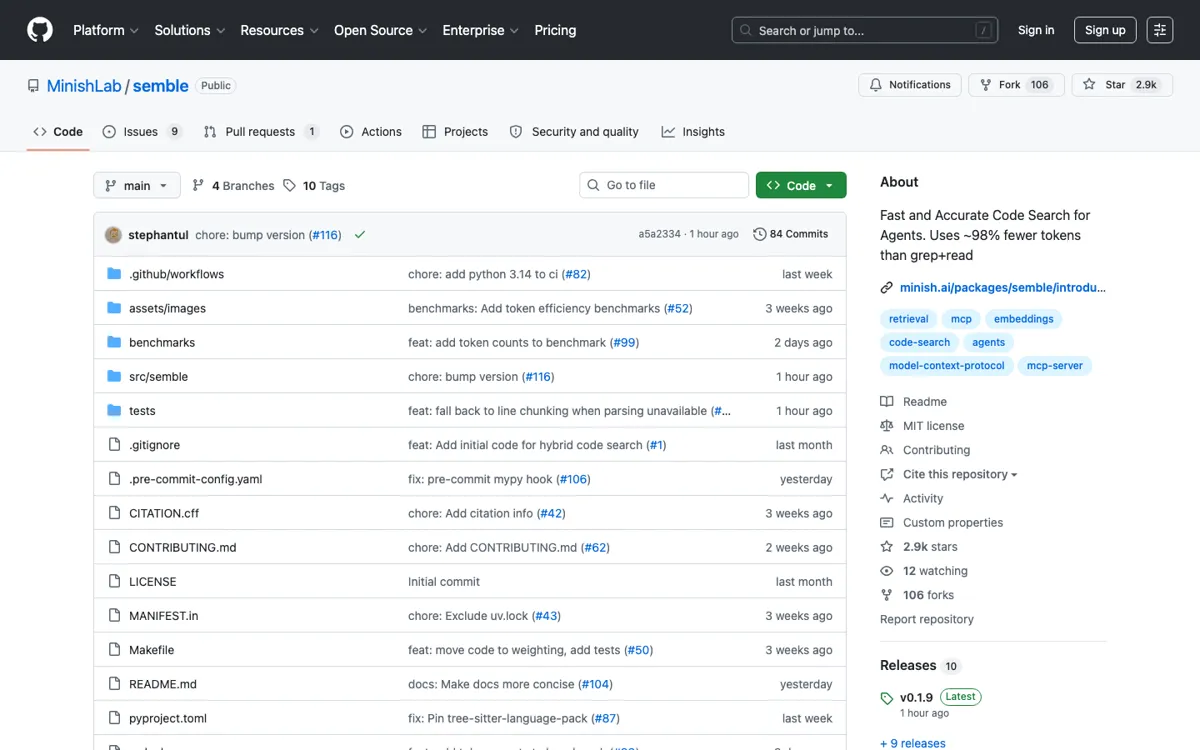
Semble Review

8.2/10

Code search for agents that cuts repo lookup waste before the model starts rereading files.

Review updated May 2026 By The AI Way Editorial Tested 204+ tools across the site 3 min read
Semble API Available CLI Tool Open Source RAG Repo Awareness

Our Verdict

Semble is worth a look when your coding agent keeps wasting tokens on repo exploration instead of the actual task. The upside is simple: it gives Claude Code, Codex, and similar tools a much tighter code retrieval layer without forcing you onto a hosted indexing product. The tradeoff is just as clear: Semble mainly fixes search, not reasoning, so if your agent already mistrusts external search results or your team wants proven end-to-end task benchmarks, you still have to do that validation yourself.

Try it
Paid product.
open_in_new Visit Semble
Official Website Snapshot Visit Site ↗

check_circle Pros

  • It attacks a real pain point for agent-heavy coding workflows: too much context burned on grep, file reads, and repeated repo exploration.
  • Setup stays lightweight for technical users because it runs on CPU, skips API keys, and ships both MCP and CLI paths.
  • The project is shipping quickly, with frequent releases and active iteration on indexing, determinism, and integration details.

cancel Cons

  • Most public proof is retrieval-level benchmarking, not hard evidence that full agent tasks finish better end to end.
  • If your model tends to distrust external retrieval tools and keeps rereading files anyway, the promised token savings can leak away in practice.
  • MCP setup appears uneven for some users, with at least one launch-thread report that the documented integration failed until they switched to the AGENTS.md workflow.

Should you use it?

Best for: Engineering teams and solo builders who already use Claude Code, Codex, Cursor, or similar agents on medium to large repos and want the search step to stop eating context.

Skip it if: Skip it if your main problem is code generation quality rather than repo navigation, or if you need a polished hosted SaaS with admin controls instead of a developer-run local package.

Is it worth the price?

The package is easy to test because the code is open and no paid tier showed up in the reachable sources, but that does not make evaluation cheap. You still need to run it against a real repo task and check whether your agent actually stops wasting reads.

One thing to know before you start

Test it on one ugly repo question, like where auth branches, where config gets loaded, or where ingestion fans out. If the agent still opens half the tree after Semble answers, you learned the important part fast.

What people actually use it for

Cut repo exploration cost in agent coding sessions

When an agent keeps bouncing across files to trace one subsystem, Semble can cut the first pass down to a smaller set of relevant snippets before the model starts opening whole files. It fits repos where grep returns too many near misses and the expensive part is figuring out which few files deserve a full read.

What does Semble actually do?

Semble sits in a part of the stack that many AI tool pages blur together: it is not another general coding copilot, and it is not a hosted RAG layer for enterprise search. Its job is much narrower and more useful than that. It helps an agent find the right code faster inside a repo, which is the step that often spirals when a model cannot immediately see where auth, config, ingestion, or state handling lives. If you have watched an agent open file after file and still miss the right path, this is the problem Semble is trying to remove.

The strongest part of the pitch is operational, not aspirational. It runs locally on CPU, works with MCP clients like Claude Code and Codex, and also ships a shell path for setups where MCP is awkward or unavailable. That matters because many agent-adjacent tools die in setup friction before you can judge whether the retrieval is good. Semble keeps that barrier low enough that a developer can test it on a real repo in one sitting. The open-source MIT license also lowers the risk of trying it compared with a closed search layer that wants your whole workflow to move into its own product.

The main caution is that Semble fixes one expensive step, not the whole agent loop. Public benchmarks and launch discussion support the claim that search can become faster and cheaper, but they do not yet prove that final task outcomes improve in a stable way across agent frameworks. Some users also questioned whether models trust alternative retrieval enough to stop rereading files, and one commenter hit MCP connection problems before succeeding through the AGENTS.md route. So the right way to evaluate Semble is not to admire the token numbers. It is to run one repeated repo task and see whether your agent actually stops wandering.

What you can do with it

Natural-language and code search over repos for agent workflows
MCP server mode for Claude Code, Codex, Cursor, OpenCode, and other MCP clients
CLI flow for agents that need shell-based search instead of MCP
CPU-only indexing and querying with no API key or external hosted service
Supports local paths and remote git URLs with cached indexes and auto reindexing for local changes

Technical details

platform
Python package with CLI and MCP server, installable via pip or uv, requiring Python 3.10+.
deployment
Runs locally on CPU with hybrid retrieval based on Model2Vec embeddings, BM25, and reranking, without external inference APIs.
api_available
Yes. Exposes MCP tools including search and find_related for agent integrations.

Top Alternatives to Semble

If Semble is close but still misses the job, try one of these instead.

Key Questions

Is Semble an AI coding agent or an add-on for one?
It is an add-on layer, not the agent itself. You use it to improve how coding agents search a repo, not to replace Claude Code, Codex, or Cursor.