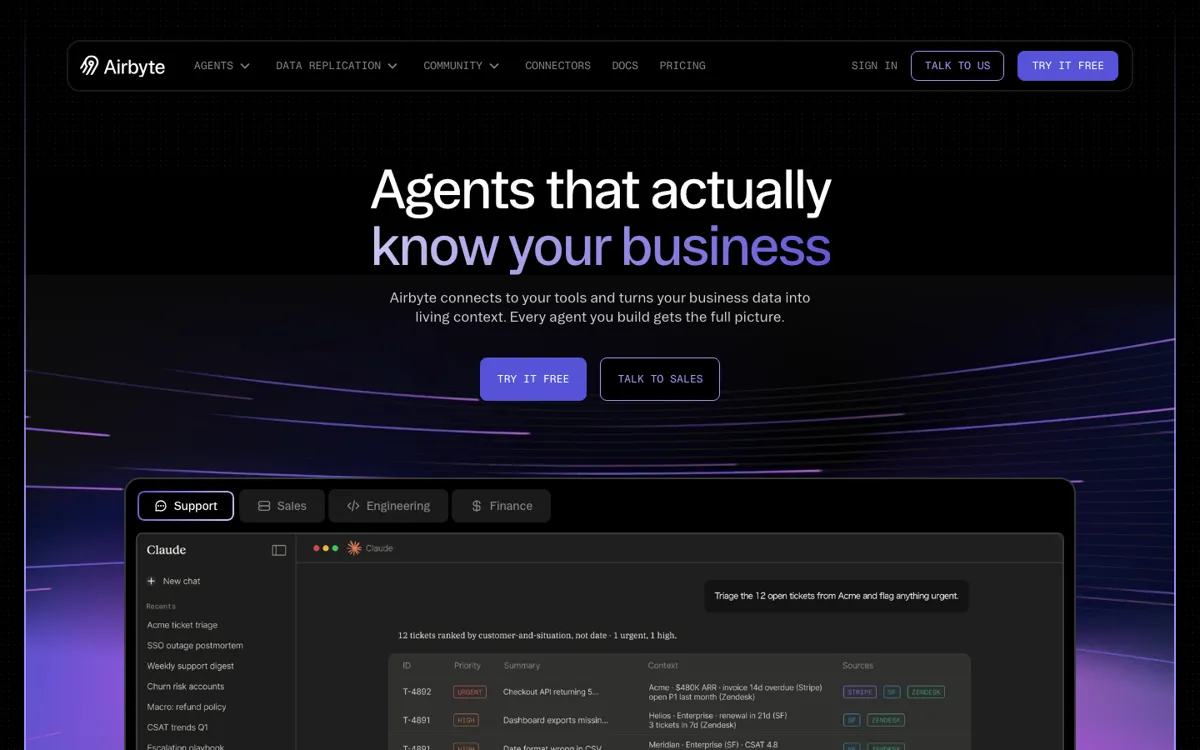
What does Airbyte Agents actually do?
Airbyte Agents matters because it treats agent context as an integration problem, not just a retrieval prompt problem. Many teams discover the same failure pattern once they move beyond demos: the model can talk, but it cannot reach the right systems, or the context it reaches is stale, partial, or permission-blind. Airbyte's official agent docs are interesting because they start from that exact pain. Instead of promising a magical agent wrapper, they position the product as a data and context layer built on top of the connector and sync machinery Airbyte already spent years developing. That changes the conversation. You are not just asking whether an agent can answer questions. You are asking whether it can safely answer with current business data from the systems your company actually uses.
That is the strongest reason to take the product seriously. Airbyte already has credibility in the tedious part of the stack, which is moving and shaping data across many systems. Airbyte Agents tries to cash in that credibility by making the same connector footprint useful for agent access, retrieval, and MCP-style integration patterns. For a team building internal copilots, support agents, revenue agents, or workflow assistants, that can be a real shortcut. Instead of spending weeks writing narrow source-by-source access code, the team can use a layer that was designed around integration sprawl from the start. The official docs make that value legible enough that the product feels like infrastructure with a clear job, not a vague AI add-on bolted onto a data company homepage.