SellerClaw Review

8.4/10

Run ecommerce sourcing, listings, ads, orders, and support through AI store agents.

Review updated June 2026 By The AI Way Editorial Tested 311+ tools across the site 5 min read
SellerAI AI Agents API Available Autonomous Agents Sales Automation Self-Hosted Workflow Builder Freemium from $10.00/mo

Our Verdict

SellerClaw is worth testing if store ops already eats hours across sourcing, listings, ads, fulfillment, and support. Its best bet is not chat advice, but controlled action: start in Advisory or Assisted mode, watch the logs, then widen autonomy only after one task proves itself. The main cost is trust and metering, because a bad agent action can burn ad spend or margin faster than a bad draft can hurt a document.

Try it
Free to start, then pay when the limits stop you. Starts at $10.00 USD.
open_in_new Try SellerClaw

What people keep saying about it

Product Hunt traction was strong for this launch, with more than 400 votes and over 130 comments in the discovery data. The praise centered on replacing manual store operations with specialist agents, while the useful doubts were about rollback, setup time, credit predictability, agent coordination, inventory sync, Amazon support, and whether a marketplace owner like Shopify could ship a built-in rival.

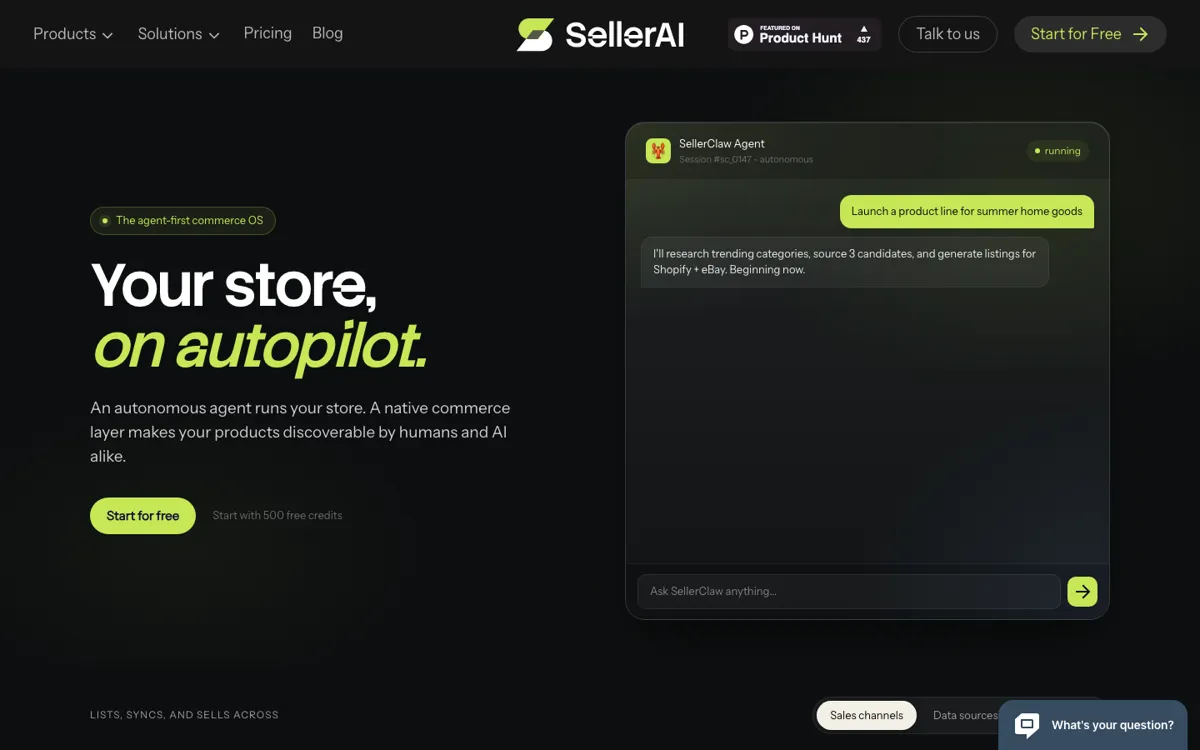
Official Website Snapshot Visit Site ↗

check_circle Pros

  • Covers the messy store tasks that usually live in separate tools: supplier sourcing, listing work, repricing, ads, orders, and tickets.
  • Approval levels let a seller start with recommendations before allowing browser actions or autonomous API execution.
  • The credit model gives concrete workload anchors, including roughly 15 credits for a listing and 40 credits for category research.
  • Local SellerClaw Agent can reduce tool-call credit use and keep supplier files or customer data closer to the seller's machine.

cancel Cons

  • Credit billing can be harder to forecast than a flat per-store subscription when repricing, ads, and support run every day.
  • The biggest risk is operational: a wrong pricing, ad, or supplier decision costs money before the seller notices.
  • SellerCart is still private beta, so the native store-builder side is not the part to rely on today.
  • Public discussion asked for clearer proof on setup time, rollback, shared context, and which marketplace connections are live now.

Should you use it?

Best for: Sellers with an existing catalog who want one agent to handle sourcing, listing generation, repricing, ad tests, order follow-up, and support under approval rules.

Skip it if: Skip it if you only need a writing assistant for product copy, or if you cannot let a third-party agent touch store, supplier, ad, or customer-support systems yet.

Is it worth the price?

Freemium Starts at $10.00 USD

The free tier is enough to connect one store and test a narrow task with 500 one-time credits. A seller running recurring listing, research, repricing, or support jobs will hit paid credits quickly; the first paid step is Starter at $10/month for 1,000 credits. If the credit meter starts driving decisions more than the store task itself, either move to a larger plan or test the local runtime before scaling usage.

The Free Tier

Free plan includes SellerClaw access, 1 sales channel connection, community support, and up to 500 credits to try.

Paid Upgrade
$10/month Starter plan with 1,000 credits/month

Paid plans add more monthly credits, more channel connections, support upgrades, top-up packs, and higher-tier API, rate limit, SSO, SLA, or self-hosting support.

One thing to know before you start

Start with one workflow that has visible output and low downside, such as drafting listings or answering a small support queue. Avoid repricing and ad-budget automation until you know how SellerClaw explains decisions, estimates credits, and handles approvals.

What people actually use it for

Turn supplier catalogs into store listings

Give SellerClaw a supplier catalog or product source, then use it to find likely sellers, build marketplace listings, and stage them for review. This is the cleanest first test because the output is visible before anything expensive happens.

Run routine store management across channels

Use it to watch inventory, orders, fulfillment status, customer messages, and marketplace listings across Shopify, eBay, Amazon, and supplier systems. The value is in catching small daily jobs before they become stock-outs, late shipments, or support tickets.

Move from ad suggestions to controlled execution

Ask SellerClaw to draft creative variants, launch tests, pause losers, and report what changed. Keep approvals tight until it proves it can respect budget, margin, and channel rules.

What does SellerClaw actually do?

SellerClaw's strongest angle is that ecommerce work rarely stops at one dashboard. A store owner might pull products from a supplier sheet, rewrite titles for Shopify, copy listings to eBay, watch Google or Meta ads, chase order status, then answer the same customer question five times. SellerClaw tries to sit across that whole loop. The agent can use direct integrations where they exist and a browser where they do not, which makes it more practical for supplier portals and back-office systems that never offered clean APIs.

The control model is the part to test first. Advisory mode keeps SellerClaw in recommendation territory, Assisted mode lets it operate through a browser while the seller reviews and guides actions, and Autonomous mode lets direct integrations execute tasks inside budget rails. That split matters because ecommerce automation has real downside. A bad blog draft can be deleted; a bad repricing rule, supplier order, or ad campaign can cost money before anyone reads the report. The safest path is to raise autonomy task by task, not across the whole store at once.

Pricing is transparent but not simple in the way flat subscriptions are simple. SellerAI uses credits: the free plan gives 500 one-time credits, Starter is $10/month for 1,000 credits, Growth is $36/month for 4,000 credits, Plus is $85/month for 10,000 credits, Pro is $160/month for 20,000 credits, and Max is $320/month for 40,000 credits. The useful detail is the task-level math: roughly 2 credits for a customer reply, 15 for a listing, and 40 for market research. Heavy daily automation still needs a real usage test before a seller can estimate monthly cost.

What you can do with it

Sources products from supplier catalogs and scores them against trends, margin, and likely demand.
Drafts product titles, descriptions, image edits, SEO tags, and marketplace-ready listings.
Runs ad and creative tests, then pauses weaker variants and scales better performers.
Watches orders, places supplier purchases, tracks shipping, and updates customers.
Replies to support tickets with order context and policy limits.
Moves between Advisory, Assisted, and Autonomous modes so sellers can tighten or loosen control.
Uses API integrations where available and browser sessions when a portal has no public API.
Can run as a cloud service or local SellerClaw Agent runtime for lower tool-call credit use.

Technical details

platform
Connects ecommerce stores and sales channels including Shopify, eBay, Amazon, supplier systems, ad platforms, and helpdesk-style support work.
deployment
Cloud-hosted SaaS is default; SellerClaw Agent can also run locally in Docker while keeping the same SellerClaw account and outbound HTTPS connection.
api_available
Supports direct APIs, MCP, REST, GraphQL, webhooks, OAuth2, custom tools, and controlled browser use when a marketplace or supplier portal has no public API.

Top Alternatives to SellerClaw

If SellerClaw is close but still misses the job, try one of these instead.

Key Questions

Is SellerClaw actually free to start?
Yes. The free plan gives 500 one-time credits, one connected store, SellerClaw agent access, and community support, so it is best used to test one narrow store task before paying.
What does SellerClaw do beyond writing product descriptions?
It can act across store operations, not just write copy. The practical task list includes sourcing, listing generation, ads, order fulfillment, customer support, repricing, and browser or API-driven store actions.
Can SellerClaw run without giving every task full autonomy?
Yes. Advisory keeps actions in a review queue, Assisted lets the agent execute tasks with human review, and Autonomous is the higher-trust mode for direct API execution.
How does the credit system work?
Credits are spent when the agent thinks, calls tools, and delivers results. The published task examples are about 2 credits for a customer reply, 15 for writing a listing, and 40 for market research.
Is there a self-hosted option?
Yes. SellerClaw Agent can run locally, but it still needs a SellerAI account and paid plan; the local runtime mainly reduces tool-call credit usage and keeps more work on the seller's hardware.