PatentDrawAI Review

6.9/10

Generate patent drawings, prior-art analysis, and claim support inside one invention workflow.

Review updated May 2026 By The AI Way Editorial Tested 133+ tools across the site 5 min read
PatentDrawAI B2B Web-Based Paid

Our Verdict

PatentDrawAI is most interesting for inventors who are losing time to process friction, not for teams that only need a one-off patent figure. Its appeal is the promise of keeping drawings, prior-art prep, and invention packaging in one place instead of bouncing across separate vendors and tools. But the broader the product pitch gets, the more you should assume specialist review still matters, especially if the filing strategy, legal language, or technical precision carries real financial risk.

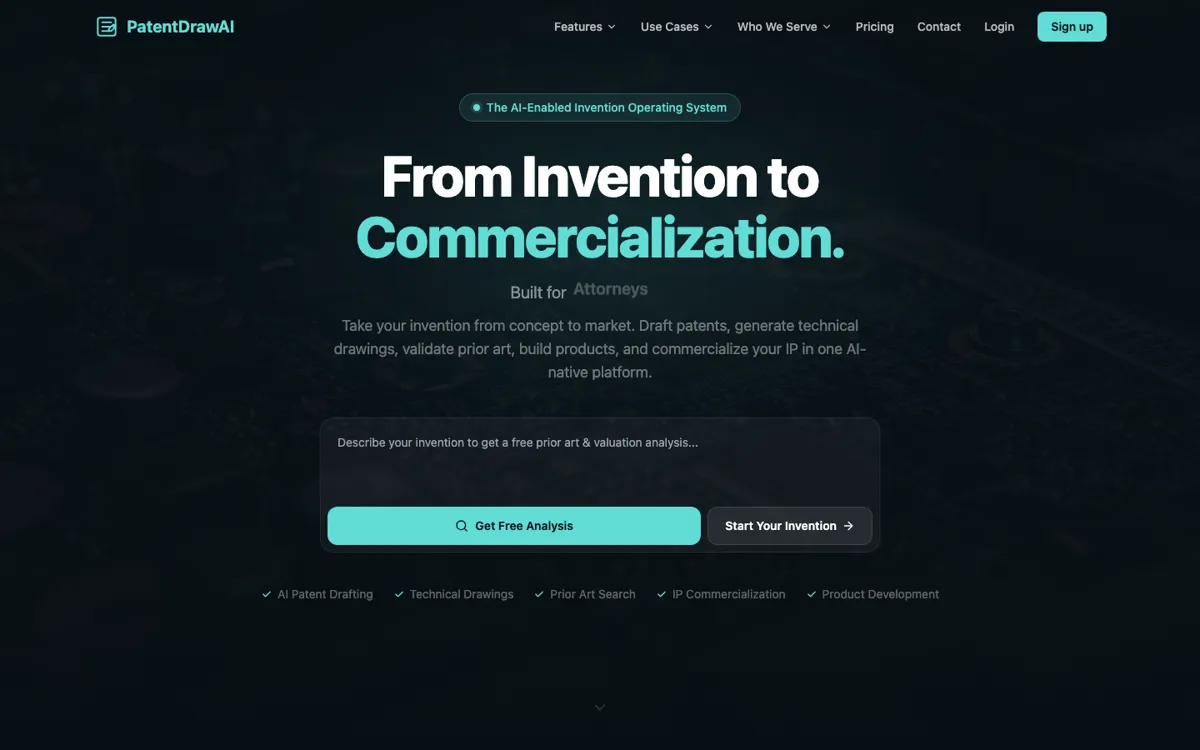
Official Website Snapshot Visit Site ↗

check_circle Pros

  • It tackles a real workflow problem by bundling patent-prep steps that are usually scattered across several services.
  • The product is easier to justify than a generic drawing tool because it ties visuals to prior-art and filing-oriented work.
  • For solo inventors or lean teams, having one place to move from concept toward patent packaging can cut a lot of coordination overhead.

cancel Cons

  • The public pages position the product broadly, but they give less hard evidence about how deep each module goes in production use.
  • No clearly extractable public starter price was visible from the accessible pages in this run, which makes buying friction higher.
  • If legal accuracy or engineering precision is the highest-stakes part of your process, you should still expect specialist review outside the tool.

Should you use it?

Best for: Best for solo inventors, small patent teams, and early-stage product builders who need to turn a rough concept into clearer drawings and patent-prep materials without managing several separate providers at once.

Skip it if: Skip this if you only need a single polished patent illustration from a known specialist, or if your filing workflow already depends on attorney-led review and formal drafting standards at every step. Also skip it if public pricing clarity is a hard requirement before you evaluate a tool.

Is it worth the price?

Paid

The main friction here is not whether the product sounds useful, it is that public pricing was not clearly extractable from the accessible pages in this run. That usually means the real buying decision will depend on a demo, sales conversation, or deeper evaluation rather than on a simple self-serve trial calculation.

One thing to know before you start

Use PatentDrawAI first on concepts that are already clear enough to sketch but still messy enough that your documentation process is slowing you down. That is where a workflow tool shows its value fastest.

What people actually use it for

Turn an invention concept into patent-prep visuals

A solo inventor often has a working concept, rough notes, and maybe a few hand sketches, but not a clean set of visuals ready for filing discussion. PatentDrawAI is useful when the bottleneck is converting that messy idea into clearer patent-oriented drawings without hiring multiple specialists immediately. The time saving comes from compressing the first packaging step, not from replacing every later legal or technical review.

Bundle prior-art and drawing work for a small IP team

A lean team handling several invention threads at once can lose time bouncing between search tools, illustrators, and draft-prep conversations. PatentDrawAI is more interesting in that setting because it claims to keep prior-art analysis and drawing-related work closer together. That can reduce coordination drag, although the team still needs to verify whether the tool's depth matches the complexity of the filings they care about.

Package early invention materials before attorney handoff

Some inventors do not want the final filing done by AI, they just want the pre-handoff materials to stop being chaotic. PatentDrawAI can help when the goal is to arrive at an attorney or advisor conversation with cleaner visuals, more structured invention notes, and a better-prepared package. That makes the legal conversation faster, but it does not remove the need for expert judgment on claims or filing strategy.

What does PatentDrawAI actually do?

Most invention work slows down long before the patent office gets involved. The idea exists, maybe there is a prototype or at least a technical concept, but the supporting materials are scattered across notes, sketches, folders, and half-finished explanations. PatentDrawAI is aimed at that messy middle. Instead of acting like a one-click image generator, it presents itself as a system for helping inventors move from concept toward filing with cleaner drawings and related patent-prep work gathered in one place.

The reason that pitch matters is simple: patent-prep friction is expensive even before legal fees fully arrive. If a tool can help generate technical drawings, support prior-art analysis, and package invention materials more cleanly, it can reduce the number of back-and-forth loops needed before an attorney, reviewer, or buyer can even react to the idea properly. That is where PatentDrawAI looks most promising from the accessible pages, as a workflow compressor for early documentation and invention packaging rather than as a narrow drawing utility.

The limitation is that broad workflow language can hide thin depth. Public pages in this run gave a clear sense of ambition but less concrete proof about exactly how far each module goes under real filing pressure. That matters because patent work has failure points that are legal, strategic, and technical, not just visual. PatentDrawAI can still be worth using if your current problem is chaos and delay in early invention prep. It is less reassuring if you need every step to stand alone as final specialist-grade output without external review.

What you can do with it

Generate patent-oriented technical drawings from invention ideas.
Support prior-art analysis as part of early patent-preparation work.
Package invention workflow steps from concept toward filing inside one product flow.
Link drawing and IP-prep work with broader product-development tasks.
Position invention assets for downstream commercialization and monetization planning.

Technical details

platform
Web app
deployment
Cloud
api_available
No public API mentioned

Top Alternatives to PatentDrawAI

If PatentDrawAI is close but still misses the job, try one of these instead.

Key Questions

Is PatentDrawAI mainly a patent drawing tool?
Not exactly. The homepage frames it more broadly as an invention operating system that also covers prior-art analysis, product development, and IP monetization alongside drawing work.
Who is likely to benefit most from it?
Inventors and small IP teams benefit most when their main problem is process sprawl. If the issue is too many scattered steps before filing conversations even begin, PatentDrawAI is easier to justify than if you only need one isolated illustration.
Can it replace attorney or specialist review?
No, not safely as a default assumption. It may speed up preparation and documentation, but the accessible public material does not support treating it as a full replacement for legal judgment or specialist-grade technical review.
Was public pricing clear from the accessible pages?
No. The pricing page existed, but this run did not surface a clearly extractable starter price, so the buying path appears less transparent than a clean self-serve SaaS flow.