Gem Review

7.3/10

A wearable AI note taker that records conversations and remembers context so you can pull it back later.

Review updated May 2026 By The AI Way Editorial Tested 99+ tools across the site 5 min read
Memoket Android App iOS App Meeting Notes Note-Taking

Our Verdict

Memoket Gem is interesting because it treats memory, not generation, as the main product. The value is wearing something that can hold onto spoken context so you do not have to reconstruct meetings, ideas, or family logistics from scraps later. But the hardware-first design is also the main filter, because people who do not want a wearable capture device in daily life will bounce before the memory story pays off.

Try it
Paid product.
open_in_new Visit Gem
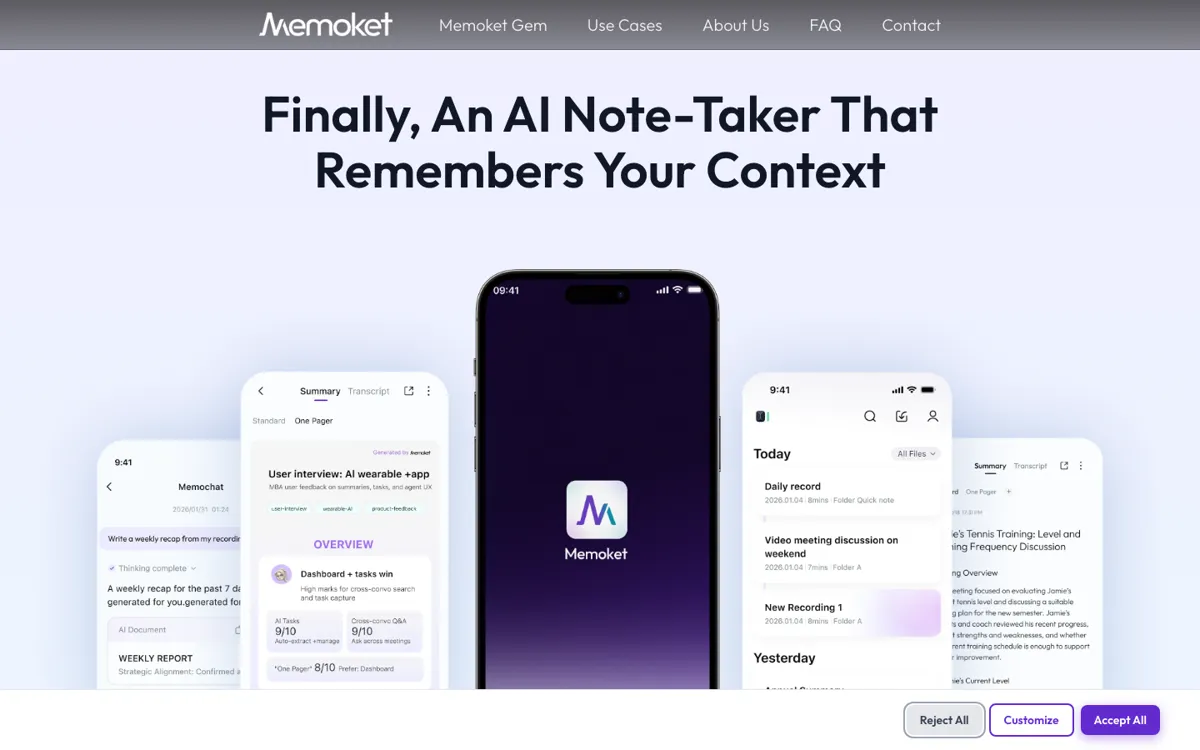
Official Website Snapshot Visit Site ↗

check_circle Pros

  • The product has a much clearer job than a generic AI chat app: capture spoken context and make it reusable later.
  • The wearable angle gives it a stronger always-there note taking position than apps you have to remember to open first.
  • The newsletter line about stopping the need to brief AI from scratch matches the official product framing well and explains the value fast.

cancel Cons

  • There is no clear public pricing in the captured pages, which makes it harder to judge commitment before digging deeper.
  • The product asks you to adopt a device habit, not just download an app, which raises the friction immediately.
  • Some people will find always-on conversation capture uncomfortable even before they evaluate the memory benefits.

Should you use it?

Best for: Best for capturing meetings, spoken planning, or ongoing conversations when the real problem is losing context afterward, not failing to generate text in the moment.

Skip it if: Skip this if you only need occasional transcripts or if wearing a device to capture spoken moments feels too intrusive for your work or personal life.

Is it worth the price?

Because public pricing is missing in the captured pages, you cannot cleanly judge the buy-in from the site alone. This looks more like a product to evaluate for fit first and price second, which is a weaker setup than a tool that shows its commitment level upfront.

One thing to know before you start

Judge Gem on whether you actually lose important spoken context every week. If that pain is rare, the device habit will likely outweigh the value.

What people actually use it for

Keeping meeting context without rewriting everything later

If you leave meetings with half a memory of what was decided, who promised what, and which side comment actually mattered, Memoket is built for that gap. Instead of hoping you took enough notes, you wear the device, capture the conversation, and come back later to recover the context. That makes more sense for people whose work is shaped by spoken decisions than for people who already live in clean written workflows.

Holding onto personal planning and family logistics

The product is not only framed around formal office meetings. Its broader use case story suggests everyday planning, learning, and life organization, which is where many people lose small but important details. If you often talk through errands, appointments, ideas, or household decisions and then forget the exact outcome, Gem is easier to justify. If most of your life is already tracked in text, it becomes harder to defend the hardware habit.

What does Gem actually do?

A lot of note tools fail before they even start because they still depend on you remembering to open them. The conversation happens, someone says the important thing, the meeting ends, and then you are left reconstructing what mattered from a few partial bullets or nothing at all. That is the pain Memoket Gem is clearly aimed at. Both the official site and the newsletter description make the same case from different angles: this is about capturing spoken context so it does not disappear, and about reducing the need to brief AI or yourself from scratch after the fact. That gives the product a sharper job than a generic recorder or chat assistant.

What makes Gem distinct is the hardware commitment. The official site frames it as a wearable AI note taker rather than just another app tab. That changes the workflow. Instead of deciding in the moment whether to record, type, or summarize, you carry the capture layer with you and use the companion experience later to organize and retrieve what was said. The use case pages suggest this can stretch across meetings, learning, and personal planning, which matters because the value comes from repeated everyday recall rather than one flashy one-off demo. The newsletter line about stopping the need to brief AI from scratch is especially strong here, because it describes the actual payoff in plain language.

The limitation is that Gem asks for more behavioral buy-in than a normal software tool. You are not just adding another app. You are deciding that wearing a device to preserve spoken context is acceptable in your work or personal life. That will be a clean no for some people, even if the memory benefit is real. The captured pages also do not surface a clear public price, which makes the commitment feel even fuzzier because you have to evaluate the habit change before you can even judge the cost cleanly. For people who only need the occasional transcript, that combination of hardware friction and pricing opacity will be hard to justify.

What you can do with it

Capture spoken conversations through a wearable note taking device.
Store conversation context so you can retrieve it later instead of re-briefing from scratch.
Use dedicated use case flows for meetings, learning, and personal planning.
Pair the wearable with app access for reviewing and organizing captured information.
Keep a running memory layer from spoken interactions instead of relying on manual notes alone.

Technical details

platform
Wearable device with companion app experience
deployment
Cloud
api_available

Top Alternatives to Gem

If Gem is close but still misses the job, try one of these instead.

Key Questions

Is Memoket Gem mainly a chat app or a recording product?
It is closer to a recording and memory product. The core pitch is capturing conversations and keeping context available later, not acting like a general-purpose chat window first.
Why use this instead of taking normal meeting notes?
Because the product is trying to remove the manual capture step. If your main problem is forgetting what was said or having to reconstruct context later, a wearable capture flow can preserve more than partial notes.
Do the captured pages show public pricing?
No. The pages captured for this review do not show a clear public price, which means you can understand the product shape before you can cleanly judge the cost.
Who should think twice before trying Gem?
People who are uncomfortable with wearable conversation capture should think twice first. That discomfort is not a side detail here, it sits right at the center of the product workflow.