Hello8 Review

7.8/10

Transcribe, translate, subtitle, dub, and localize video and audio with a mix of AI automation and human review.

Review updated May 2026 By The AI Way Editorial Tested 133+ tools across the site 5 min read
Hello8 Dubbing Transcription Video Translation Web-Based Freemium

Our Verdict

Hello8 is strongest when you need spoken content to move across languages without babysitting separate tools for transcript cleanup, subtitles, translation, and dubbing. Its real value is not just speed, but the hybrid AI-plus-human layer that gives teams a better shot at publishable localization quality. But if your job is only to grab a cheap transcript once in a while, this workflow can feel heavier than necessary.

Try it
Free to start, then pay when the limits stop you.
open_in_new Try Hello8
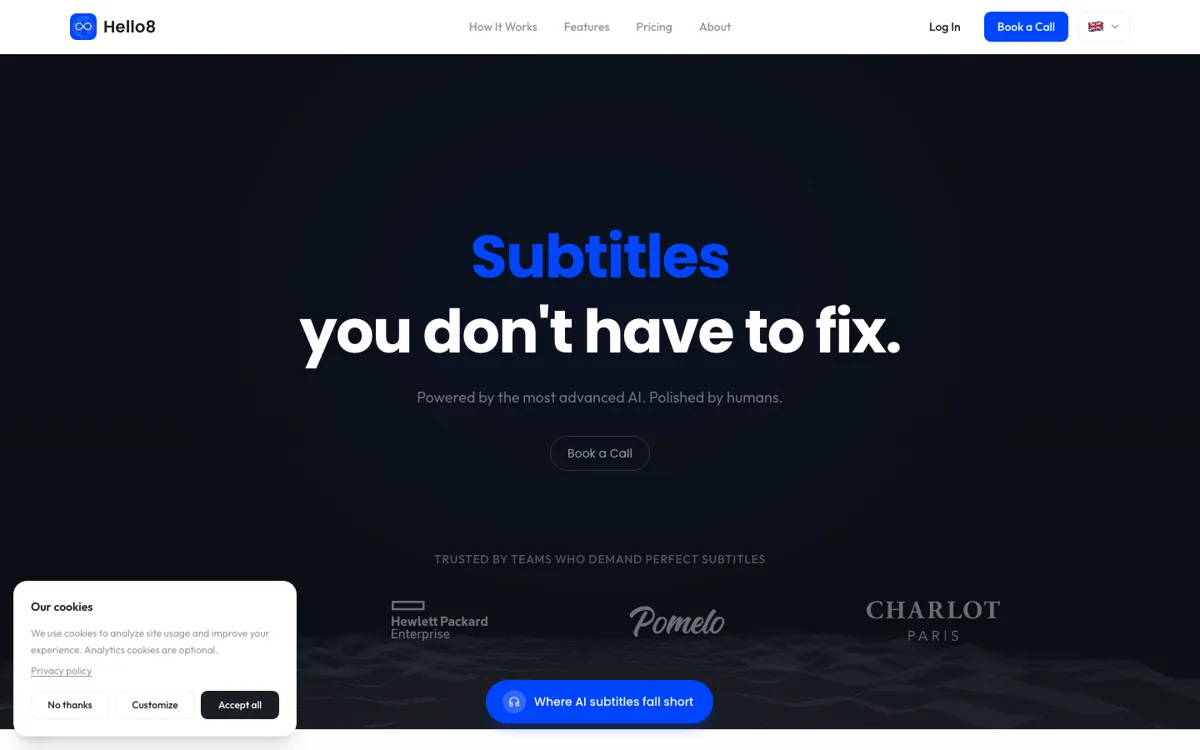
Official Website Snapshot Visit Site ↗

check_circle Pros

  • It treats localization as a full workflow, not just a subtitle export step.
  • The AI-plus-human positioning gives it a clearer quality story than fully automated transcript tools that stop at raw output.
  • It is easier to justify for recurring multi-language media work because transcription, translation, subtitling, and dubbing stay connected.

cancel Cons

  • The product makes less sense for one-off transcript jobs where review quality and multilingual adaptation are not important.
  • Public pricing was not transparent enough in this run to support a confident starting-price number, which makes cost planning less immediate from the outside.
  • A hybrid workflow usually means more process than a bare-bones AI caption tool, so buyers wanting the fastest possible self-serve output may find it heavier than needed.

Should you use it?

Best for: Best for turning webinars, podcasts, interviews, training videos, and other spoken media into reviewed multi-language subtitles, translations, and dubbed versions.

Skip it if: Skip this if you only need a quick raw transcript or a one-time subtitle draft and do not care about localization quality control. Also skip it if you need a fully transparent low-end public price before you even test the workflow.

Is it worth the price?

Freemium

The product looks easier to justify once you are localizing content repeatedly rather than occasionally. If you only need a transcript once in a while, the workflow depth can outweigh the value before pricing even enters the picture.

The Free Tier

Public pricing structure suggested a freemium or testable entry path, but exact free-tier limits were not extracted cleanly enough to state more without guessing.

Paid Upgrade
Contact for pricing

Paid access appears to unlock fuller localization workflow depth beyond basic trial or entry usage.

One thing to know before you start

Test Hello8 with one content type you actually publish, like a webinar or customer interview, rather than a random short clip. The product is easier to judge when you measure whether the translated subtitles or dubbed output are close enough to ship, not just whether a transcript appears quickly.

What people actually use it for

Localize webinars and training videos for teams in multiple regions

If one recorded session needs to be understood in several markets, Hello8 is more useful than a plain caption generator because it connects transcript, translation, subtitle, and dubbing work in one pipeline. That matters when the output has to be watched by real customers, partners, or internal teams rather than treated as a rough internal draft. The payoff is weaker when the video will only ever be watched in one language.

Repurpose interviews or podcasts into reviewed multi-language assets

Audio and video interviews are easy to publish once in the source language and easy to ignore everywhere else. Hello8 makes more sense when you want those assets to travel, because the product is built for turning spoken media into localized deliverables instead of leaving translation as an afterthought. It is less necessary if your audience never extends beyond the original language.

Handle recurring subtitle and dubbing work without stitching together separate tools

Teams doing repeated content localization usually lose time in the handoff between transcript tools, translators, subtitle editors, and voice workflows. Hello8 is strongest when that handoff problem is happening often enough to justify a dedicated system. It is harder to justify for occasional hobby use where a stack of lighter tools is good enough.

What does Hello8 actually do?

A lot of transcription tools stop at the moment they produce text. That is fine if the only goal is to search a meeting or skim a recording, but it falls short when the real job is publishing spoken content for audiences in other languages. At that point, the hard part is no longer getting words onto a page. It is cleaning the transcript, translating it well, building subtitles, deciding whether dubbing is needed, and making sure the result is usable enough to ship. Hello8 is built around that larger job instead of pretending transcription alone finishes the work.

The strongest signal on the official site is the hybrid workflow. Hello8 does not present itself as a fully manual agency and it does not pretend AI alone is always enough. Instead it positions AI and human review together, which gives the platform a clearer place in teams that care about localization quality but still want speed. That is especially relevant for webinars, podcasts, interviews, product explainers, and training assets, where a bad translation or awkward subtitle track can make a polished source recording feel untrustworthy in the target language.

The limitation is that this kind of product is easiest to justify with repeated volume. If you only need the occasional transcript or a cheap one-language caption file, a dedicated localization workflow can feel heavier than necessary. Public pricing also was not transparent enough in this pass to support a confident entry number, which is its own friction point for evaluation. So Hello8 looks strongest when you already know localized spoken content is part of your operating rhythm, not when you are just browsing for the fastest low-commitment caption shortcut.

What you can do with it

Generate transcripts from spoken media before pushing them into translation and subtitle workflows.
Translate and subtitle video or audio content across multiple languages from one platform.
Add dubbing and localization steps instead of stopping at raw captions.
Use a hybrid AI-plus-human workflow when accuracy matters more than fast draft output alone.
Adapt interviews, webinars, podcasts, and training media for multi-language distribution.

Technical details

platform
Web app
deployment
Cloud
api_available

Top Alternatives to Hello8

If Hello8 is close but still misses the job, try one of these instead.

Key Questions

Is Hello8 just a transcription tool?
No. The official site frames it as a broader localization workflow covering transcription, translation, subtitles, dubbing, and human-reviewed output rather than raw transcript generation alone.
Who gets the most value from Hello8?
Teams localizing spoken content repeatedly get the clearest value. It is most useful when webinars, interviews, podcasts, or training media need to travel across languages instead of staying as one-language assets.
Is Hello8 a good fit for one-off subtitle jobs?
Usually not. It can still do the work, but the product appears better suited to recurring localization workflows than to occasional low-stakes caption tasks.
Why would someone choose Hello8 over a bare transcript generator?
Because the job does not end at the transcript. Hello8 is aimed at teams that need cleaner translated subtitles, dubbing, and a review layer before the content is ready to publish in another language.