Halupedia Review

5.1/10

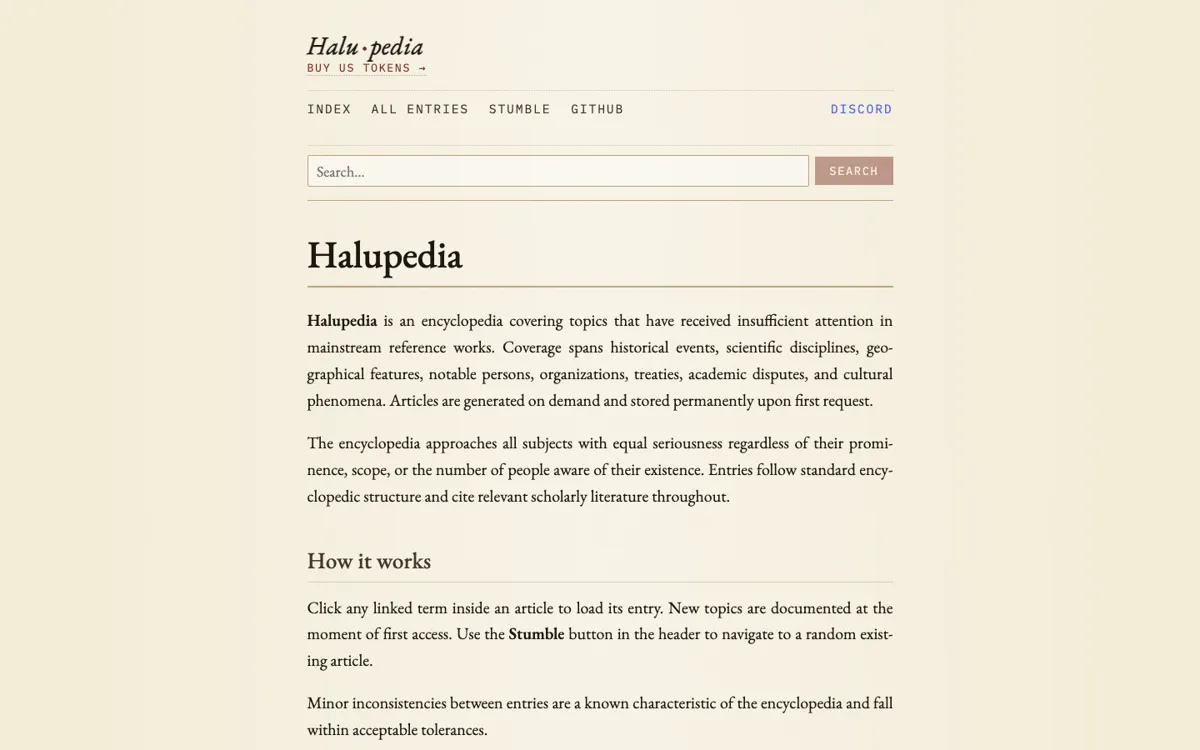
Explore an AI-generated encyclopedia for a universe that only appears when you visit it.

Review updated May 2026 By The AI Way Editorial Tested 321+ tools across the site 4 min read
Hallucinopedia Web-Based Freemium

Our Verdict

Halupedia works when you treat it as a reading toy built out of AI hallucination, not a tool for learning anything true. Its best trick is the encyclopedia framing, because that makes random generation feel like exploration instead of a one-off prompt gimmick. But the same framing is also the hard limit, if you need factual grounding or stable utility, this stops being charming very quickly.

Try it
Free to start, then pay when the limits stop you.
open_in_new Try Halupedia
Official Website Snapshot Visit Site ↗

check_circle Pros

  • It gives AI-generated nonsense a strong container, so clicking around feels like exploring a system instead of reading isolated outputs.
  • The fake encyclopedia format makes the product understandable in one line, which is rare for small AI experiments.
  • On-the-fly article generation means the world can keep expanding as readers open new entries.

cancel Cons

  • The product has almost no value if you need reliable facts, because the whole concept depends on plausible invention.
  • It exposes very little structured product information, which makes it harder to judge limits before using it.
  • What feels clever at first can flatten into the same core trick, open a page, get a confident fake article, repeat.

Should you use it?

Best for: Browsing AI-generated lore for fun, especially if you like clicking through encyclopedia links and watching a fictional world accrete around your curiosity. It fits better as a novelty reading experience than a productivity tool.

Skip it if: Skip this if you want source-backed answers, stable reference material, or a writing assistant for real work. The product is built around made-up knowledge, not around helping you separate true from false.

Is it worth the price?

Freemium

There is no public pricing signal here, so this is something you try out as an experiment, not something you can sensibly budget for. If the concept itself does not hook you in the first session, there is not enough visible product structure yet to justify much patience.

Paid Upgrade

The reviewed public page presents Halupedia as an exploratory AI-generated universe, but it does not expose a public pricing table or tier breakdown.

One thing to know before you start

Use it the way you would use a weird interactive fiction site, start from one entry and follow links that sound oddly specific. The more you expect utility, the less satisfying the experience will be.

What people actually use it for

Wander through a generated world instead of prompting a chatbot directly

If you are bored of typing one-off creative prompts and getting disconnected blobs of text back, Halupedia gives the same model behavior a more inviting structure. You open one article, follow a cross-link, then another, and the world feels like it is revealing itself rather than being dumped on you in a single reply. That makes the experience more playful, even though the underlying output is still fabricated.

Show someone a memorable AI demo in under a minute

Halupedia is easy to demo because the premise lands immediately. You can explain it as a fake encyclopedia for a universe that appears while you browse it, then hand over the link and let the person click around. That works better than tools that need setup or a careful prompt, but it also means the novelty has to carry the experience because there is no serious work outcome at the end.

What does Halupedia actually do?

A lot of AI demo sites show the same pattern: enter prompt, wait, get text, close tab. The problem is not only that the outputs are uneven, it is that the surrounding experience gives you no reason to stay. Halupedia fixes that by borrowing the shape of an encyclopedia instead of the shape of a chatbot. The premise instantly tells you how to use it. You are not there to ask for help with a task. You are there to browse, click, get pulled into adjacent entries, and see whether the invented world can keep its tone long enough to feel internally consistent.

The project gets more interesting once you see how the world keeps expanding. It generates an encyclopedia entry whenever someone requests an unknown slug, routes that request through an LLM, then caches the result so the world starts to feel persistent instead of disposable. That means the product solution is not just text generation. It is generation plus cross-linking plus an interface that encourages drift. Features like an index, all entries view, stumble mode, and threaded comments reinforce that this is meant to be explored like a library shelf, not consumed like a chat log.

The boundary is simple and important: Halupedia gets weaker the moment you ask it to be useful in a factual sense. The encyclopedia styling can make nonsense feel oddly authoritative, which is part of the artistic joke and also the main risk. There is also very little product scaffolding here, so you do not get much help understanding persistence, moderation, or whether the novelty deepens over time. That is why the best way to approach it is as a contained AI experiment. If you want a tool for research, writing support, or source-backed explanation, this is the wrong tab to open.

What you can do with it

Generate encyclopedia-style articles for topics in a fictional universe.
Create new entries on the fly when you open an unknown slug.
Link articles densely so one made-up page leads into more made-up pages.
Offer a stumble-style browsing mode for wandering through random entries.
Cache generated articles after they are created.

Technical details

Models
Uses an LLM via OpenRouter according to the linked GitHub repo
deployment
Web
Open source
true

Top Alternatives to Halupedia

If Halupedia is close but still misses the job, try one of these instead.

Key Questions

Is Halupedia meant for research or for entertainment?
It leans much closer to entertainment and curiosity than to serious research. The value is exploring an invented universe that expands as you browse, not getting reliable factual answers about the real world.
What makes Halupedia different from a normal wiki?
A normal wiki documents an existing world. Halupedia is building the world as you explore it, so the appeal comes from discovering how the fictional universe grows rather than looking up stable reference material.
Who is most likely to enjoy Halupedia?
People who like lore, worldbuilding, and playful AI exploration get the most out of it. If you need practical productivity or trustworthy factual research, it will feel like the wrong tool.
When should you skip Halupedia?
Skip it when your goal is accuracy, workflow acceleration, or a tool that connects to real work output. Halupedia makes more sense as a curiosity product than as a serious utility.