Tycoon AI Review

8.0/10

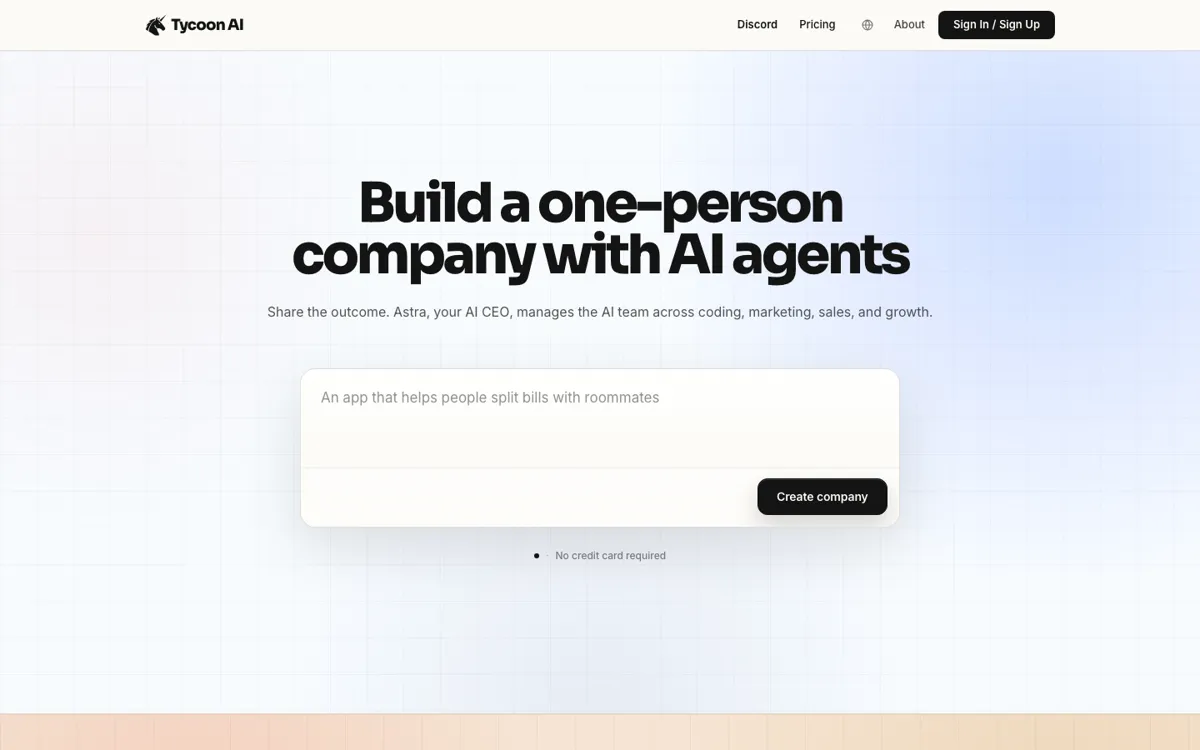
Build a one-person company with AI agents

Review updated May 2026 By The AI Way Editorial Tested 262+ tools across the site 4 min read
Tycoon AI AI Agents App Integration Autonomous Agents No Credit Card Required Workflow Builder Freemium from $49.00/mo

Our Verdict

Tycoon is interesting when you do not want to orchestrate five agent tools yourself and would rather push one business target into a single command layer. The upside is that Astra turns fuzzy founder asks into tracked work across code, growth, research, and ops. The tradeoff is that you are buying into Tycoon’s operating model, approval logic, and wallet billing system, not a simple copilot you can slot anywhere.

Try it
Free to start, then pay when the limits stop you. Starts at $49.00 USD.
open_in_new Try Tycoon AI
Official Website Snapshot Visit Site ↗

check_circle Pros

  • It has a clearer control surface than most agent stacks, because you talk to one CEO layer instead of hand-routing every task yourself.
  • The product is built around long-running work, KPI tracking, and approval gates, which matters more for real company ops than one-off prompt outputs.
  • The wallet model removes a lot of tool and API key setup friction if you want one bill for models, agents, tools, and business spend.

cancel Cons

  • The promise is very broad, so you still have to trust Tycoon’s internal review loop when multiple AI workers are handing work back to another AI manager.
  • Its pricing is easy to enter but can become budget fog once labor, tool calls, ads, and outside services all drain the same wallet.
  • This is opinionated software for AI-run companies, so teams that already have a mature PM, CRM, and automation stack may find the full operating model heavy-handed.

Should you use it?

Best for: Solo founders or tiny startup teams that want one system to turn goals like shipping an MVP, growing traffic, or running launch work into coordinated tasks across coding, marketing, research, and reporting.

Skip it if: Skip it if you mainly want a transparent automation builder where every step, cost, and trigger is manually designed by you. Tycoon is stronger as an AI-managed operating layer than as a low-level workflow canvas.

Is it worth the price?

Freemium Starts at $49.00 USD

The entry plan is cheap enough to test, but the real spend question is not the $49 sticker. It is whether you are comfortable putting labor, model usage, integrations, and even ad or contractor spend into one wallet that can quietly become your company’s metered operating budget.

The Free Tier

Free to start, no credit card required on the homepage. Paid plans begin when you fund the Company Wallet.

Paid Upgrade
$49/month

Monthly payment becomes wallet credit that covers AI labor, model usage, tools, hosting, ads, and other approved operating spend, with unused balance rolling over while subscribed.

One thing to know before you start

Treat Tycoon like an operating system trial, not a chatbot trial. Give it one bounded goal with a deadline, a budget rule, and a clear approval threshold, then watch whether Astra keeps the workstream coherent without creating hidden spend or vague success criteria.

What people actually use it for

Launch a small product without building a human team first

A solo founder can hand Astra a concrete launch target, like shipping an MVP and getting it ready for launch, then let Tycoon split the work into product, landing page, research, and growth tasks. The value here is not just content generation. It is having one layer decide who should work next, what needs approval, and what counts as done across several moving parts.

Run ongoing growth work from a KPI instead of a prompt list

Tycoon fits founders who think in targets like traffic, MRR, or onboarding completion and want the system to keep spinning up follow-up work instead of waiting for the next prompt. The combination of KPI framing, specialist agents, and persistent project memory makes more sense for recurring growth loops than a generic assistant that forgets the broader goal after each session.

Centralize ops when tool sprawl is already becoming the problem

If the real pain is not missing AI outputs but juggling too many separate tools, Tycoon’s wallet and agent model can be useful. One workspace can cover coding, research, finance, legal, support, and outside service spend, which gives founders a single operating layer. That only pays off if you actually want consolidation. If you prefer direct control over each vendor and workflow, it will feel like overreach.

What does Tycoon AI actually do?

Most agent products still dump coordination work back on you. You pick the tool, choose the model, write the prompt, babysit the handoff, then decide whether the output is good enough to move forward. Tycoon tries to take over that middle-management layer. Instead of asking you to operate a swarm by hand, it gives you Astra as the single place where goals, approvals, and work routing meet. That makes the product easier to grasp than a raw multi-agent framework, especially for founders who care more about outcomes than agent architecture.

The part that feels meaningfully different is the way Tycoon ties execution to business structure. It is not selling one specialist agent or one narrow workflow. It is selling a founder-plus-CEO-plus-specialists operating model that can stretch across days instead of one request. The wallet billing layer makes that positioning more serious, because it treats model calls, tools, hosting, ads, and outside services as part of one operating budget. That gives the product a clearer business shape, but it also raises the bar for trust because you are delegating both work and spend.

That trust question is the main boundary. The sharpest criticism is not about whether agents are exciting. It is about what actually grounds Astra’s reviews, whether green checks are enough, and whether a management hierarchy introduces extra drift or wasted spend. Those are the right objections. Tycoon looks most compelling when you want an opinionated AI company operating system and are willing to test its management layer on real work. It looks weaker if you need a fully transparent builder where every rule, validator, and cost edge is visible before you commit serious operations to it.

What you can do with it

Astra acts as an AI CEO that turns goals and KPIs into structured workstreams.
You can text the system through Tycoon, iMessage, Slack, or Discord instead of managing each agent directly.
Specialist agents cover coding, research, marketing, finance, legal, SEO, support, and custom roles.
Astra manages multi-day projects, tracks task status, and escalates strategy, spend, publishing, and irreversible actions for approval.
Company Wallet bundles AI labor, model usage, tools, ads, hosting, and other approved business spend into one credit pool.

Technical details

platform
Web app with messaging entry points through Tycoon, iMessage, Slack, and Discord.
deployment
Cloud-hosted workspace built around persistent CEO threads, approval boundaries for risky actions, and a shared Company Wallet that meters labor, tools, and outside spend under one operating layer.
api_available
There is no clear public API layer in the core product pitch. The product is presented as a managed agent workspace that plugs into tools like Slack, GitHub, Stripe, GA4, and PostHog instead of selling itself as an API-first building block.

Top Alternatives to Tycoon AI

If Tycoon AI is close but still misses the job, try one of these instead.

Key Questions

Is Tycoon really for solo founders, or does it need a team to make sense?
It is built to make the most sense for a solo founder first. The whole pitch is that one person can hand over company work to Astra and specialist agents. You can collaborate with other humans, but the product’s value is strongest when you are trying to replace coordination overhead, not add another layer on top of an already large team.
Does Tycoon charge separately for AI usage on top of the subscription?
Not in the usual seat-plus-token way. Your subscription funds a wallet, and usage is drawn from that credit pool. That is simpler on paper, but it also means your real spend depends on how much work, tooling, and outside spend you let the system handle.
What is the biggest risk in adopting Tycoon?
The biggest risk is over-trusting the management layer before you know how well it reviews work. Tycoon’s pitch depends on Astra making good delegation and approval decisions. If your workflow needs hard external validation at every step, you should test with narrow tasks before giving it anything business-critical.