StoreClaw Review

8.3/10

AI ecommerce agents that audit stores, find profit leaks, and push revenue fixes automatically.

Review updated May 2026 By The AI Way Editorial Tested 262+ tools across the site 5 min read
StoreClaw AI Agents B2B SaaS Web-Based Freemium

Our Verdict

StoreClaw is promising because it aims at a real ecommerce pain, stores rarely lose money because data is missing, they lose money because nobody has time to turn that data into constant profit-focused action. Its best angle is that the AI agent is supposed to do the scanning and prioritizing for you. The risk is obvious too: if the output feels like dressed-up generic CRO advice, the product stops looking like an agent and starts looking like another expensive analytics layer.

Try it
Free to start, then pay when the limits stop you.
open_in_new Try StoreClaw
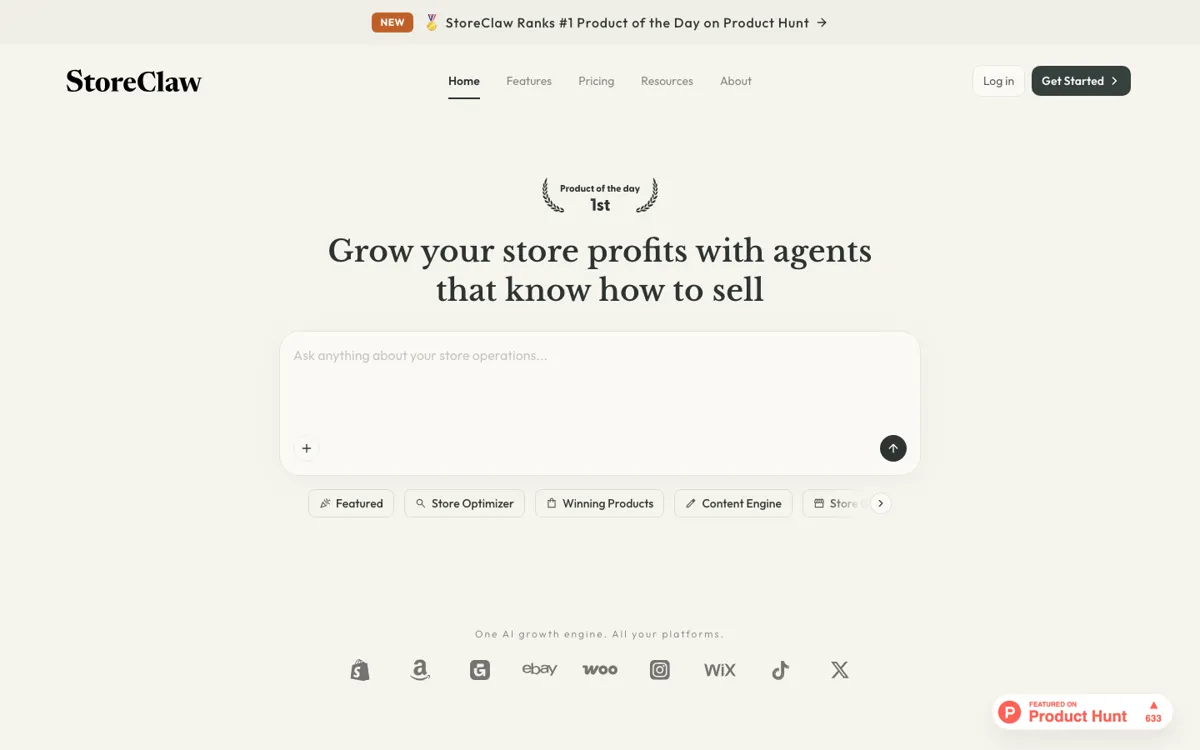
Official Website Snapshot Visit Site ↗

check_circle Pros

  • The product story is commercially sharp. It is talking about profit leaks and store sales, not vague AI productivity gains.
  • An always-on agent framing is easier to justify in ecommerce than in many other categories because stores create constant opportunities for pricing, funnel, and retention fixes.
  • The Product Hunt launch signal is unusually strong, with heavy votes and comments, which suggests operators are reacting to a concrete business pain rather than to a generic AI gimmick.

cancel Cons

  • The real test is recommendation quality. If the product cannot move beyond obvious optimization advice, the agent pitch weakens fast.
  • The current public pricing evidence reviewed here is not concrete enough to model cost clearly, which makes budget qualification harder than the headline value proposition.
  • This is most relevant for stores with active traffic and sales volume, so smaller merchants without enough signal may not feel the product's promised leverage.

Should you use it?

Best for: Ecommerce founders, operators, and growth teams who want a system that keeps looking for revenue leaks, conversion misses, and retention opportunities without running manual store audits every week.

Skip it if: Skip StoreClaw if your store is too early to generate meaningful optimization signal or if you mainly need raw reporting rather than prioritized action on what to change next.

Is it worth the price?

Freemium

The free entry only matters if it gives enough room to see whether the agent finds store-specific wins instead of generic advice. The paid jump makes sense for stores with enough traffic and sales volume that even one or two strong optimization calls can pay for the tool, but it will feel early for merchants who still do not have enough signal to optimize.

The Free Tier

The official pricing page says 'Start free and scale with StoreClaw', but the current public HTML reviewed this round does not expose a durable numeric free-plan breakdown.

Paid Upgrade

The product is framed as a paid optimization layer for stores, with the main value tied to ongoing agent-driven profit and conversion recommendations rather than a one-time report.

One thing to know before you start

Judge StoreClaw on the first few actions it surfaces, not on the dashboard polish. If the first recommendations are concrete enough that your team can execute them this week, the product is doing its job.

What people actually use it for

Catch revenue leaks without weekly manual audits

A strong fit for stores that have enough volume to create constant optimization work, but not enough time to manually review every page, funnel, and pricing decision. StoreClaw is trying to make that scanning automatic so the team gets a shorter list of changes that actually matter.

Prioritize ecommerce fixes by profit impact

Useful when a growth team already has too many possible experiments and not enough clarity on what deserves attention first. The agent layer is more valuable here than another report because the bottleneck is prioritization, not data access.

Run an always-on optimization layer for established stores

Good for operators who want store performance monitored continuously while the rest of the team is busy on campaigns, merchandising, and fulfillment. The product makes the most sense when optimization is a recurring operational job, not a one-time project.

What does StoreClaw actually do?

StoreClaw is attacking a familiar ecommerce problem: stores accumulate small conversion and profit leaks faster than teams can audit them. A homepage section underperforms, a product page message weakens intent, pricing leaves margin on the table, or retention opportunities go untouched simply because nobody has time to keep checking everything. Merchants usually do not fail because there is zero data. They fail because turning that data into specific, repeated store improvements is time-consuming and easy to postpone.

That is why the agent framing matters here more than it would in a generic business tool. If StoreClaw is doing its job, the team should not be staring at another passive dashboard. It should be getting pointed toward concrete fixes tied to how the store sells. In a strong scenario, that means faster decisions on what to change, what to test, and where the next meaningful revenue gain is hiding. For ecommerce teams already juggling ads, content, fulfillment, and merchandising, reducing audit work is a real operational advantage.

The boundary is simple but important. StoreClaw only works if the store has enough activity and enough willingness to act on the output. Early shops with thin traffic may not generate useful signal, and teams that ignore recommendations will not get much from an always-on agent. There is also a credibility bar the product has to clear. If the advice feels obvious or generic, the AI layer stops looking differentiated quickly. So this is best treated as a profit-focused optimization tool for active stores, not a magic fix for weak demand.

What you can do with it

Scan ecommerce stores for revenue leaks and profit opportunities.
Use AI agents to surface store-specific sales and optimization actions.
Focus recommendations on conversion, retention, and margin improvement instead of raw analytics alone.
Act as an always-on audit layer for store growth teams.
Turn store performance signals into prioritized fixes rather than static reports.

Technical details

platform
Web-based ecommerce optimization product built around AI agents for store analysis.
deployment
Cloud SaaS for online store teams.
api_available
No public API was confirmed from the official pages reviewed this round.

Top Alternatives to StoreClaw

If StoreClaw is close but still misses the job, try one of these instead.

Key Questions

What does StoreClaw actually do for a store team?
It is meant to keep scanning the store for profit and sales opportunities, then push the team toward concrete actions instead of making them dig through analytics alone.
Who is StoreClaw best suited for?
It is best suited for stores with real traffic, real sales activity, and a team that can act on optimization recommendations regularly. That is where an always-on agent can create leverage.
Is StoreClaw mainly an analytics tool?
Not in the way the product presents itself. The pitch is closer to an action layer on top of store performance, where the goal is finding and prioritizing fixes, not just showing charts.