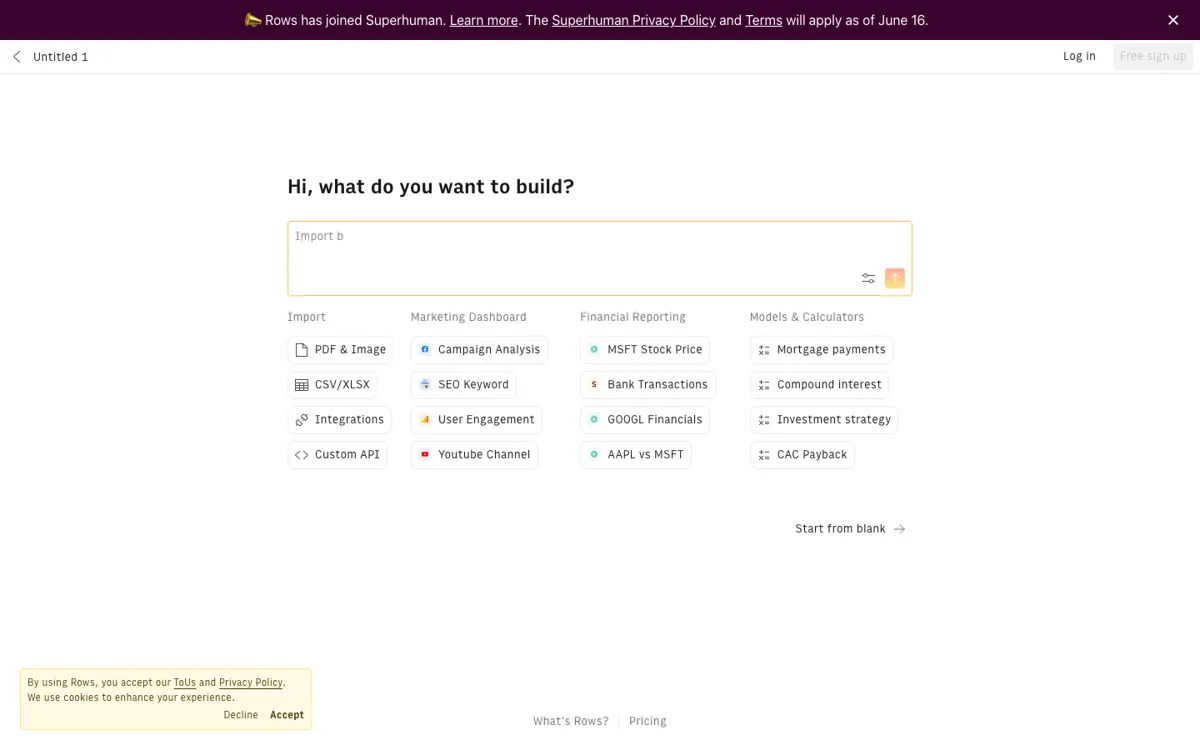
What does Rows actually do?
Rows is trying to win a very specific fight: the one where business teams already know the answer should be sitting somewhere in a spreadsheet, but the path to get there is miserable. Maybe the data is trapped in a PDF, spread across several exports, or blocked behind formulas nobody wants to maintain. Its value is not that it adds AI to a grid. Its value is that it collapses several annoying steps, extraction, cleanup, lookup, summarization, and charting, into one place where non-technical users already know how to work.
The product feels most differentiated when the job is multi-step and spreadsheet-native at the same time. You can ask for joins between tables, create calculated columns, run what-if analysis, classify text, or reconcile mismatched records without dropping into SQL or separate scripts. That is useful for ops, finance, and growth work where the bottleneck is often not lack of data, but the human glue work required to make disconnected tables usable. If your team spends more time fixing sheet logic than deciding what the numbers mean, Rows is aimed straight at that pain.