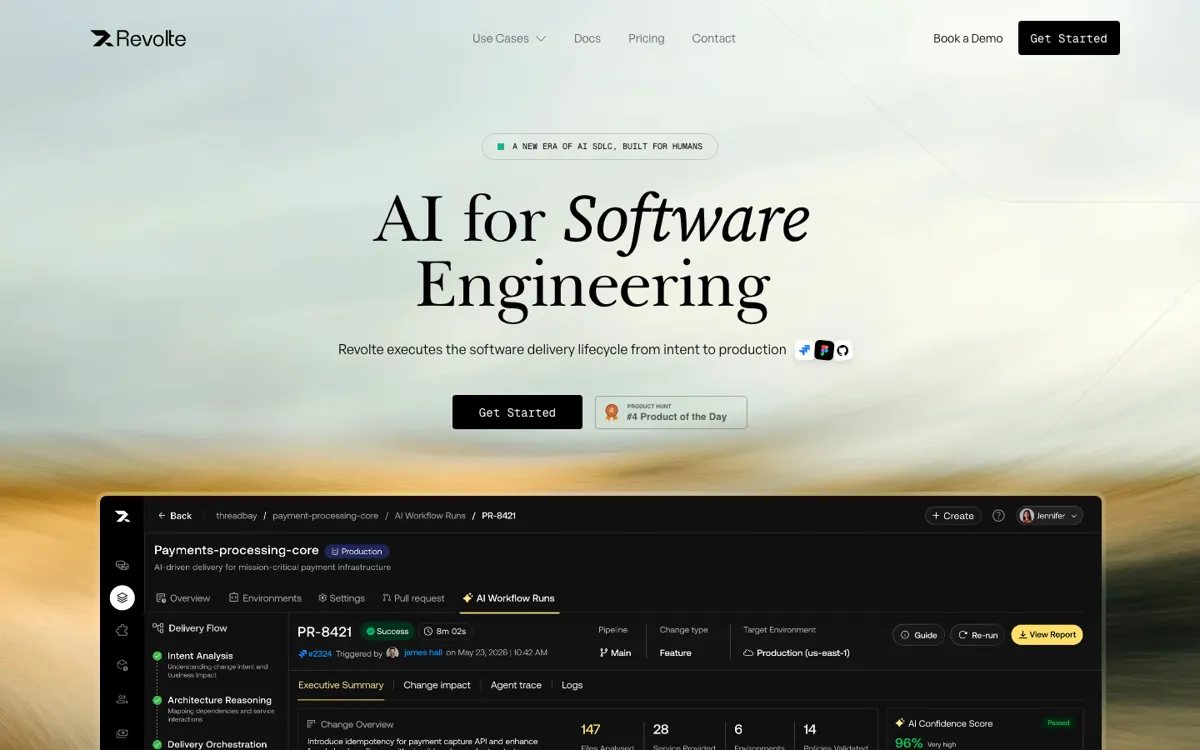
What does Revolte actually do?
What makes Revolte more credible than many AI engineering launches is that it does not stop at the usual promise of faster code generation. The product is anchored in the parts of delivery teams actually have to coordinate: isolated dev environments, tests, PR checks, previews, deployments, rollbacks, runtime observability, and policy-driven execution. That framing matters because software delivery usually breaks when a ticket leaves the editor and has to pass through review, CI, preview, release, and production follow-up. Revolte is trying to keep those handoffs inside one governed path.
The build-new-applications flow is especially concrete. A ticket can turn into a reviewable PR without hand-holding, the task can run in its own VM, quality gates can fire before the team sees the change, and stakeholders can inspect a branch preview instead of a screenshot. That combination gives the product a stronger operational story than agents that simply open pull requests and leave the rest to humans. It also explains why Revolte keeps emphasizing governed execution rather than raw autonomy. The promise is not just that AI can code. It is that AI can push delivery work forward without blowing up review discipline.