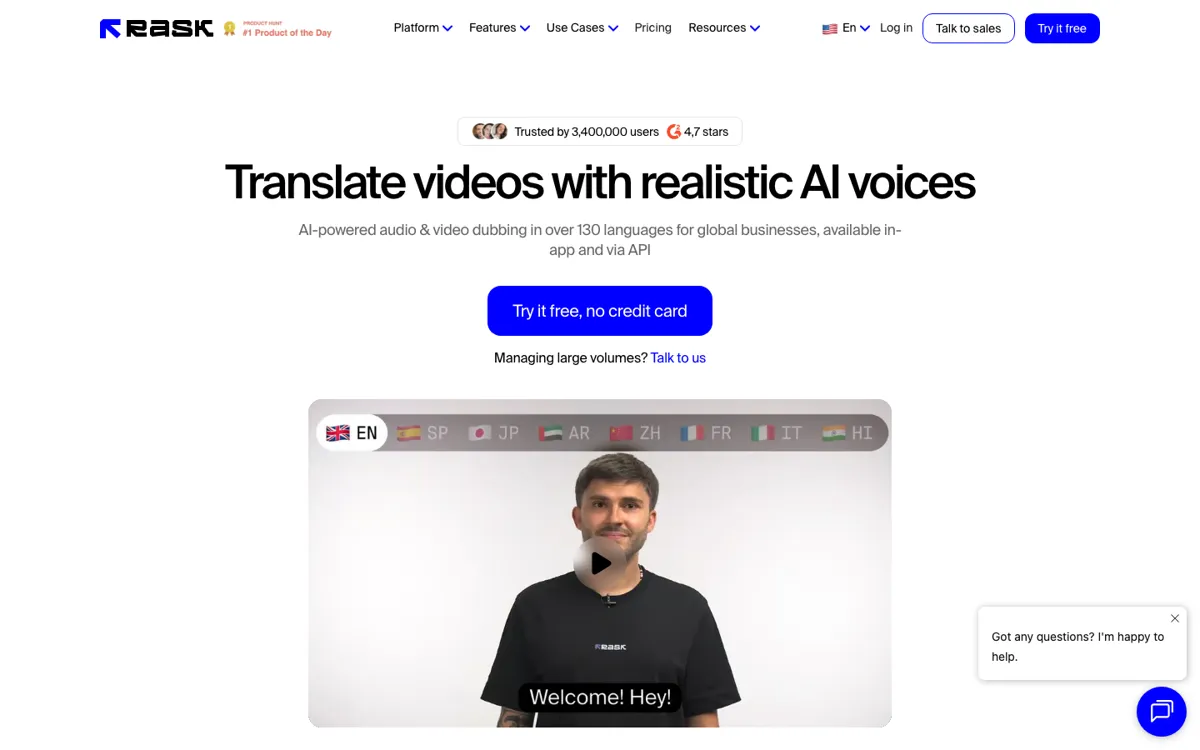
What does Rask AI actually do?
Rask AI exists for a problem that gets painful the moment content starts crossing borders regularly. Translating one marketing video by hand is annoying. Translating a catalog of tutorials, podcast episodes, customer stories, or training materials into five or ten languages becomes an operations problem. You need transcription, translation accuracy, speaker handling, subtitles, voice consistency, and some kind of review loop, all while keeping turnaround time under control. Rask's public product pages are valuable because they do not hide that reality. The tool is built for localization throughput, not for casual experimentation dressed up as an enterprise workflow.
The product looks strongest where multilingual distribution is already part of the business model. The homepage and enterprise pages keep pointing to translation dictionaries, prompt-based control, multi-speaker support, voice cloning, timestamps, lip-sync, and API access. Those are not decorative features. They are the pieces you need when one clean English source asset has to become many language-specific versions without losing naming consistency, pacing, or a recognizable voice. For course businesses, media publishers, and international marketing teams, that is much more useful than a simpler subtitle-only tool, because the bottleneck is usually not transcription alone, it is maintaining believable localized delivery at scale.