HeyGen Review

8.6/10

Turn scripts, images, decks, and PDFs into avatar-led videos, dubbed content, and localized clips.

Review updated May 2026 By The AI Way Editorial Tested 99+ tools across the site 5 min read
HeyGen API Available Avatar Generation Lip Syncing Video Translation Web-Based Freemium

Our Verdict

HeyGen is best when video is a communication task, not a filmmaking task. Its real value is that it turns scripts, decks, portraits, and existing clips into avatar-led or translated videos fast enough for training, marketing, sales, and localization teams to use repeatedly, not just experimentally. But that same speed comes from a fairly opinionated format, so if your content depends on distinctive cinematic style or brand nuance beyond avatar delivery, the results can start to feel formulaic.

Try it
Free to start, then pay when the limits stop you.
open_in_new Try HeyGen
Official Website Snapshot Visit Site ↗

check_circle Pros

  • It connects avatar generation, translation, lip sync, subtitles, and text-based editing in one place, which is exactly what high-volume business video teams need.
  • The translation path is a major practical advantage because HeyGen pairs multilingual dubbing with voice cloning and lip sync instead of treating localization as a separate workflow.
  • It supports many input types, including scripts, images, presentations, PDFs, and audio, so it can start where real business content already exists.
  • The API path makes it possible to operationalize HeyGen inside larger content or localization systems instead of keeping it as a manual browser-only tool.

cancel Cons

  • The avatar-first output style is efficient, but it can feel repetitive if your brand depends on more bespoke visual storytelling.
  • A lot of the product's promise is strongest for business communication formats, so it is less compelling if you mainly want open-ended creative video experimentation.
  • As with most AI video platforms, the free tier is useful for testing but not the version that shows what sustained production actually feels like.

Should you use it?

Best for: Making training videos, localized explainers, sales outreach, product ads, and talking-avatar content where speed and multilingual scale matter more than bespoke production craft.

Skip it if: Skip it if you need visually distinctive filmmaking or highly custom motion design, because HeyGen is optimized for scalable communication videos rather than deeply original visual direction.

Is it worth the price?

Freemium

The free plan is enough to understand the format, not the long-term workflow. If localization, avatar volume, or recurring business video production are your actual goals, you will be evaluating HeyGen as a paid system almost immediately.

The Free Tier

The free plan supports text-to-video and basic AI-generated video creation for testing the platform.

Paid Upgrade
API pricing starts at $5, and the creator-facing product has paid creator, pro, and team tiers above the free plan.

Paid plans expand advanced video creation, editing options, higher-volume workflows, and enterprise/API access for recurring production use.

One thing to know before you start

Use HeyGen first on content that is already script-driven, like onboarding, outreach, or localization. That is where its speed advantage is easiest to prove without asking the avatars to carry too much creative weight.

What people actually use it for

Localize existing videos for global audiences without reshooting

HeyGen is strongest when the hard part is not making one video, but making the same video work across many markets. Upload a finished clip, translate it into over 175 languages and dialects, and keep the delivery closer to the original through voice cloning and lip sync. That saves enormous time compared with re-recording every market separately, especially for training, support, and product education content.

Scale talking-head business videos from scripts and documents

If your team already has scripts, PDFs, presentations, product notes, or outreach copy, HeyGen lets you turn those inputs into avatar-led videos fast. That is useful for marketing teams, enablement teams, and internal comms groups that need regular output without booking talent, cameras, and editors every time. It is less useful when the content has to feel handcrafted shot by shot.

Automate avatar and video generation inside a larger product workflow

The API matters when HeyGen is part of a system instead of a standalone tool. Teams can use video generation, translation, text-to-speech, and avatar endpoints to embed communication video into apps, localization pipelines, or internal content workflows. That makes the product more operational than many avatar tools that stop at the browser interface.

What does HeyGen actually do?

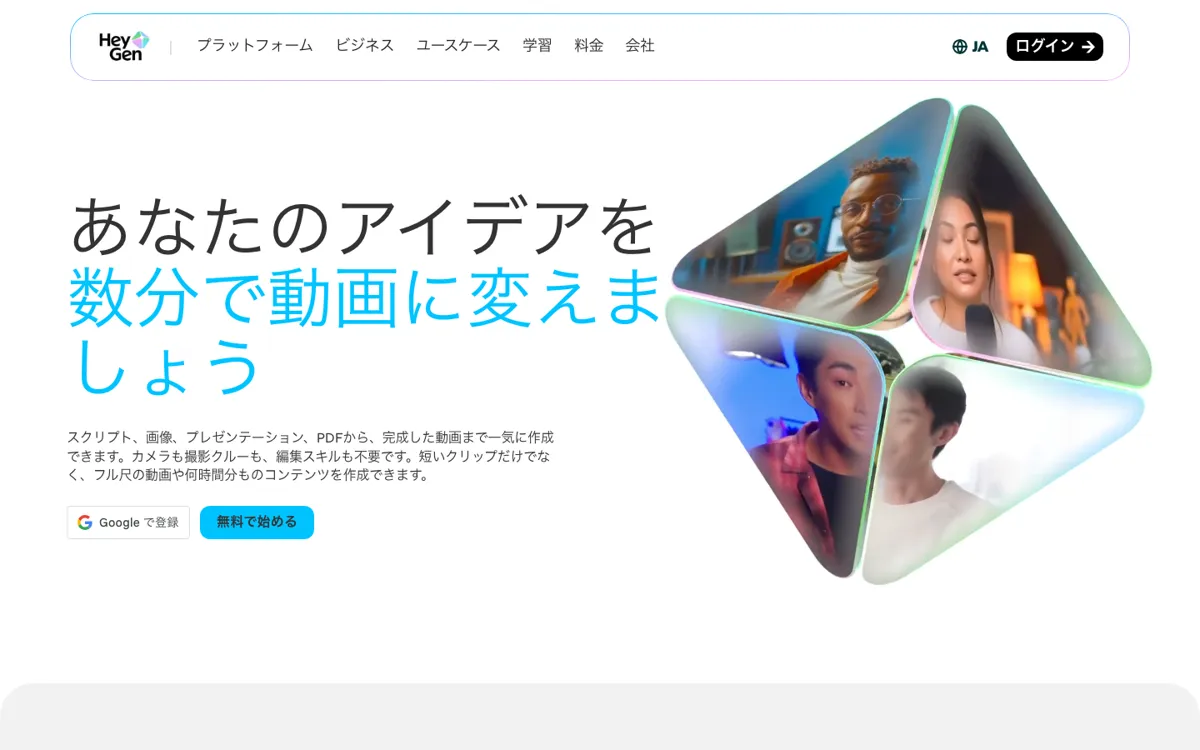
Traditional video production breaks down fastest when the same message has to be repeated dozens or hundreds of times. A sales team needs personalized outreach. A learning team needs onboarding in multiple languages. A marketing team wants product ads, UGC-style clips, and explainers from the same source material. In those situations, filming is not just slow, it is structurally mismatched to the job. That is the pain HeyGen is built around. The homepage keeps returning to the same promise from different angles: take a script, image, deck, PDF, or audio track, and turn it into a finished AI video without needing a camera crew or post-production chain for every version.

What makes HeyGen practical is that it bundles the business-video stack instead of stopping at avatars. The platform covers text-to-video, portrait animation, AI presenters, video translation, voice cloning, subtitles, text-based editing, and APIs for automation. The localization angle is especially important. Translating a video while trying to keep voice tone, lip sync, and pacing aligned is much more valuable than simple subtitle generation, because it produces content that can actually travel across markets with less manual repair. For teams creating training, marketing, and customer-facing communication, that combination is a lot more useful than a generic avatar novelty tool.

The limitation is that HeyGen's biggest strength is also its ceiling. It is designed for scalable communication, which means the output often works best when the format itself can be standardized. If your project needs eccentric visual direction, cinematic scene construction, or a strong authorial look, the avatar-first approach can start to feel too clean and too similar from one video to the next. The product is strongest when consistency, speed, and localization are the priority. It is weaker when the creative brief depends on a video feeling unmistakably handmade or visually surprising in every frame.

What you can do with it

Generate avatar-led videos from scripts, images, slide decks, PDFs, and audio files.
Translate existing videos into more than 175 languages and dialects with lip sync and voice cloning.
Create product ads, UGC-style clips, training videos, and sales outreach from one workspace.
Animate still portraits into speaking videos with realistic lip sync and hand movement.
Use APIs for video generation, translation, text-to-speech, avatars, and templated studio workflows.

Technical details

platform
Web app
deployment
Cloud-hosted
api_available
Yes

Top Alternatives to HeyGen

If HeyGen is close but still misses the job, try one of these instead.

Key Questions

Is HeyGen mainly for creative filmmaking or business communication videos?
It is much stronger for business communication videos. The product is optimized for training, sales, marketing, avatar explainers, and localization rather than highly custom cinematic storytelling.
Can HeyGen really translate videos into other languages with lip sync?
Yes. HeyGen's site says it can dub videos into more than 175 languages and dialects with voice cloning, lip sync, and automatically generated subtitles.
Does HeyGen have a free way to try it?
Yes, but it is mainly for testing the workflow. Paid plans are where the fuller editing, production, and scaling value start to matter.
When does HeyGen make the most sense to pay for?
It makes the most sense once you need repeated avatar videos, multilingual versions, or video generation embedded in a larger team workflow instead of one-off experiments.