Deepdub Review

7.7/10

Localize film, TV, and enterprise voice experiences with AI dubbing and expressive voice APIs.

Review updated May 2026 By The AI Way Editorial Tested 99+ tools across the site 5 min read
Deepdub API Available Commercial Rights Customer Support Multi-language Video Translation Voice Cloning

Our Verdict

Deepdub is not really aiming at casual dubbing buyers, and that is exactly what makes it stand out. Its value is strongest when the job involves long-form media, licensed voices, production oversight, or enterprise voice deployment that would break a simpler self-serve tool. But the same enterprise posture also means less price transparency and a higher likelihood that you will need a sales conversation or managed workflow before you know the real fit.

Try it
Paid product.
open_in_new Visit Deepdub
Official Website Snapshot Visit Site ↗

check_circle Pros

  • The product is clearly built for serious localization work, with post-production language, managed services, and examples tied to TV, film, FAST channels, and enterprise media.
  • Deepdub does not stop at plain text to speech, because it also exposes speech-to-speech, voice cloning, accent control, real-time APIs, and human-assisted quality steps.
  • The enterprise trust signals are unusually strong for this category, including licensed voice claims, TPN Gold, SOC 2, GDPR alignment, and named customer references.

cancel Cons

  • Public pricing is weak on the dubbing side, so buyers cannot estimate total cost from the marketing site alone.
  • The product assumes a more professional pipeline than creator-first tools, which makes it heavier if you only need quick self-serve video localization.
  • Some of the quality story depends on human adapters and production support, so the best outcome may require more process than a buyer expecting one-click automation wants.

Should you use it?

Best for: Best for dubbing series, films, broadcast libraries, training catalogs, or enterprise voice systems where emotional delivery, licensed voices, and deployment standards matter more than the cheapest self-serve workflow.

Skip it if: Skip this if you need transparent click-to-buy pricing today, or if your main job is small creator videos where a lighter dubbing tool is enough and a sales-led process would slow you down.

Is it worth the price?

Deepdub looks like a platform you buy when quality, rights, and scalability beat price simplicity. If you are comparing tools mainly by a visible monthly tier table, this one will likely feel opaque before it feels trustworthy.

The Free Tier

API side offers a 14-day free trial with up to 10,000 characters, roughly 10 minutes of content.

Paid Upgrade
Contact for pricing

After the trial, the API side moves to fixed pricing for additional usage, but the official site does not publish a full public dubbing tier table.

One thing to know before you start

Do not judge Deepdub by one short demo line. Test it on a real scene with performance swings, named entities, and timing pressure, because that is the kind of material its enterprise pitch is built around.

What people actually use it for

Dub long-form entertainment or broadcast libraries

Deepdub makes the most sense when the source material is not a throwaway clip but a film, series episode, documentary, or large content library that needs emotional carryover across languages. The site leans on post-production language, managed workflows, and examples tied to theatrical releases, FAST channels, and Hulu or Pluto TV distribution. That matters because long-form dubbing breaks on more than pronunciation. You also need timing, casting logic, licensed voices, and review steps that simpler creator tools often skip.

Localize enterprise training or corporate media with tighter control

For corporate teams with global training libraries or multilingual internal content, Deepdub is better suited to controlled rollout than to casual experimentation. The platform positions corporates as a core solution area, and the FAQ plus API pages emphasize security standards, licensed voices, and scalable delivery. That makes it a stronger option when procurement, compliance, and brand consistency matter. It is less attractive if you just want fast self-serve exports without involving a more structured localization process.

Add expressive voice to AI agents at enterprise scale

Deepdub is not only a dubbing vendor anymore, because the Voice API for agents page clearly pushes a second buyer story around real-time enterprise voice. Teams building customer support bots, financial assistants, training agents, or media narration systems can use low-latency speech with accent and emotion controls instead of treating voice as an afterthought. This is useful when you need commercial-ready voices and operational support, but it is more than many teams need if a basic TTS API already covers the job.

What does Deepdub actually do?

A lot of dubbing tools are optimized for speed-first localization, which works fine until the source material actually carries performance, brand risk, or distribution value. Once the content is a film scene, a streaming catalog, a FAST channel, or a regulated enterprise training library, the buyer is no longer choosing only between faster and slower output. They are choosing between preserving emotion, staying inside compliance rules, using licensed voices, and keeping a review process that will not embarrass the brand later. Deepdub is aimed squarely at that harder layer of the problem, and the official site keeps framing the product around media pipelines, corporate localization, and voice deployment at scale rather than creator convenience alone.

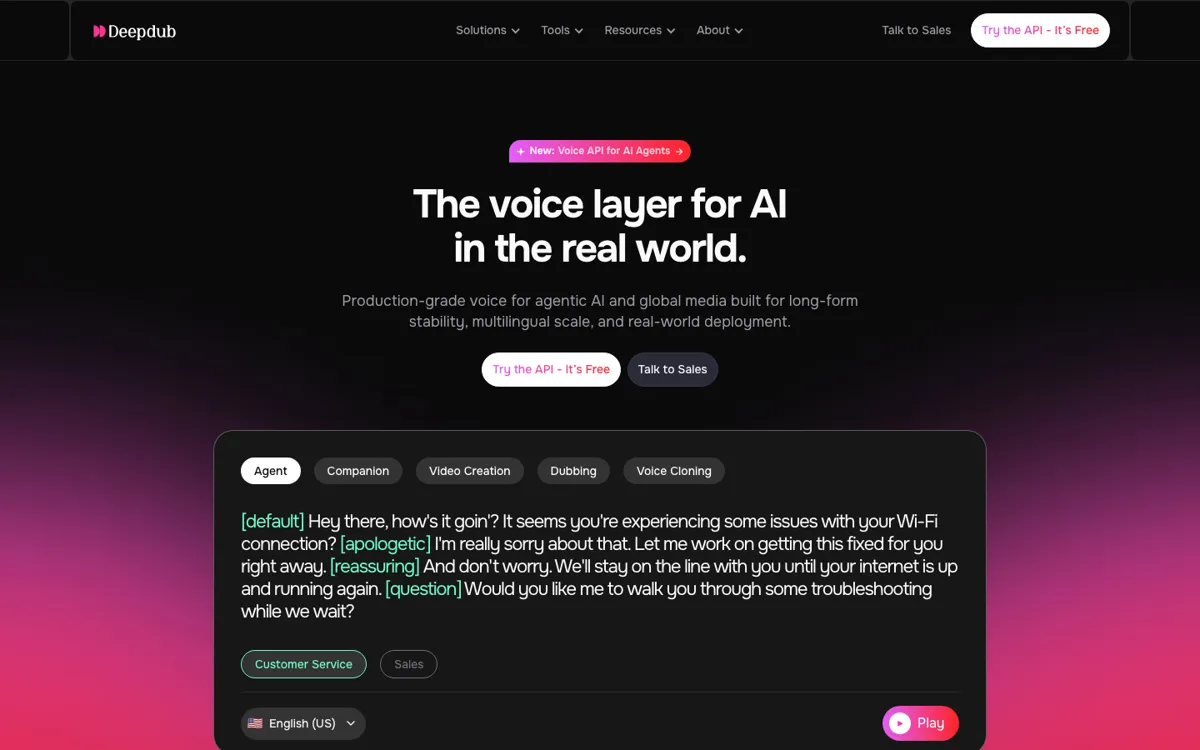
The solution story is broader than one model demo. Deepdub combines emotional text to speech, speech to speech, voice cloning, accent control, a voice library, real-time APIs, managed services, and human-assisted production steps. The docs add concrete developer routes through REST, WebSocket, Python, and JavaScript integration, while the API marketing pages push low latency, commercial licensing, and enterprise support. On the dubbing side, the FAQ keeps reinforcing that this is tied to real post-production and localization work, including native-speaking human adapters and in-house production oversight. That combination makes sense for buyers who need more than a voice sample generator and are trying to operationalize multilingual audio output.

The limitation is that enterprise seriousness cuts both ways. Public pricing is sparse, the self-serve path is less obvious for full dubbing than for the API side, and part of the quality promise depends on a workflow that includes people, not just automation. That is not a flaw if your team already expects procurement, review, and managed localization support. But it does mean Deepdub is a bad fit for buyers who want to compare five tools from a pricing page and start dubbing immediately on a small budget. If your purchase process demands instant cost clarity, this product will feel hard to pin down before it feels reassuring.

What you can do with it

Dub films, series, channels, and corporate content with AI-led and AI-assisted localization workflows.
Generate expressive text to speech with control over accent, tempo, variance, and emotion.
Translate and convert voices with speech-to-speech and voice cloning tools.
Use fully licensed broadcast-ready voices across 100+ or 130+ languages, depending on product line.
Deploy real-time voice APIs for AI agents with low-latency streaming and enterprise support.
Combine AI output with human adapters and production teams for higher-stakes dubbing work.

Technical details

platform
Web platform with REST API, WebSocket API, Python SDK, and JavaScript SDK
deployment
Cloud
api_available
Yes

Top Alternatives to Deepdub

If Deepdub is close but still misses the job, try one of these instead.

Key Questions

Is Deepdub mainly a creator dubbing tool or an enterprise localization platform?
It is much closer to an enterprise localization platform. The official site focuses on media and entertainment, language service providers, corporate localization, managed services, and large-scale voice deployment rather than casual creator use.
Can Deepdub handle film and broadcast-style dubbing work?
Yes. Deepdub says it has dubbed thousands of hours of content and references work tied to theatrical releases, Pluto TV channels, Hulu-available content, and other large media workflows.
Does Deepdub rely only on AI for quality?
No. The FAQ says Deepdub combines AI with native-speaking human adapters and an in-house production team, so the best-quality path is not purely one-click automation.
Can you see full dubbing prices on the public site?
Not clearly. The API pages describe a 14-day free trial and additional usage pricing, but the main dubbing side does not publish a straightforward public tier table you can budget from.