What does Rapport actually do?
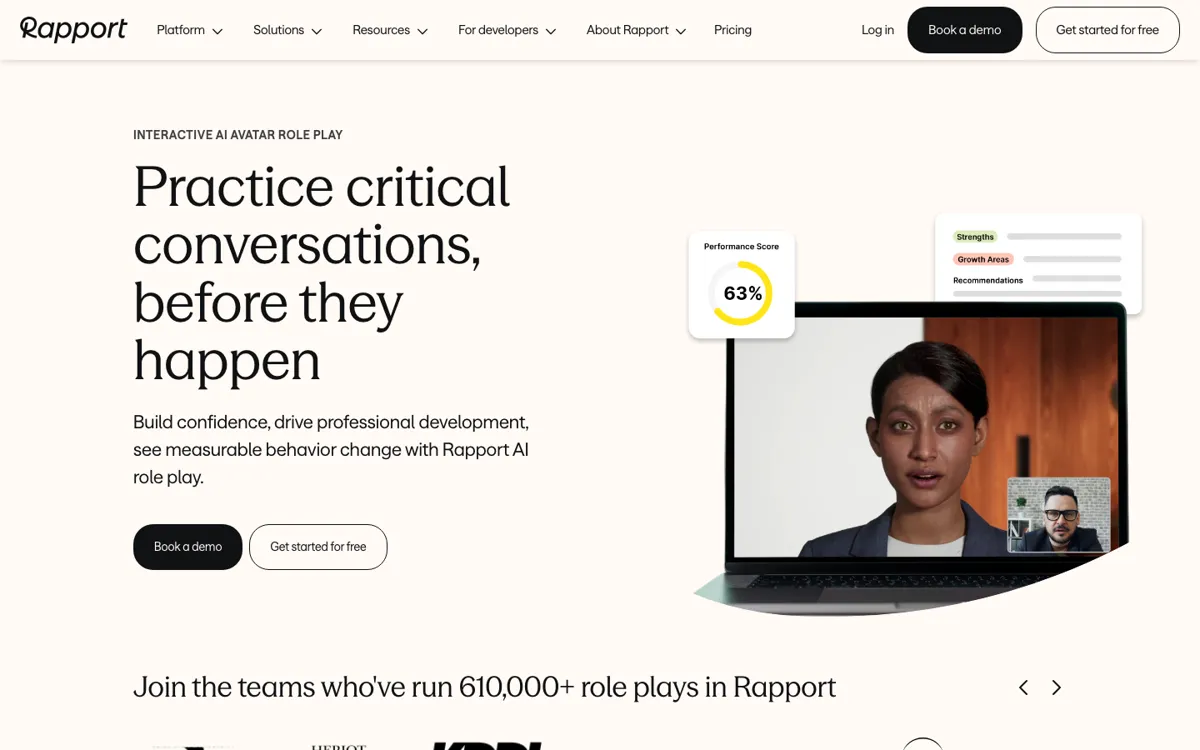
Rapport makes the most sense if you think of it as a practice range for human conversations. Before you get buried in avatar tech, it pushes concrete scenes like a manager delivering hard news, a hotel guest arriving upset, and a sales rep pitching a buyer. That framing matters because it tells you what the product is trying to replace. It is not trying to beat general chat tools at open-ended conversation. It is trying to replace awkward live role-play sessions, static e-learning modules, and manager guesswork with repeatable simulated conversations that can be scored and reviewed later.
The platform also has more deployment depth than a lot of AI avatar products that stop at a flashy demo. Teams can ship it as a standalone browser flow, a web embed, a learner portal, an Unreal-linked experience, or an enterprise on-prem or private cloud setup. On the technical side, Rapport exposes a broad voice and model stack, from ChatGPT, Gemini, and Groq to STT/TTS providers like Google, Azure, AWS, ElevenLabs, Whisper, and Speechmatics. That gives technical teams room to tune latency, voice quality, and infrastructure instead of accepting a fixed black box.