Convai Review

8.0/10

Build real-time AI characters for games, XR scenes, and browser worlds with voice, actions, and memory.

Review updated May 2026 By The AI Way Editorial Tested 278+ tools across the site 5 min read
Convai API Available Game Development Multi-language NPC Real-Time Voice AI Freemium from $22.00/mo

Our Verdict

Convai is worth using when the real job is making NPCs or virtual characters hold live conversations inside a game, browser world, or XR scene instead of bolting a generic chatbot onto a landing page. Its edge is the combination of engine plugins, character APIs, knowledge banks, and real-time action hooks that make the character feel like part of the environment. The cost is that you are buying builder infrastructure with quotas and concurrency limits, so the free tier is for proving the loop, not for shipping a busy production world.

Try it
Free to start, then pay when the limits stop you. Starts at $22.00 USD.
open_in_new Try Convai
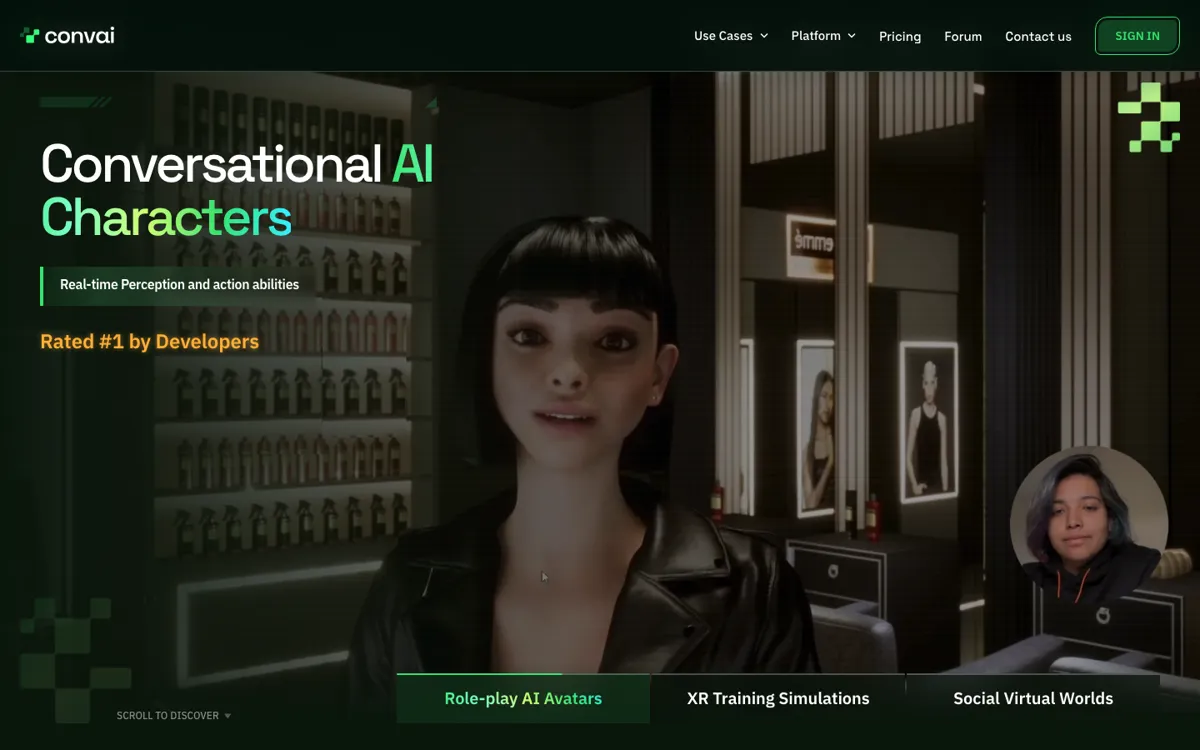
Official Website Snapshot Visit Site ↗

check_circle Pros

  • The product is built around actual game and immersive-scene deployment, with first-party docs for Unity, Unreal Engine, web plugins, and API usage instead of stopping at a chat demo.
  • The character stack is broader than plain speech output because it includes backstory, actions, knowledge banks, voice options, and plan-based perception features.
  • The pricing page is unusually concrete about what changes between tiers, including interaction quotas, concurrency, knowledge bank size, and flagship model caps.
  • A free plan exists, which is enough to test whether your character loop works before paying for larger quotas.

cancel Cons

  • This is not a lightweight website chatbot tool, so non-developers or teams without an actual character experience to embed will hit setup overhead fast.
  • The free plan is narrow at 100 interactions per month, which is enough for a demo but not enough to learn much about sustained player traffic.
  • Important production levers like higher session concurrency, bigger knowledge banks, and more flagship-model usage live behind paid tiers.
  • Some voice features are gated harder than the marketing copy suggests, with custom voice cloning called out in the FAQ as enterprise-tier only.

Should you use it?

Best for: Best for prototyping and shipping AI NPCs, training characters, or browser-based roleplay scenes where players need to talk to a character that can answer, act, and keep context in real time.

Skip it if: Skip this if you need a plain customer-support chatbot, an AI girlfriend app, or a general chat assistant with no game, simulation, or interactive-scene layer behind it.

Is it worth the price?

Freemium Starts at $22.00 USD

The free plan works for one-character demos, quick plugin tests, and early scene validation. Paid tiers start making sense once a prototype turns into shared testing, because that is when interaction caps, session concurrency, and model limits stop feeling like footnotes and start blocking the build.

The Free Tier

Free plan includes 100 interactions per month.

Paid Upgrade
$22/month billed yearly

Indie Dev raises the quota to 3,000 interactions per month and unlocks a 5 MB knowledge bank with larger voice and flagship-model caps than free.

One thing to know before you start

Start in Convai Playground with one narrow scene and one knowledge bank before wiring animation, voices, or multi-character logic. That isolates whether the character's conversation loop is good enough before you spend time on engine polish.

What people actually use it for

Adding a talkative NPC to a Unity or Unreal prototype

Convai fits the common early-stage game task where you want one character to answer the player, stay in role, and react to prompts without building your own conversation stack from scratch. The engine plugins and quick-start material make that path more direct than stitching together speech, model calls, and character state on your own. It is strongest when you are testing whether live dialogue improves the scene. It is weaker if your project only needs branching text and no real-time interaction.

Building a browser-based character demo or roleplay scene

The web plugin and Playground positioning make Convai workable for browser worlds, pitch demos, and lightweight interactive scenes where a user needs to talk to a virtual guide, trainer, or in-world character. This is useful when the character itself is the product moment. The main limit is quota pressure: once many users start talking at once, concurrency and interaction caps stop being abstract and start affecting what plan you can actually run.

Training or simulation scenarios that need character memory and actions

Convai is also a fit for simulations where a character should do more than answer generic questions. Knowledge banks, action APIs, narrative settings, and session limits matter more in training scenes, practice environments, or branded character experiences where the agent needs boundaries. That makes Convai more interesting than a standard companion chatbot. The tradeoff is that you still have to design the scenario carefully, because the platform gives building blocks, not a finished training product.

What does Convai actually do?

Convai is easiest to understand if you stop thinking about chatbots and start thinking about characters inside a scene. The homepage, docs, and SDK material all point in that direction. You are not just opening a chat window and changing the theme color. You are creating a character with a voice, backstory, knowledge, and behavior rules, then dropping it into a game prototype, browser world, or XR setup where a user can talk to it live. That changes the evaluation immediately. The useful question is not whether the model can answer a prompt. The useful question is whether the character can stay believable while a player or trainee interacts with it in real time.

The strongest part of Convai is the way the tooling lines up with actual deployment targets. The docs cover Playground, no-code experiences, Unity, Unreal Engine, web plugins, and API reference, which means the product has a clearer path from test scene to working integration than many generic AI character demos. The pricing and FAQ pages also expose the operational limits that matter later: interaction quotas, session concurrency, knowledge bank size, flagship model caps, and third-party voice caps. That kind of detail is valuable because it tells you early whether Convai is a cheap experiment, a serious production candidate, or something you will outgrow once traffic spikes.

The downside is that Convai is still builder infrastructure. You need a scene, an interaction loop, and a reason for the character to exist. If your use case is just "put an AI assistant on the website," this is the wrong shape of tool. Even for the right audience, the free plan is intentionally small at 100 interactions per month, so it proves the plumbing more than the business case. Paid plans widen the runway, but they also force you to think about concurrency, voice usage, and which model tier you can afford. That is normal for a production character platform, but it means Convai rewards teams that already know what kind of character experience they are trying to ship.

What you can do with it

Creates conversational AI characters that can speak, respond, and stay in role inside games and virtual worlds.
Connects characters to knowledge banks, long-term memory, actions, and narrative settings through Convai's APIs and dashboard.
Ships plugins and integration paths for Unity, Unreal Engine, web experiences, and other deployment targets.
Supports multimodal character behavior such as vision, lip sync, animations, and third-party voice options on supported plans.
Includes Playground, Avatar Studio, and Convai Sim for testing, no-code scene building, and cloud-rendered character experiences.

Technical details

platform
Hosted character platform with Playground, cloud-rendered Avatar Studio and Convai Sim, plus runtime integrations for Unity, Unreal Engine, web plugins, and XR-oriented experiences.
deployment
The service runs as Convai-hosted infrastructure, while the actual character experience is embedded into the developer's game, browser scene, or simulation with plan-based limits on session concurrency, vision sessions, and interaction caps.
quota_model
Plans are enforced by interaction quota, character session concurrency, knowledge bank size, flagship-model caps, HQ third-party voice caps, and monthly active end users.
api_available
Character Crafting APIs cover character base settings, interactions, AI settings, backstory, chat history, narrative design, actions, and language-voice selection, with separate plugin and core API docs.
engine_integrations
The official docs split setup paths across Unity, Unreal Engine, and web plugins instead of treating deployment as one generic SDK flow.
voice_and_language_stack
The homepage advertises 65+ languages and 500+ voices, while the FAQ adds that custom voices currently require ElevenLabs Pro and some voice-cloning support is reserved for enterprise use.

Top Alternatives to Convai

If Convai is close but still misses the job, try one of these instead.

Key Questions

Is Convai meant for a normal website chatbot?
No. Convai is built for character-driven experiences in games, browser scenes, simulations, and XR setups, so it makes less sense if all you need is a simple support chat box.
Can Convai work with custom avatars?
Yes. The FAQ says Convai is visually independent, so you can use your own avatar models. If you want lip sync, your avatar needs one of the supported blendshape setups such as OVR, ARKit, or Reallusion.
Does Convai offer a free plan?
Yes. The pricing page shows a free tier at $0 per month, but it is capped at 100 interactions per month, so it is best treated as a test tier rather than a production plan.
When do paid plans become necessary?
Paid plans become necessary once you need more traffic headroom, bigger knowledge banks, more concurrent sessions, or higher caps for flagship models and third-party voices. The first paid tier starts at $22 per month on yearly billing.