Owlish Review

8.2/10

AI support agents trained on your docs to cut repetitive customer questions.

Review updated May 2026 By The AI Way Editorial Tested 262+ tools across the site 5 min read
Owlish AI Agents Customer Support Customer Support Agent SaaS Web-Based Freemium from $49.00/mo

Our Verdict

Owlish is a sensible AI support product because it points at a real operational pain, repeated questions that should never have needed a human reply in the first place. Its best angle is using existing docs as the training layer instead of making support teams start from zero. The catch is that bad or stale documentation will poison the whole experience fast, so the product only works as well as the material and escalation logic behind it.

Try it
Free to start, then pay when the limits stop you. Starts at $49.00 USD.
open_in_new Try Owlish
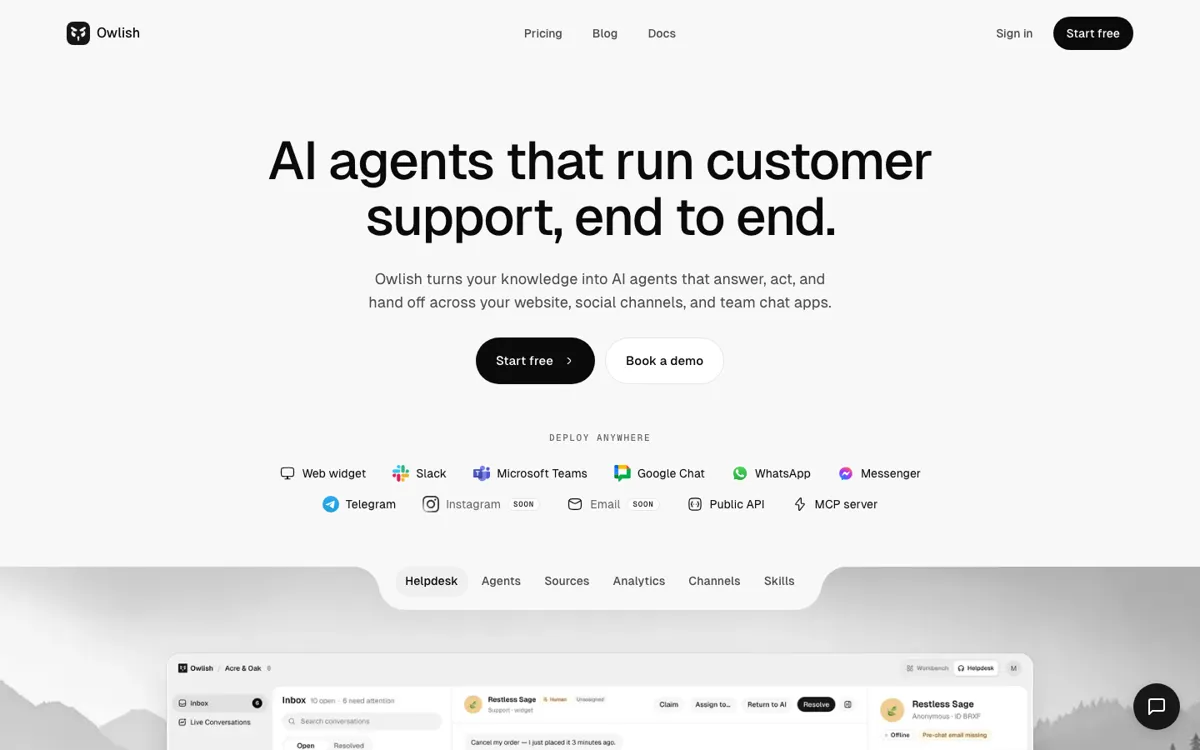
Official Website Snapshot Visit Site ↗

check_circle Pros

  • The product has a concrete job, reduce support volume on questions that already have documented answers, which is easier to value than vague AI support language.
  • Training on docs is a good fit for support teams because it uses an asset many SaaS companies already have instead of demanding a brand new knowledge workflow.
  • The official pricing page is public and specific, which makes it easier to judge whether the free tier or paid jump fits the current support burden.

cancel Cons

  • The product quality is tightly tied to documentation quality, so weak docs will produce weak support automation no matter how good the agent layer sounds.
  • Support deflection is easy to oversell, which means teams still need to pressure-test accuracy and escalation behavior before trusting the agent with high-volume traffic.
  • This is a crowded category, so the product needs to keep proving that its doc-trained approach is meaningfully better than generic AI support bots.

Should you use it?

Best for: SaaS and product teams with repeat support questions, usable docs, and enough ticket volume that deflecting even a modest share of repetitive requests saves real team time every week.

Skip it if: Skip Owlish if your docs are thin, outdated, or constantly wrong. It also makes less sense if your support volume is still too small for automation gains to matter.

Is it worth the price?

Freemium Starts at $49.00 USD

The free tier is enough to find out whether your docs can actually carry first-line support. The paid tiers make sense once support volume is high enough that every deflected reply saves real team time, but they will feel early if the bigger problem is weak documentation rather than ticket load.

The Free Tier

The official pricing page shows a Free tier at $0.

Paid Upgrade
Starter begins at $49/month, with higher plans at $149 and $449 monthly.

Paid tiers are positioned for larger-scale support automation beyond the free proving-ground level.

One thing to know before you start

Test Owlish on the 20 support questions your team is most tired of answering, not on your cleanest marketing FAQ. That is where the product either saves real support time or exposes weak documentation fast.

What people actually use it for

Deflect repetitive support tickets with existing docs

A strong fit when the same product questions keep hitting the queue and the answers already exist somewhere in documentation. Owlish is aimed at turning that written material into a first-line response layer.

Give small support teams an always-on docs-trained frontline

Useful when a lean team cannot keep replying to low-complexity questions all day. The product matters most when deflection frees real human attention for harder cases.

Pressure-test whether your docs are strong enough for AI support

Good for teams that want to see whether their documentation can support automation at all. The product can expose knowledge gaps just as clearly as it reduces ticket load.

What does Owlish actually do?

Owlish goes after one of the most predictable support problems in software: human agents spend too much time repeating answers that already exist in product docs. The waste is not in discovering the answer. The waste is in retyping it, reframing it, and handling it again for every new customer who never found the right page. That is exactly the kind of support load AI should be able to reduce, if the system can stay grounded in documentation instead of improvising responses from thin air.

That is why the docs-trained framing matters. A support agent trained on strong documentation has a clearer lane than a generic AI bot trying to behave like a universal assistant. The product is easiest to justify when the company already has enough docs quality and enough support volume that deflection gains show up in daily operations. In that scenario, the value is not abstract. It is fewer repetitive tickets, faster first responses, and more human time available for messy or high-stakes support work.

The limit is straightforward but serious. Automation based on weak documentation will fail in a very specific way: the system will answer confidently, but not helpfully enough. That means the product is not just testing the AI layer, it is testing the integrity of the company's documentation and escalation design. Teams that ignore that will overestimate the tool. So the honest read is this: Owlish is a credible support-volume reducer for documentation-rich teams, but not a shortcut around weak knowledge foundations.

What you can do with it

Train AI support agents on your docs to answer repetitive customer questions.
Deflect support volume before tickets reach a human queue.
Use documentation as the knowledge layer instead of rebuilding answers from scratch inside a support inbox.
Offer a free entry tier before moving into paid support-scale usage.
Pair support automation with docs and workflow resources on the official product surface.

Technical details

platform
Web-based support automation product with docs-trained AI agents and a console sign-in flow.
deployment
Cloud SaaS with pricing, docs, blog, and console access on the public product surface.
api_available
No public API was confirmed from the official pages reviewed this round.

Top Alternatives to Owlish

If Owlish is close but still misses the job, try one of these instead.

Key Questions

What does Owlish train on?
It trains on your documentation so the agent can answer repetitive support questions from the material your team already maintains. That is the core of the product, not a side feature.
Who gets the most value from Owlish?
Teams with repeat support volume and solid documentation get the clearest value. If the same questions keep coming in and the answers are already written down, Owlish has the right kind of problem to solve.
Is the free tier enough to evaluate it?
Yes for testing the basic fit. The free tier is useful for finding out whether your docs are strong enough to support agent deflection before you commit to a paid support-automation plan.