Needle Review

8.0/10

A 26M tool-calling model distilled from Gemini for lightweight agent workflows.

Review updated May 2026 By The AI Way Editorial Tested 166+ tools across the site 5 min read
Cactus Compute AI Agents Model Comparison Open Source Free

Our Verdict

Needle is worth attention when the interesting question is not general chat quality, but how small a tool-calling model can get before it stops being useful. Its biggest advantage is the compression story: a 26M model aimed at agent-style tool use, which makes it attractive for developers experimenting with cheaper or lighter inference paths. The tradeoff is that this is still a repo-centric engineering artifact, not a ready-made product. If you need a polished app, the heat around Needle will not translate into immediate value.

Try it
Free to start.
open_in_new Try Needle
Official Website Snapshot Visit Site ↗

check_circle Pros

  • The tiny model size is a real differentiator, because the whole point is to make tool-calling behavior available in a much lighter package.
  • The open repo gives developers direct access to code, architecture notes, and experimentation surface instead of forcing them into a closed API box.
  • The HN reaction shows that the project landed as a serious technical milestone rather than a forgettable open-source dump.
  • It is a practical benchmark for teams asking whether they really need large hosted models for every agent step.

cancel Cons

  • This is not a ready-made end-user product, so non-technical teams will get far less value from it than the HN hype might suggest.
  • A tiny tool-calling model can be exciting on paper while still falling short once the workflow needs broader reasoning, robustness, or domain adaptation.
  • The repo-first delivery means setup, evaluation, and integration burden stays on the developer rather than on a managed platform.

Should you use it?

Best for: Best for developers and research-minded teams that want to test lightweight tool-calling agents, compare distilled model behavior, or study whether tiny models can handle real orchestration tasks.

Skip it if: Skip this if you need a hosted AI product, a polished workflow UI, or a turnkey business tool. Also skip it if your main need is broad assistant quality rather than compact tool-use experiments.

Is it worth the price?

Free

The practical advantage is not a cheap SaaS plan, but open access. The real cost sits in engineering time, evaluation effort, and the work needed to prove whether a tiny distilled model can carry your actual tool-calling workload.

The Free Tier

The project is openly available through GitHub, so access is not gated behind a SaaS trial or paid entry tier.

Paid Upgrade
Contact for pricing

Paid plans usually unlock higher limits, cleaner exports, and broader commercial use.

One thing to know before you start

Test Needle on one narrow tool-calling flow you already understand well. If it stays stable there, you learn something useful. If it breaks immediately, you also learn quickly where the tiny-model tradeoff bites.

What people actually use it for

Benchmark whether a tiny tool-calling model can replace heavier agent steps

Needle is useful when a team wants to know whether every agent action really needs a large hosted model behind it. Running a 26M distilled model on a narrow workflow gives a cleaner answer than arguing in the abstract about future efficiency. If it holds up on the tool-calling path you care about, it can change cost and latency assumptions fast.

Study how tool-use behavior survives aggressive model compression

The project fits researchers and infra teams who care about the mechanics of distillation, not just the end result. Because the repo exposes the code and architecture notes, it gives people a concrete artifact to inspect, adapt, and compare. That is more valuable than a black-box product announcement when the point is understanding what was preserved and what was lost.

Prototype lightweight local or embedded agent workflows

If a team is exploring where a tiny model could sit inside a local, on-device, or cost-sensitive pipeline, Needle is an obvious candidate to test. The project gives developers something small enough to experiment with before they commit to larger runtime and infrastructure choices. That matters most when deployment constraints are part of the product design, not just an afterthought.

What does Needle actually do?

Needle caught fire because the core pitch is easy to understand and unusually sharp. Instead of promising that a new model is a bit better at everything, it focuses on one behavior that matters a lot for agent systems: tool calling. Then it compresses that story even further by attaching it to a tiny 26M model. That combination gives developers a very specific reason to pay attention. The question is not whether the model is a universal assistant. The question is whether useful tool-use behavior can survive aggressive size reduction well enough to change how agent stacks are built. That is the part people were reacting to on HN.

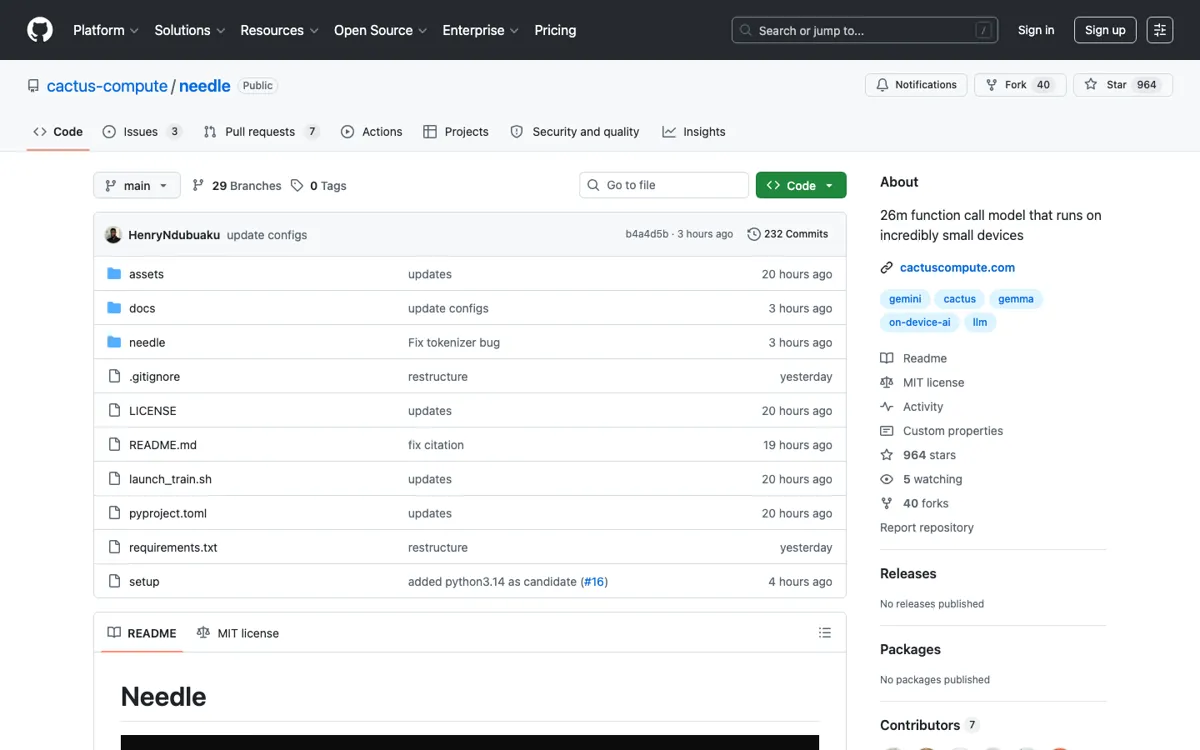
The project also makes it clear that this is a repo-first artifact, not a polished software product. The GitHub surface, README, and architecture notes are the delivery mechanism. That means the value sits with engineers who want to run tests, inspect the implementation, compare behaviors, and maybe borrow ideas or weights for their own systems. It is a stronger fit for model builders, infra teams, and experimental agent developers than for buyers looking for a workflow product. The open repo is a feature here, but it also shifts the burden of evaluation and integration back onto the team using it.

That is why the hype needs to be interpreted carefully. Needle absolutely shows signs of breakout technical interest, and that matters, because attention this concentrated often turns into follow-on experimentation and ecosystem discussion. But heat around an open model repo is not the same as proof of product adoption. The right way to read Needle is as a potentially important building block for lightweight tool-calling systems, not as a finished mainstream AI app. If the tiny-model tradeoff holds in real workflows, it becomes much more than a curiosity. If not, it still remains a valuable benchmark for where the lower bound might be.

What you can do with it

Run a compact 26M model trained for tool calling instead of depending on a much larger hosted agent model for every step.
Study the repo's training and architecture notes to see how tool-use behavior was distilled from Gemini into a small model.
Use the project as a building block for lightweight agent systems where latency, deployment size, or cost matter more than polished chat UX.
Inspect and extend the code directly through GitHub rather than relying on a closed hosted service.
Benchmark whether compact tool-calling models are good enough for your workflow before committing to heavier orchestration stacks.

Technical details

model_scale
Needle is presented as a 26M-parameter model, which is the core reason the project matters, because the whole claim is about shrinking tool-calling behavior into a tiny footprint.
open_repo_surface
The value is delivered through an open GitHub codebase and architecture notes, not a hosted SaaS layer, so deployment, testing, and extension are developer-led from the start.
tool_calling_focus
The model is specialized for tool use rather than broad consumer chat, which changes how teams should evaluate it and where it can fit in a stack.
distillation_method
The project is framed around distilling Gemini tool-calling behavior, which makes the repo more about compressed agent capability than about general chat quality.

Top Alternatives to Needle

If Needle is close but still misses the job, try one of these instead.

Key Questions

Is Needle a full AI product or an open model repo?
It is much closer to an open model repo. The HN launch and GitHub surface both frame it as a compact tool-calling model and engineering artifact, not as a hosted app with a finished user workflow.
Why did Needle get so much attention?
Because the compression story is unusually clear. A 26M model distilled for tool calling is easy for technical people to immediately benchmark in their heads against much larger agent setups, so the project sparks both excitement and skepticism fast.
Who should actually evaluate Needle first?
Developers, infra teams, and researchers should evaluate it first. They are the ones most likely to benefit from a smaller tool-calling model and most capable of testing whether it survives real workflow pressure.
What is the biggest risk in overreading the hype?
Mistaking technical interest for product maturity. A repo can be genuinely important and still not be a ready answer for teams that need reliability, support, and a polished workflow out of the box.