Gigacatalyst Review

8.3/10

An embedded AI app builder that lets each SaaS customer create custom workflows, dashboards, and automations inside the host product.

Review updated May 2026 By The AI Way Editorial Tested 166+ tools across the site 5 min read
Gigacatalyst App Integration B2B Security Workflow Builder

Our Verdict

Gigacatalyst is easiest to justify when a SaaS company keeps getting customer workflow requests that are too specific for the roadmap but too important to ignore. Its biggest advantage is that customers can build those apps inside the host product, on the host data, without pushing every request back onto engineering. The tradeoff is that the whole pitch depends on governance and correctness holding up after the first impressive demo.

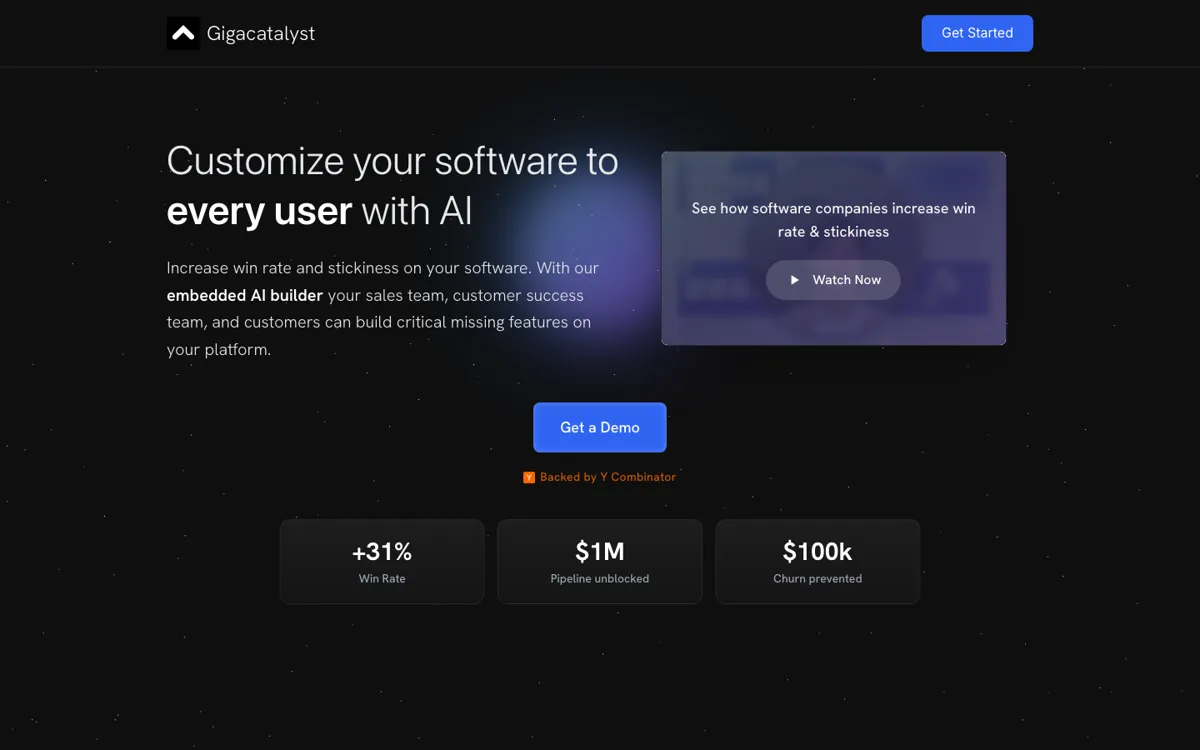
Official Website Snapshot Visit Site ↗

check_circle Pros

  • It tackles a real B2B SaaS pain point, customer workflow mismatch, instead of settling for a shallow chatbot feature.
  • The category framing is much clearer than most AI builders because the product is specifically built for embedded, customer-facing app generation inside another SaaS product.
  • The official product surface takes governance seriously with sandboxing, action controls, role scopes, and model restrictions shown as core parts of the system.

cancel Cons

  • No public pricing is shown, so buyers cannot easily judge whether the retention upside is realistic for their scale before a sales conversation.
  • The whole value case depends on generated apps staying correct and governable, which is exactly where enterprise buyers will push hardest.
  • Customer-specific app generation can create support and product-sprawl risk if the host company does not manage what should stay standard versus what should be customizable.

Should you use it?

Best for: Best for B2B SaaS teams that keep hearing customer requests for custom dashboards, forms, automations, or workflow tools and want those requests absorbed inside the product instead of sent to the roadmap queue.

Skip it if: Skip this if your customers mostly want a fixed standardized product or if your team is not prepared to govern customer-generated app logic after it starts spreading. Also skip it if you only need internal AI tooling rather than a builder your customers will use themselves.

Is it worth the price?

Because there is no public rate card, this is hard to qualify casually. The real buying question is whether reducing churn and one-off roadmap pressure would pay back the implementation effort enough to justify a sales-led purchase.

One thing to know before you start

Try it on a workflow request your team keeps punting as too niche to build. If the generated result is usable without opening a long support tail, you will learn more than a demo ever shows.

What people actually use it for

Let customers create the missing workflow your roadmap will not ship soon

Gigacatalyst fits when a SaaS company keeps hearing the same painful sentence from customers: your product is close, but not quite shaped for our workflow. Instead of pushing every request into a feature backlog, the embedded builder lets customers describe the workflow they need and generate an app, automation, or dashboard connected to real product data. That matters most when the requested gap is business-critical but too niche to justify core roadmap work.

Increase retention by making the product adapt to each account

The product is strongest when churn risk comes from workflow mismatch rather than missing generic capability. If each customer wants a slightly different internal tool, form, triage flow, or dashboard, Gigacatalyst aims to keep those variations inside the host platform rather than pushing customers toward spreadsheets, shadow IT, or another vendor. That makes it a retention play, not only an AI feature checkbox.

Give customer success and sales a safer way to solve one-off demands

The homepage explicitly frames the builder as something sales teams, customer success teams, and customers themselves can use. That is valuable when the commercial team keeps seeing deal friction caused by 'missing' product behavior, but engineering cannot custom-build everything. The risk is that success depends on guardrails actually holding, because once revenue teams can unlock custom apps quickly, the temptation to over-customize grows just as fast.

What does Gigacatalyst actually do?

A lot of SaaS churn is not caused by a bad product so much as a product that is almost right for every customer and perfectly right for none of them. One customer wants a support triage tool, another wants a renewal risk dashboard, another needs a weird approval flow that never makes it onto the roadmap because only six accounts asked for it. Those requests pile up in sales calls, success escalations, and renewal debates. Engineering cannot keep shipping one-off versions for every account, so the customer either lives with the mismatch, builds a spreadsheet workaround, or starts looking for something more flexible. Gigacatalyst is aimed at that exact retention trap.

The most important thing about Gigacatalyst is that it is not selling a standalone builder to developers. It is selling an embedded AI app builder to SaaS companies that want their own customers to create missing workflows inside the product. The captured materials define the category with unusual clarity: embedded under the host brand, connected to host APIs, inheriting host security, and wrapped in a governed sharing model with sandboxing, role scopes, credentials, and app distribution. That architecture matters because it is what separates a flashy AI code generator from something a SaaS company might actually trust its customers to use on live product data.

The risk is not whether the demos look impressive. The risk is whether the product can keep correctness and governance intact once customers start building dozens or hundreds of custom apps around real business workflows. That is exactly why the HN discussion themes matter. Questions about customer-specific sprawl, proof of paid demand, and correctness are not side issues. They are the core test for whether Gigacatalyst is a durable product or just a compelling category pitch. The product becomes valuable when it can absorb roadmap pressure without creating platform chaos. If it cannot do that, the same flexibility that improves retention in theory will become support debt in practice.

What you can do with it

Embed an AI builder inside a SaaS product so customers can describe and generate their own apps in natural language.
Connect generated apps to the host platform's APIs and data instead of building on mock or disconnected workflows.
Let customers create dashboards, internal tools, and automations without opening an engineering ticket.
Share generated apps across teams or companies through a built-in app store and role-scoped access model.
Run generated code inside sandboxed execution with model restrictions, action controls, and inherited auth boundaries.

Technical details

host_api_training
Gigacatalyst is framed as learning the host SaaS APIs and design language so customers can generate connected apps against live product data rather than produce generic external prototypes.
sandbox_governance
Sandboxed execution, role-based credentials, action permissions, and model restrictions are presented as part of the default operating model, not as optional cleanup after the apps are generated.
security_inheritance
Generated apps inherit the host platform's auth boundaries, tenant isolation, and existing security model instead of creating a second permission stack per customer app.
embedded_distribution_model
The builder is embedded inside another SaaS product, and the generated apps can be shared or distributed through a built-in app store under the host company's brand.

Top Alternatives to Gigacatalyst

If Gigacatalyst is close but still misses the job, try one of these instead.

Key Questions

Is Gigacatalyst just another AI chatbot for SaaS?
No. The official surface frames it as an embedded AI app builder, not a chat layer. The point is to let customers generate real apps, dashboards, and automations connected to the host product's APIs and data.
What kind of SaaS team gets the most value from it?
Teams that keep losing time or deals to customer-specific workflow requests get the most value. If the product is strong but too rigid for how different accounts operate, Gigacatalyst is aimed at that mismatch.
Why is governance such a big part of the pitch?
Because customer-facing app generation is dangerous without guardrails. The product only works if generated apps stay inside the host platform's security, tenant, and action boundaries instead of turning into uncontrolled custom logic.
What is still unclear from the captured public surface?
Public pricing is still unclear. The captured homepage talks about business outcomes and implementation speed, but it does not show a self-serve price ladder, so budget fit still depends on a sales conversation.