VoxCPM Review

7.8/10

Generate multilingual speech, designed voices, and cloned voices from open-source TTS models.

Review updated June 2026 By The AI Way Editorial Tested 298+ tools across the site 5 min read
OpenBMB Multi-language Open Source Self-Hosted Text-to-Speech Voice AI Voice Cloning Free

Read this first

Treat VoxCPM as infrastructure, not a finished creator app. If nobody on the team can own Python setup, GPU runtime choices, and cloning safety rules, the model quality will not save the rollout.

Our Verdict

VoxCPM is worth shortlisting when you need an open TTS model that can design voices from text and still run under your own stack. Its biggest advantage is the control surface: multilingual speech, reference cloning, prompt-based cloning, fine-tuning, and deployable serving options sit in one repo. The tradeoff is that this is not a polished SaaS voice studio; teams without Python, GPU, or model-serving comfort will spend time on setup before they get reliable output.

Try it
Free to start.
open_in_new Try VoxCPM
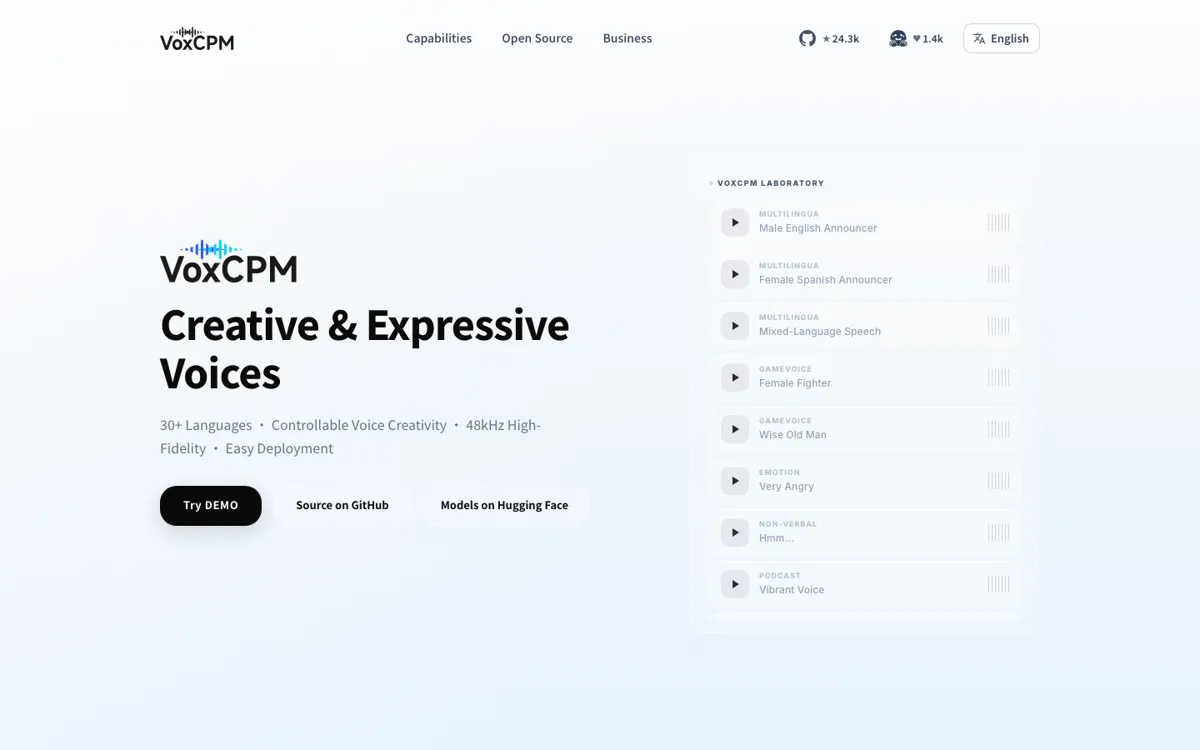
Official Website Snapshot Visit Site ↗

check_circle Pros

  • Voice design removes the need to record a seed voice when you only need a character direction such as tone, age, pace, or emotion.
  • Apache-2.0 code and weights make it usable for commercial projects without waiting on a vendor sales process.
  • Implementation routes are concrete enough to choose between Python, CLI, local demo, fine-tuning, NanoVLLM, and vLLM-Omni serving.
  • The 2026 GitHub trend spike gives it more community attention than most open TTS repos at the same maturity level.

cancel Cons

  • A hosted no-code editor is not the center of the product, so nontechnical creators will hit setup work fast.
  • Long or highly expressive inputs can still produce unstable results, so batch narration needs review passes.
  • Voice cloning creates consent and labeling obligations that the user has to enforce outside the model.
  • The public site does not publish SaaS-style usage limits, queues, uptime, or support commitments.

Should you use it?

Best for: Building a local or self-hosted TTS pipeline where multilingual output, character voice design, or controllable voice cloning matters more than a ready-made editor UI.

Skip it if: Skip it if you need a browser voice studio with team seats, usage analytics, licensing paperwork, and support guarantees already packaged.

Is it worth the price?

Free

The model is free to use under Apache-2.0 terms, but the real cost is compute and engineering time. A demo is enough for checking voice quality; production use moves the bill into GPUs, serving, review, and abuse-prevention work.

The Free Tier

Open-source use is free under Apache-2.0; the practical limit is self-hosting, compute, and setup rather than a published hosted quota.

One thing to know before you start

Use the hosted demo and audio sample page first to reject weak language or style cases before installing anything. For production tests, start with the default VoxCPM2 path, then compare NanoVLLM or vLLM-Omni only after the base voice quality passes review.

What people actually use it for

Prototype multilingual app voices

Feed product copy, tutorial lines, or dialogue into VoxCPM2 and check whether the same model can cover English, Chinese, Spanish, Hindi, Arabic, and other supported languages before committing to a vendor voice library.

Create character voices from direction

Write the voice direction into the prompt, such as a young gentle speaker or an angry game character, and generate audio without recording a reference actor for every early concept.

Clone a permitted reference voice

Use a short approved recording when the task needs a recognizable timbre, then add style control for speed, emotion, or delivery while keeping consent and labeling rules outside the model.

Serve TTS inside a product

Move from local generation to NanoVLLM or vLLM-Omni when the product needs streaming, concurrent requests, or an OpenAI-compatible speech endpoint instead of manual audio file generation.

What does VoxCPM actually do?

VoxCPM2 matters because it combines several capabilities that are often split across separate TTS tools. It can take plain text and produce speech, but it can also accept a natural-language voice description before the text, use a reference clip for cloning, or use prompt audio plus transcript for closer continuation. The concrete numbers shape the buying decision: 2B parameters, 30 supported languages, 48kHz output, more than 2 million hours of training data, and roughly 8 GB VRAM listed in the model details.

The product is strongest for builders. A creator can try the Hugging Face Space or listen to the demo page, but the durable paths are Python, CLI, local web demo, fine-tuning, and serving. The repo documents commands for direct synthesis, voice design, reference cloning, batch generation, and deployment through NanoVLLM or vLLM-Omni. That makes VoxCPM more comparable to an open voice infrastructure layer than to a finished editing suite with folders, exports, permissions, and account billing.

The main risk is not price; it is control. Voice cloning can create convincing synthetic speech, so teams need consent checks, AI labels, and review steps before public use. Long or highly expressive inputs can still produce artifacts or unstable output, and language quality can vary by training coverage. VoxCPM is a strong open TTS candidate when those constraints are acceptable, but it should not be treated as a one-click replacement for a managed voice platform.

What you can do with it

Generate speech from text through a Python API, CLI command, local web demo, or Hugging Face demo.
Describe a voice in text, such as age, gender, tone, emotion, or pace, and synthesize audio without a reference recording.
Clone a voice from a short reference clip, then add style control for pace, emotion, or delivery.
Use prompt audio plus transcript for higher-fidelity voice continuation when close vocal detail matters.
Synthesize across 30 supported languages and multiple Chinese dialect examples without explicit language tags in most cases.
Serve VoxCPM2 through NanoVLLM or vLLM-Omni for streaming, batching, and OpenAI-compatible audio endpoints.
Fine-tune with SFT or LoRA when a project needs custom voices or domain-specific speech behavior.

Technical details

model_core
Tokenizer-free diffusion autoregressive TTS model based on MiniCPM-4, with 2B parameters, BF16 weights, 6.25 Hz LM token rate, and 8192-token maximum sequence length.
audio_stack
AudioVAE V2 accepts 16kHz reference audio and outputs 48kHz audio with built-in super-resolution.
serving_paths
NanoVLLM-VoxCPM supports high-throughput concurrent serving; vLLM-Omni supports VoxCPM2 with continuous batching and an OpenAI-compatible /v1/audio/speech endpoint.
license_and_weights
Code and model weights are Apache-2.0, with Hugging Face and ModelScope distribution.
runtime_requirements
Python >=3.10, PyTorch >=2.5.0, CUDA >=12.0 for the standard GPU path, roughly 8 GB VRAM, plus automatic device selection across CUDA, MPS, and CPU.

Top Alternatives to VoxCPM

If VoxCPM is close but still misses the job, try one of these instead.

Key Questions

Is VoxCPM a SaaS voice generator?
No. It is mainly an open-source TTS model and toolkit with demos, docs, model weights, CLI, Python usage, and serving options.
Can VoxCPM design a voice without reference audio?
Yes. VoxCPM2 supports voice design from a natural-language description, so a prompt can specify traits such as age, gender, tone, emotion, or pace.
Can VoxCPM be used commercially?
Yes, the code and weights are released under Apache-2.0, but teams still need to handle consent, labeling, and misuse controls for cloned or synthetic voices.
What setup does VoxCPM require?
Expect developer setup. You will deal with pip installation, Python API, CLI, a local web demo, automatic device selection, PyTorch requirements, and GPU-oriented deployment paths.
What are the main technical limits?
Very long or highly expressive inputs can be unstable, voice design results can vary between generations, and performance may differ across languages.