tl;dv Review

7.9/10

AI meeting recorder for transcripts, conversational intelligence, and CRM synced notes

Review updated May 2026 By The AI Way Editorial Tested 262+ tools across the site 4 min read
tl;dv CRM Integration Meeting Notes SaaS Summarization Team Collaboration Transcription Web-Based Freemium

Our Verdict

tl;dv is strongest when your team needs meetings to become searchable follow through, not just recordings. The recording and transcript layer is table stakes. The more important part is that it tries to extract insights, answer questions from calls, and ship the useful parts into the systems your team already works in. If meetings are mostly disposable status calls, that is overkill. If they drive deals or decisions, the extra layer is valuable.

Try it
Free to start, then pay when the limits stop you.
open_in_new Try tl;dv
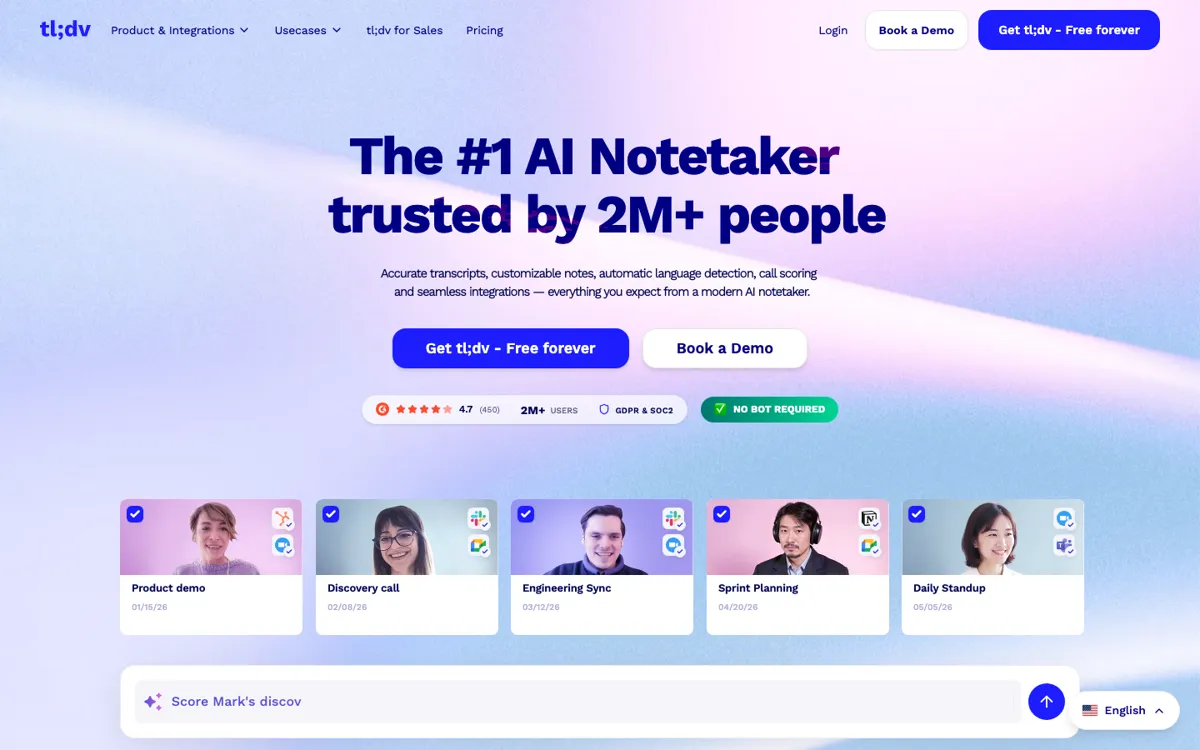
Official Website Snapshot Visit Site ↗

check_circle Pros

  • It connects meeting capture to real workflow automation instead of stopping at a transcript archive.
  • Support for Google Meet, Teams, and Zoom covers the main collaboration stack many teams already use.
  • Conversational intelligence makes the product more useful for sales and revenue teams that need patterns, objections, and answers pulled out of calls quickly.
  • The integration breadth is a serious plus if you want meeting notes to land in CRM or project tools without manual copying.

cancel Cons

  • The fetched pricing page did not expose stable plan detail in this round, so buyers still need extra verification before comparing cost against rivals.
  • Teams that rarely revisit calls may not unlock enough value from the insight layer to justify another meeting tool in the stack.
  • As with any meeting recorder, the product becomes much less useful if the team does not build habits around reviewing summaries or syncing outcomes.
  • Sales oriented positioning can make it feel heavier than necessary for individuals who only want simple personal note capture.

Should you use it?

Best for: Sales, customer, and cross functional teams that want meetings turned into summaries, searchable insights, and synced follow ups instead of static recordings.

Skip it if: Skip it if you only need lightweight personal notes from occasional calls and do not care about integrations, meeting intelligence, or downstream team workflows.

Is it worth the price?

Freemium

There is enough public signal to treat tl;dv as a freemium product, but the serious purchase case is not about free notes. It is about whether synced meeting intelligence saves enough manual handoff work to justify the paid rollout across a team.

The Free Tier

The public product framing supports a free entry assumption, but this round did not surface stable plan limits from the pricing page fetch.

Paid Upgrade

Paid value appears to center on stronger team workflows and broader meeting intelligence, but exact public plan detail was not reliably surfaced in the reviewed fetches.

One thing to know before you start

Set up the integrations first, not last. tl;dv gets much better when summaries and insights land where the team already works instead of waiting inside one more dashboard.

What people actually use it for

Extract usable sales and customer insights from recurring calls

A revenue or customer team can use tl;dv to stop rewatching calls just to recover objections, requests, or next steps. The product can capture the conversation, summarize it, and push the useful pieces into the tools where follow up work actually happens. That turns the meeting into something the rest of the team can act on instead of a recording nobody opens twice.

What does tl;dv actually do?

tl;dv is designed for a specific meeting problem: conversations create useful signals, but those signals usually disappear because nobody has time to revisit the full recording. Teams remember part of what was said, capture a few notes, and lose the rest. By combining recording, transcription, AI notes, and conversational intelligence, tl;dv is trying to turn that messy call residue into something searchable and reusable. That makes the product more meaningful for teams that depend on meetings as part of their actual operating system, not just their calendar.

The strongest part of the pitch is workflow connectivity. Recording alone is easy to find elsewhere. What matters is whether meeting outputs can move into CRM, project tools, and day to day collaboration systems without extra busywork. tl;dv's integration story points directly at that need. For sales managers, customer teams, and other meeting heavy operators, this can reduce the lag between what was said on a call and what the business does next. That is a much stronger value proposition than simple note capture.

The main caution is that products like this only compound when the team builds habits around them. If no one checks summaries, no one searches transcripts, and no one uses the synced outputs, then even strong AI meeting software turns into passive storage. tl;dv is therefore best for organizations that already feel the pain of scattered meeting knowledge and are ready to use the product as part of a broader follow up process, not just as a background recorder.

What you can do with it

Records and transcribes Google Meet, Microsoft Teams, and Zoom calls
Generates AI meeting notes and summaries from recorded conversations
Adds conversational intelligence for instant answers and meeting insights
Syncs meeting data into CRM and project tools through 5,000 plus integrations
Turns video calls into reusable notes for sales and cross functional workflows

Technical details

platform
Web based meeting intelligence product designed around video meeting capture, AI note generation, and downstream workflow sync.
deployment
Cloud hosted product built for team use across Google Meet, Microsoft Teams, Zoom, CRM systems, and project tools.
api_available
The reviewed public pages emphasize large scale integrations rather than a clearly surfaced standalone API, so the practical integration story here is workflow connectivity more than developer first extensibility.

Top Alternatives to tl;dv

If tl;dv is close but still misses the job, try one of these instead.

Key Questions

Is tl;dv mainly a recorder or an insight tool?
It starts as a recorder, but the stronger value is in summaries, searchable intelligence, and syncing outcomes into the rest of the team's workflow.
Who gets the most value from tl;dv?
Teams that run a lot of customer, sales, or coordination meetings get the clearest upside because they can reuse the meeting outputs after the call instead of letting them disappear.
Can you judge tl;dv pricing from the public fetches alone?
Not fully. You can infer a freemium entry point, but the exact plan detail was not stably exposed in the fetched pricing path reviewed this round.