Stable Diffusion Review

8.3/10

Generate and edit images through Stable Diffusion models, API access, and self-hosted licensing paths.

Review updated May 2026 By The AI Way Editorial Tested 166+ tools across the site 5 min read
Stability AI API Available Image-to-Image Self-Hosted Text-to-Image Freemium from $0.01/mo

Our Verdict

Stable Diffusion is what you open when the image model needs to fit into a product, pipeline, or licensed deployment instead of living inside one closed prompt box. Its best trait is range: official API pricing, self-hosted licensing, multiple model variants, and a real editing toolkit all sit on the same surface. But that same range is the tax, because you have to choose between models, credits, and access paths before the product feels simple.

Try it
Free to start, then pay when the limits stop you. Starts at $0.01 USD.
open_in_new Try Stable Diffusion
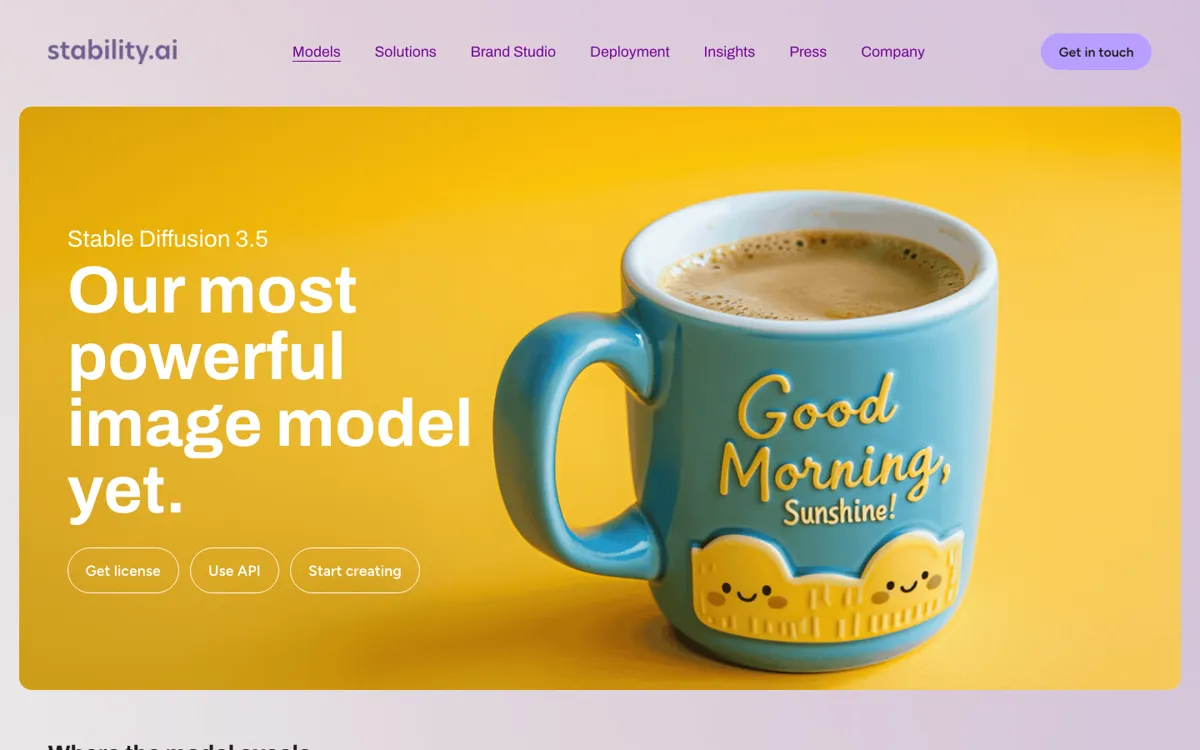
Official Website Snapshot Visit Site ↗

check_circle Pros

  • The official surface makes room for several real adoption paths at once: API use, self-hosted licensing, cloud partners, and web-based creation.
  • Stable Diffusion is not limited to first-pass generation, because the platform also prices and documents editing tools like inpaint, outpaint, object removal, and structure-guided control.
  • The model lineup is segmented clearly enough that teams can trade off speed, quality, and hardware fit instead of being forced into one default model.

cancel Cons

  • Even with clearer API pricing now visible, Stable Diffusion still makes you think in credits, model variants, and deployment routes instead of one simple consumer subscription.
  • The official experience is better at explaining infrastructure choices than at giving a beginner the fastest path from prompt to finished image.
  • Important details like rate limits, billing checks, and account setup sit in separate pricing and FAQ pages, so the full picture takes more digging than lighter image apps require.

Should you use it?

Best for: Adding image generation and editing to a product or workflow where API pricing, model choice, or self-hosted licensing affects the technical plan.

Skip it if: Skip it if your only job is to open one app, type a prompt, and get moving, because Stable Diffusion keeps asking you to choose models, credits, or deployment routes before it feels lightweight.

Is it worth the price?

Freemium Starts at $0.01 USD

The pricing story is usable now, but it is still an infrastructure-style pricing story. You start with 25 free credits and then buy usage in $0.01 credits, which works fine for builders but feels less friendly than a plain monthly image-app plan.

The Free Tier

The official developer platform says you start with 25 free credits.

Paid Upgrade
$0.01 per credit, with Stable Diffusion 3.5 image services priced per call in credits

You can pay for the exact Stable Diffusion model or image-editing service you call instead of buying one broad seat first.

One thing to know before you start

Use Stable Diffusion when the image stack has to survive beyond one campaign or one experiment. If you cannot explain why you need model choice or API access, start by testing a simpler image product first.

What people actually use it for

Ship image generation inside software that already has users

Stable Diffusion fits when the image feature needs to sit inside an existing app instead of sending users away to a separate art tool. The developer platform exposes per-service pricing and a broad menu of generation, edit, and control endpoints, so a team can price the feature into its own product instead of buying a vague all-in-one seat.

Pick a model tier that matches speed, quality, or hardware constraints

The official Stable Image page spells out different jobs for Large, Turbo, and Medium. That matters when one workflow needs the strongest prompt adherence, another needs faster output, and another needs something designed to run on consumer hardware. This is a better fit for model selection work than for casual one-click image play.

Keep licensing or infrastructure options open for future deployment

Stable Diffusion is still useful when a team is not ready to commit to one access model forever. The official surface points to self-hosted licensing, API access, cloud partners, and web-based tools, which gives technical buyers room to start one way and move later without changing model families immediately.

What does Stable Diffusion actually do?

Stable Diffusion still matters because the model family is the product decision, not just the hidden engine behind a toy prompt box. On the current official Stable Image page, Stability AI leads with model variants, license routes, API access, and web-based creation instead of pretending everyone wants the same experience. That is useful if you are choosing an image stack for a product feature, an internal workflow, or a team that may need to move between hosted use and more controlled deployment later. You are not only asking whether the images look good. You are asking whether the model family can survive contact with real software, real budgets, and real workflow constraints. Stable Diffusion gives you enough surface area to answer that question, which is why technical buyers still keep it on the table.

The practical upside is breadth. The official platform now lays out paid image services in a way that is finally concrete: 1 credit equals $0.01, new accounts start with 25 free credits, and individual services such as Stable Diffusion 3.5 Large, Large Turbo, Medium, Flash, inpaint, outpaint, erase object, structure guidance, and style transfer all have visible usage prices. That makes it much easier to reason about Stable Diffusion as infrastructure. The same surface also points to self-hosted licensing and cloud-partner routes, so a team can start with API usage and still preserve future deployment choices. GitHub reinforces that this is not just a glossy landing page, because Stability still maintains a public generative-models repository with active model documentation and implementation details.

The tradeoff is cognitive load. Stable Diffusion is better than before at explaining what it sells, but it still does not feel like the simplest consumer image product. You have to think about which model tier fits the job, whether usage credits map to your budget, whether API limits matter, and whether the job really needs a model family instead of a narrower image app. The FAQ page even pushes some practical details, like rate limits and billing troubleshooting, into separate support text. That is not fatal if you are a builder, a platform team, or a buyer comparing deployment options. But if you just want to open one polished app, generate a few images, and never think about infrastructure again, Stable Diffusion still asks for more attention than the lightest alternatives.

What you can do with it

Switch between Stable Diffusion 3.5 Large, Turbo, and Medium depending on quality, speed, or consumer-hardware fit.
Generate images through Stability's API with per-model credit pricing instead of one fixed hosted plan.
Use built-in image editing services such as erase object, inpaint, outpaint, remove background, and search-and-replace.
Choose a self-hosted license, cloud partner route, or web-based creation path instead of staying inside one interface.

Technical details

platform
Web-based creation tools, developer API, and self-hosted license paths
llm_model
Stable Diffusion 3.5 family including Large, Large Turbo, Medium, and Flash, plus SDXL 1.0 on the developer platform
deployment
API, cloud-partner deployment, or self-hosted licensed deployment
api_available
Yes, Stability AI Developer Platform exposes Stable Diffusion image APIs

Top Alternatives to Stable Diffusion

If Stable Diffusion is close but still misses the job, try one of these instead.

Key Questions

Is Stable Diffusion mainly a consumer image app?
Not really. On the official surface reviewed here, it is presented more like a model family with API, editing, and weights access than like a single consumer image product with one simple plan.
Can you use Stable Diffusion beyond plain text-to-image generation?
Yes. The official page explicitly mentions image editing APIs, and the broader Stability site links to platform API access.
How does Stable Diffusion pricing work on the official platform now?
It uses usage credits. The official developer pricing page says 1 credit equals $0.01, you start with 25 free credits, and specific Stable Diffusion services have their own credit prices.
When is Stable Diffusion the better choice over a simpler image tool?
It is the better choice when model access, deployment flexibility, API use, or self-hosted licensing matter as much as the image output itself.