Runtime Review

8.5/10

Sandboxed coding agents for everyone on your team.

Review updated May 2026 By The AI Way Editorial Tested 262+ tools across the site 5 min read
Runtime AI Agents Autonomous Agents Sandbox Security Team Collaboration Web-Based Freemium from $29.00/mo

Our Verdict

Runtime matters because it focuses on the missing layer between coding agents are impressive and a team can actually use them safely. Its strongest value is turning agent execution into something sandboxed, shareable, and operational instead of one engineer's risky local experiment. The catch is that this is infrastructure-grade value, so if your team has not yet hit safety or coordination pain with agents, Runtime will feel more serious than necessary.

Try it
Free to start, then pay when the limits stop you. Starts at $29.00 USD.
open_in_new Try Runtime
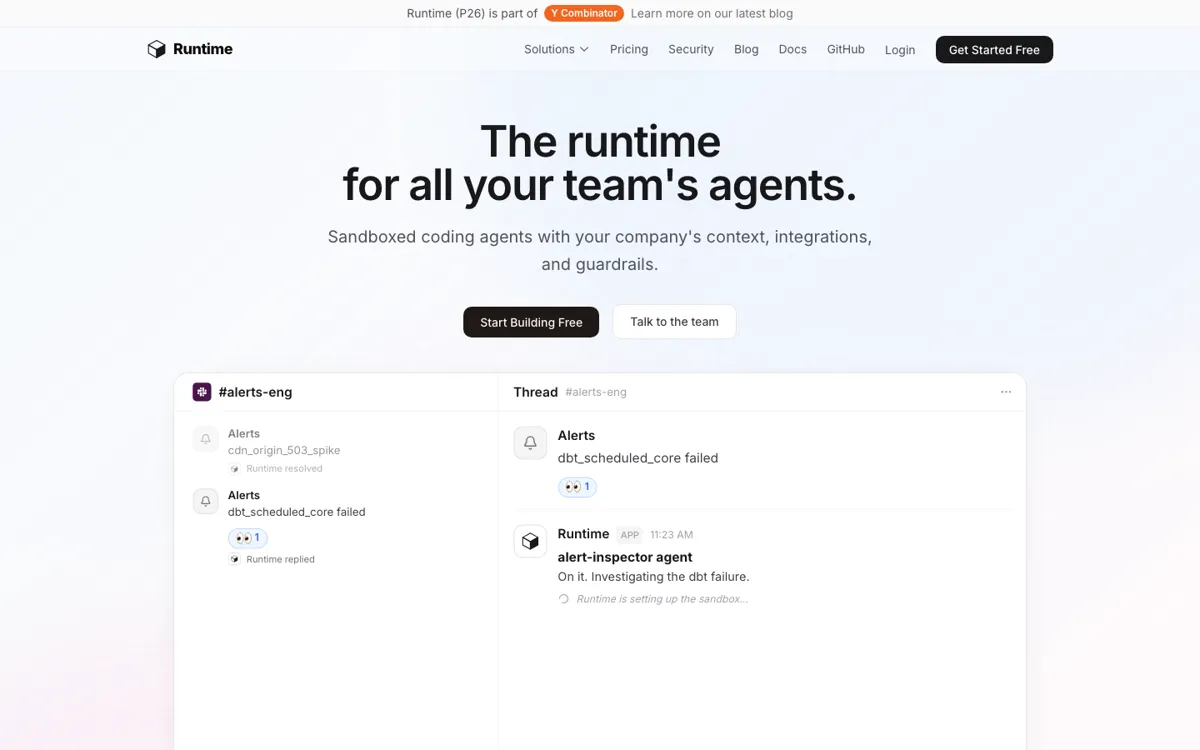
Official Website Snapshot Visit Site ↗

check_circle Pros

  • The product solves a real blocker for team adoption of coding agents, execution safety and isolation, instead of just wrapping another model in a nicer UI.
  • The public pricing is concrete, with a real free tier and clear paid steps, which makes evaluation easier than agent products that hide every serious number behind a sales call.
  • GitHub and docs signals suggest the product is being shaped as a real execution platform, not just a landing page attached to the current agent hype wave.

cancel Cons

  • This is still a technical platform, so the value is easier to feel for engineering teams than for casual individual users trying agent coding for the first time.
  • If the team is not yet suffering from local environment risk, permission boundaries, or shared execution headaches, the runtime layer can feel like extra system before it feels like leverage.
  • As with most fast-moving agent infrastructure, real trust depends on execution details and policy behavior, not just the tagline, so teams still need to pressure-test it in real workflows.

Should you use it?

Best for: Engineering teams that already want coding agents in regular workflow but need sandboxing, shared execution, and safer operational boundaries before they trust those agents with serious work.

Skip it if: Skip Runtime if your current agent usage is still occasional solo experimentation. It becomes valuable when the problem is team-safe execution, not just getting code suggestions faster.

Is it worth the price?

Freemium Starts at $29.00 USD

The free tier is enough to test whether your team actually needs sandboxed agent execution or is still just experimenting. The $29 and $99 jumps only make sense when agents are already becoming regular team infrastructure, not occasional demos. If sandboxing has not yet become a real bottleneck, paid Runtime will feel early.

The Free Tier

The official pricing page shows a Free tier at $0.

Paid Upgrade
Pro starts at $29 and Team starts at $99 on the official pricing page.

Paid tiers move the product from basic access into more serious team usage around managed sandboxed execution.

One thing to know before you start

Do not test Runtime on a toy prompt. Test it on the kind of coding task your team would normally hesitate to give an agent because of environment risk. That is where the sandbox story either proves itself or falls apart.

What people actually use it for

Run coding agents without giving them raw local-machine trust

A strong fit when a team wants agents to execute real coding tasks but does not want every run happening against one developer's uncontrolled local setup. Runtime matters when isolation is the blocker to adoption.

Share agent execution across a team

Useful when coding agents are moving from personal experiments into a workflow several engineers need to use, observe, and trust. The product is built for that team transition, not just for solo tinkering.

Operationalize coding agents with safer boundaries

Good for teams that already believe the agents are capable enough but still need policy, sandbox, and execution controls before the workflow feels production-safe.

What does Runtime actually do?

Runtime addresses one of the biggest blockers in team adoption of coding agents: trust in execution. A coding model may already be good enough to propose changes, write code, or navigate a repo, but that does not automatically make it safe to run broadly inside a company workflow. The first serious questions are usually operational. Where does the agent run? What can it touch? How do several people use it without inheriting one engineer's local machine assumptions? Runtime is built around those questions, not around generic AI coding excitement.

That is why the sandbox angle matters. The value is not only that an agent can write code. The value is that the agent can run inside a controlled execution layer that the team can reason about. Once agents move beyond isolated demos, safety and repeatability become part of the product. The public pricing and docs make the platform easier to evaluate because they show this is being sold as a real team tool, with a free entry point and clearer operational framing than products that only present a vague agent promise.

The limitation is audience maturity. Runtime is not a first-stop AI coding product for everyone. It is best when teams already want coding agents but are blocked on how to deploy them safely and share them across the organization. If the workflow is still one engineer experimenting casually, the runtime layer may feel heavy. But once the problem becomes execution boundaries, permissions, and team adoption, the product starts to look much more like core infrastructure than optional polish.

What you can do with it

Run coding agents inside isolated sandboxes instead of directly on a shared machine.
Give a whole team access to coding-agent execution through a shared runtime layer.
Separate execution control from any single engineer's local environment.
Use policy and sandbox boundaries to make agent work safer to operationalize.
Start free, then move into paid team usage as managed execution needs grow.

Technical details

platform
Web-based control surface and developer runtime platform for sandboxed coding-agent execution.
deployment
Cloud product with sandboxed execution, plus open-source repository signals and self-hosting documentation surfaced on the official docs side.
api_available
Yes. The product is positioned as a runtime/control-plane layer for coding agents, with docs and repository signals pointing to programmable integration rather than a chat-only product.

Top Alternatives to Runtime

If Runtime is close but still misses the job, try one of these instead.

Key Questions

What does Runtime actually sandbox?
It sandboxes coding-agent execution so teams can run agents with safer boundaries than a raw local-machine workflow. The point is not just code generation, it is controlled execution.
Who is Runtime really for?
It is for engineering teams trying to make coding agents usable across the team, not just for one developer testing prompts locally. The value shows up when safety and shared execution become real blockers.
Is Runtime priced for teams or just individuals?
The official pricing page suggests both entry and team expansion paths. There is a free tier, then paid tiers at $29 and $99 that make the product easier to evaluate as usage grows.