Manus Review

7.5/10

General-purpose AI agent for research, docs, decks, browser tasks, and business workflows.

Review updated May 2026 By The AI Way Editorial Tested 262+ tools across the site 5 min read
Manus AI Agents Autonomous Agents Browser Automation Knowledge Base Web-Based Workflow Builder Paid

Our Verdict

Manus is worth attention if you want to delegate real knowledge work, not just ask for ideas or copy. Its appeal is that it sits closer to an execution agent that can research, browse, and assemble outputs like docs or decks, which makes it more ambitious than a normal assistant. The risk is the usual one with general-purpose agents: once the job stretches across several steps, users will care less about the concept and more about how consistently it finishes the task without supervision.

Try it
Paid product.
open_in_new Visit Manus
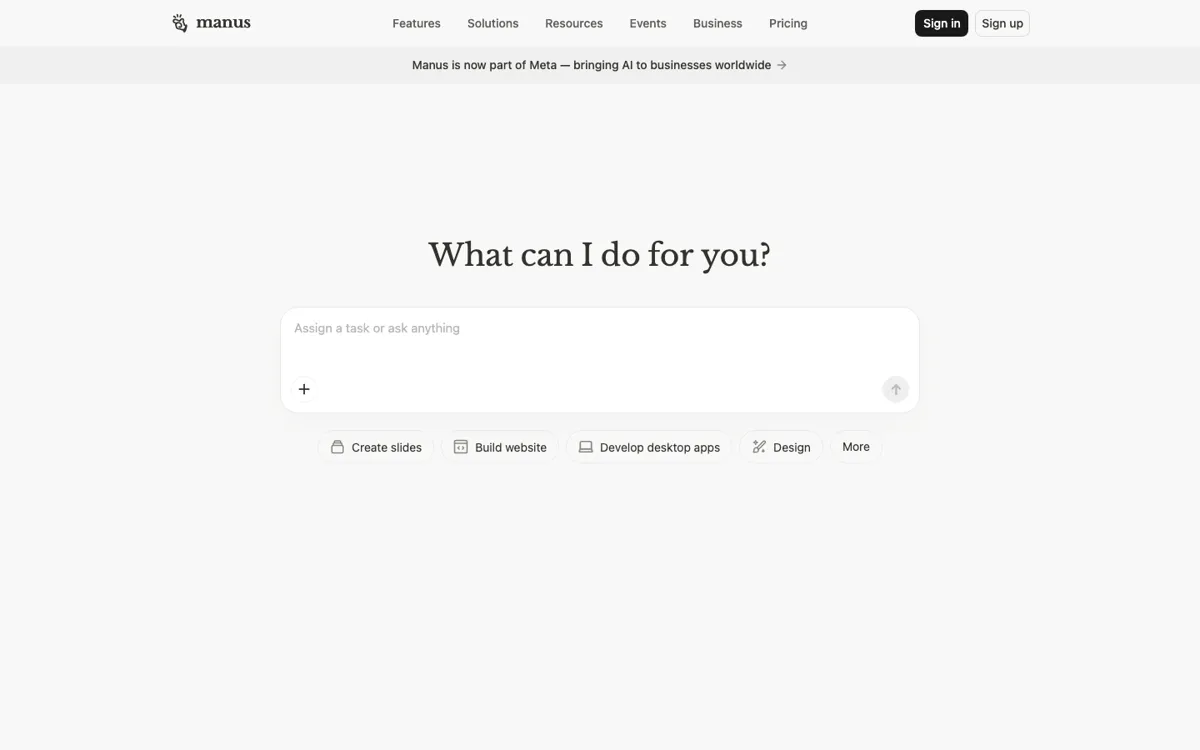
Official Website Snapshot Visit Site ↗

check_circle Pros

  • It is aimed at multi-step work, which gives it a stronger case than assistants that stop after returning a draft or answer.
  • The browser and research angle makes it easier to picture real delegated tasks, especially when the end result needs evidence gathering before writing or packaging the output.
  • It can overlap with parts of automation and agent tooling without making the user build the flow manually from scratch.

cancel Cons

  • General-purpose agent products are hardest to trust on messy tasks, because one weak step in browsing, extraction, or handoff can break the whole result.
  • It can be easy to overestimate what an agent like this should own, especially if your workflow needs deterministic automation rather than flexible task execution.
  • If pricing and usage boundaries are not extremely clear, the product gets harder to justify for routine operational work.

Should you use it?

Best for: Research-heavy tasks, document prep, deck prep, browser-assisted information gathering, and agent-style business workflows where the goal is to hand over a job, not just get text back.

Skip it if: Skip it if you need strict deterministic automation, low-level control over every workflow step, or a simpler AI tool that only drafts text without trying to act like an execution agent.

Is it worth the price?

Paid

Agent products only feel worth it when they reliably replace real work, not when they only create impressive demos. For Manus, the pricing question is tightly tied to task completion quality, because the more you depend on it for multi-step work, the less tolerant you become of vague limits or inconsistent execution.

Paid Upgrade

Access is positioned as paid, but the current official pricing capture did not yield a clean public starting tier worth hard-coding into this JSON.

One thing to know before you start

Test Manus on one bounded but messy task, like research that must end as a usable brief or deck outline. That exposes the real product faster than asking for generic brainstorming.

What people actually use it for

Research that ends in a usable brief

A user can hand over a research topic that needs browsing, comparison, and synthesis, then judge the product on whether it returns something closer to a usable brief than a raw pile of notes.

Turning findings into decks or docs

Teams exploring a topic can use Manus when they need the agent to not only gather material but also package it into a document or presentation-ready structure.

Agent-style workflow assistance without manual flow building

A business user who wants some of the outcome of automation tooling can use Manus for delegated tasks where building and maintaining a full node-based workflow would be overkill.

What does Manus actually do?

Manus sits in the part of the market where people are no longer impressed by text generation alone. The reason it gets attention is the promise of a general-purpose AI agent that can actually do work across several steps and return something finished enough to use. That matters because the requested outputs are not trivial. Research, documents, and decks all imply browsing, filtering, synthesizing, and packaging, which is a much higher bar than answering a prompt cleanly in one shot.

The product also invites comparison with tools like n8n and OpenClaw, but the overlap is only partial. Those tools become stronger when users want more explicit control, more deterministic workflow behavior, or more hands-on orchestration. Manus is more interesting when the user does not want to construct the machine and instead wants to hand over the task boundary itself. That is a meaningful difference, because the product is selling delegated execution rather than workflow construction as the main convenience.

The hard part is reliability, not concept clarity. General-purpose agent products always sound compelling on the landing page, but they only become worth paying for when they can carry messy tasks without collapsing at the browsing, reasoning, or packaging stage. That is why the practical buying question is not whether Manus looks ambitious. It is whether it finishes enough real tasks cleanly enough to replace part of a user's research or ops workload rather than just offering a more exciting form of AI demo.

What you can do with it

Run multi-step research and synthesis tasks instead of single prompt replies
Operate in the browser to gather information and complete web-based actions
Turn agent work into deliverables like docs, decks, and structured research outputs
Support workflow-style usage for business and team operations
Integrate with Slack for team-facing task flow
Handle broader agent tasks than a standard chat assistant

Technical details

platform
Agent workspace built to take a delegated task from prompt to browsed research and packaged output instead of stopping at a chat answer
deployment
Cloud execution model centered on browser operation, wide research passes, and deliverable generation, which is materially different from static prompt tools or rule-based automation builders
api_available
The official integration signal that matters here is Slack-facing workflow use, not a broad public API story, which makes the product feel more like an embedded work agent than a developer platform

Top Alternatives to Manus

If Manus is close but still misses the job, try one of these instead.

Key Questions

Is Manus closer to a chatbot or an execution agent?
It is closer to an execution agent. The important promise is not better chat, but taking on a job that spans browsing, research, and output creation.
When would someone choose Manus over n8n or OpenClaw?
Choose Manus when the goal is to hand over a bounded task and get back a finished result without designing the workflow yourself. Choose explicit automation or orchestration tools when control, repeatability, and step-level logic matter more than convenience.
What is the right way to test Manus?
Give it one real task with a clear finish line, like researching a topic and turning that into a brief, doc, or deck outline. That tests whether it can actually carry work across steps instead of only sounding impressive in a demo.