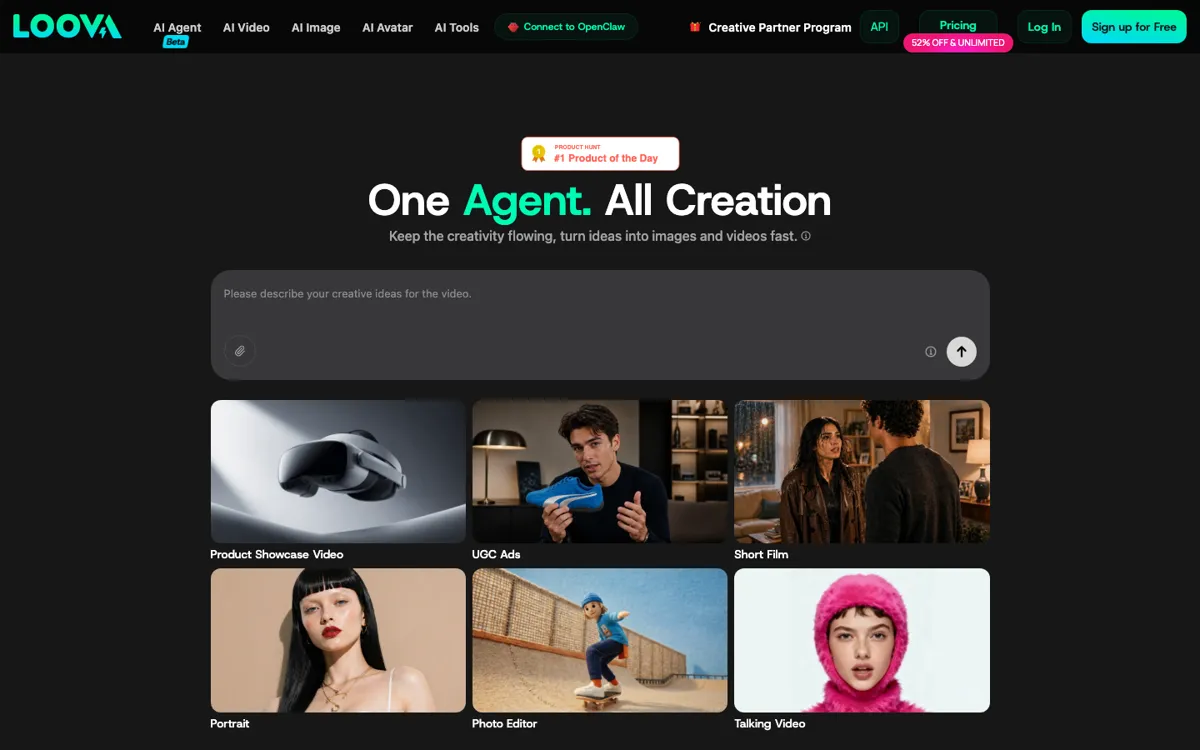
What does Loova Agents actually do?
Loova gets more interesting once you stop judging it as a single clip generator. The real pitch is reducing the tool-hopping between script, storyboard, visuals, voice, and final assembly.
Turn a rough video idea into storyboard, script, voiceover, scenes, and finished cinematic output through one agent-led flow.
Loova Agents is most compelling when the real pain is not making one AI clip, but making a whole promotional video without bouncing between ten tools and losing consistency halfway through. Its strongest promise is workflow compression: one agent chain handles the jump from idea to finished cinematic structure. That is more valuable than a plain model wrapper if it works reliably. The tradeoff is that creative automation products often look amazing on the first pass and then get expensive in revision cycles, so buyers should judge Loova by how much cleanup it removes after generation, not just by how quickly it starts.
Creators, startups, ad teams, and solo marketers who want to turn rough concepts into more complete video campaigns without manually coordinating every production step.
Skip it if: Skip it if your workflow depends on frame-level control, heavy post-production, or an established editing stack that already handles script, shot design, and revision management well. Loova is built for compression, not maximum manual control.
The paid entry is approachable if Loova replaces several separate creative tools or saves enough production time per campaign. It is less compelling if you only need occasional experiments, because the value depends on repeated end-to-end use rather than isolated clip generation.
Free access exists for testing generation workflows, with tighter usage ceilings than paid plans.
Paid plans expand generation capacity, unlock broader workflow access, and make API-based or heavier recurring production use more realistic.
Test Loova on a real campaign asset, not a novelty prompt. The key question is whether the agent chain reduces your revision burden once brand voice, scene consistency, and final polish start to matter.
A founder or marketer can use Loova Agents when they know the offer but do not want to manually write script, define scenes, create visuals, and assemble the final video in separate steps.
Small teams can use it to get from concept to ad-style video faster when they do not have a dedicated editor, storyboard artist, voice workflow, and motion setup in-house.
Teams with recurring campaign needs can use the API and workflow model to fold video generation into a broader content system rather than treating each video as a one-off experiment.
Loova gets more interesting once you stop judging it as a single clip generator. The real pitch is reducing the tool-hopping between script, storyboard, visuals, voice, and final assembly.
If Loova Agents is close but still misses the job, try one of these instead.