Local Deep Research Review

6.5/10

A local AI research assistant that searches the web, papers, and your own documents, then returns cited research output.

Review updated May 2026 By The AI Way Editorial Tested 99+ tools across the site 5 min read
LearningCircuit API Available Literature Review Open Source Privacy Focused Self-Hosted Web-Based

Our Verdict

Local Deep Research is for people who want an AI system to do the research pass, not just improvise an answer from memory. Its value is strongest when citations, local control, and access to private documents matter more than instant convenience. But it behaves more like a self-hosted research workbench than a polished consumer web app, so the setup burden is part of the product, not a small footnote.

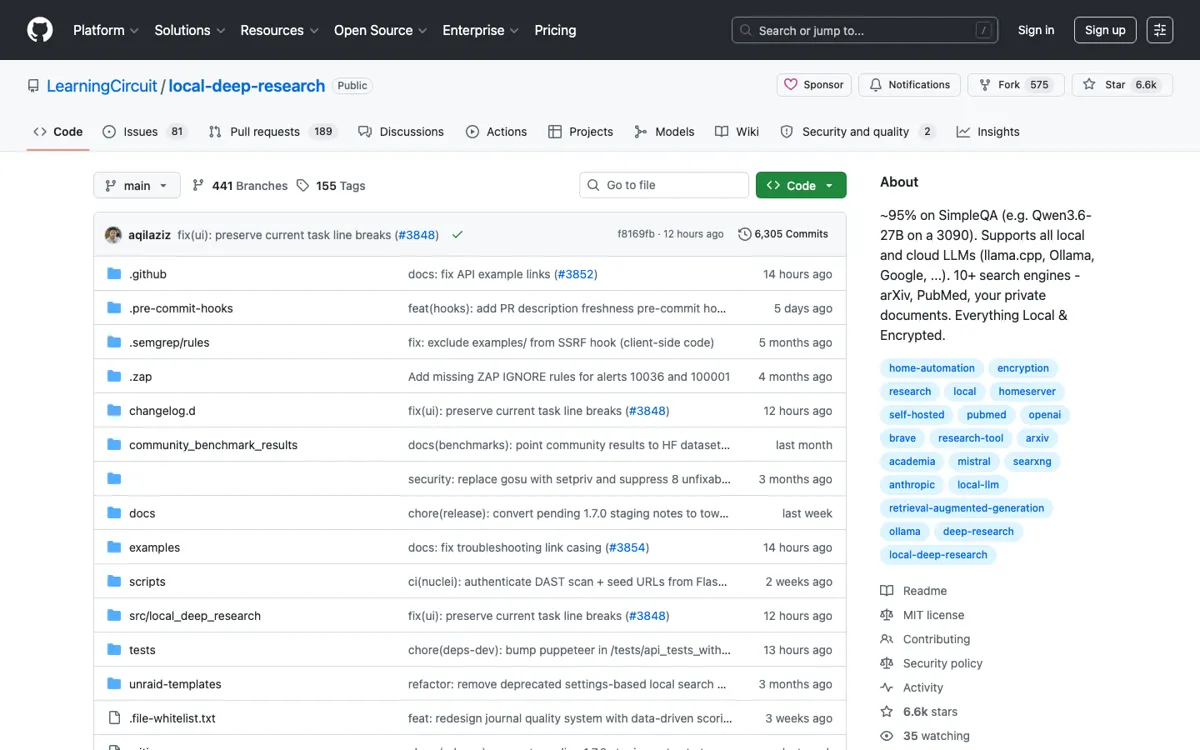
Official Website Snapshot Visit Site ↗

check_circle Pros

  • It is built to search multiple source types and return cited output, which makes it more useful for serious fact-finding than a plain chat response.
  • Running locally gives users more control over private documents and model choice than a hosted research assistant usually allows.
  • The project supports both local and cloud LLM paths, so you can tune the privacy and cost tradeoff instead of accepting one fixed provider.

cancel Cons

  • There is no clear independent product website or public pricing page, so onboarding starts from a GitHub project rather than a polished product funnel.
  • Using it properly means dealing with local setup, providers, and self-hosting decisions, which raises the barrier for non-technical users.
  • Its value depends on whether you actually need source-backed research and document retrieval, because lighter question-answering jobs may not justify the extra setup.

Should you use it?

Best for: Best for running source-backed research across web pages, papers, and private documents when privacy or local control matters. It also fits users who want a local research tool instead of depending on a hosted deep research product.

Skip it if: Skip this if you want a plug-and-play web app with clear pricing and no setup. It is also a poor fit if your questions do not need citations, document retrieval, or multi-source synthesis.

Is it worth the price?

There is no captured public pricing page, so the real cost comes from the infrastructure and model providers you choose around it. If you need something predictable for a non-technical team, the missing pricing story and self-hosted setup are part of the cost, not side details you can ignore.

One thing to know before you start

Start by testing one research question that genuinely needs citations and multiple sources. That makes it much easier to tell whether the setup overhead is buying you better output or just a more complicated chat stack.

What people actually use it for

Researching a topic across papers, web sources, and your own files

This is the core use case Local Deep Research is built around. You give it a question that would normally require bouncing between search results, academic papers, and saved notes, then let it pull those sources into one research pass with citations. The value is higher when you already have private documents or domain material you want included, because that is where a normal web chatbot usually falls short.

Running a privacy-first research workflow on your own machine

The project makes more sense when the issue is not only answer quality, but where the data lives and which model providers you trust. Because it can run locally and connect to different LLM backends, it gives you a way to keep the workflow closer to your machine and your documents. That is useful for sensitive work, but it only pays off if you are willing to own the setup and maintenance yourself.

What does Local Deep Research actually do?

Most chat-based AI tools are fine until the question gets long, messy, or citation-sensitive. That is the gap Local Deep Research is trying to fill. The repository does not sell itself like a lightweight writing assistant or a general chatbot. It is framed as an AI-powered research assistant that can search the web, scan academic sources like arXiv and PubMed, look through your private documents, and then synthesize the results into something source-backed. In plain terms, it is for the moment when one model answer is not enough and you need the system to gather evidence before it talks back.

The setup model tells you a lot about who this tool is really for. The project points users toward Docker, pip install, and a local interface on port 5000, which means the product behaves like a self-hosted research workbench rather than a polished website you sign into in 30 seconds. That tradeoff is not incidental. Running locally lets you choose local or cloud models, keep your documents closer to your own environment, and build up a searchable knowledge base from the material you collect. For users who care about privacy, control, or academic-style retrieval, that can be the whole reason to pick it.

The hard limit is that Local Deep Research still feels more like a strong open-source product than a finished mainstream product funnel. There is no clear independent official website in the sources I checked, no simple pricing story, and no sign that a non-technical user is the default customer. If you already know why you need local research, citations, and document-backed synthesis, that may be acceptable. If you just want easy answers with no setup and no infrastructure choices, this tool asks for more commitment than the average person will want to give.

What you can do with it

Search across the web, academic databases, and your own private documents in one research flow.
Generate research output with citations instead of a plain ungrounded answer.
Run locally for privacy-sensitive work instead of sending everything through a hosted web product.
Connect both local and cloud LLM providers, including Ollama and other OpenAI-compatible endpoints.
Build a searchable personal knowledge base from documents gathered during research.
Use a local web interface after setup instead of staying inside raw scripts.

Technical details

llm_model
Local and cloud LLMs including Ollama, llama.cpp, Google and others
deployment
Self-hosted local web app via Docker or pip install
open_source
Yes
api_available
HTTP API examples documented in repository

Top Alternatives to Local Deep Research

If Local Deep Research is close but still misses the job, try one of these instead.

Key Questions

Is Local Deep Research a hosted web app?
Not from the sources I verified. The documented path is to run it locally through Docker or install it yourself, then open a local web interface, so it behaves more like a self-hosted product than a standard SaaS app.
What kind of research is this tool meant to handle?
It is meant for questions that need evidence gathering across multiple sources. The project explicitly points to web search, academic sources, and private documents, then combines them into cited research output.
Do you need to bring your own model provider?
Usually yes. The repository says it supports both local and cloud LLMs, including Ollama and other provider paths, so part of the setup is deciding which model backend you want to use.
Who should avoid Local Deep Research?
People who want a simple hosted assistant with no setup should probably avoid it. The value only really lands when local control, source-backed output, or private document research matter enough to justify the extra work.