LobeHub Review

8.7/10

Chief Agent Operator for running multi-agent work from one place

Review updated May 2026 By The AI Way Editorial Tested 204+ tools across the site 4 min read
LobeHub AI Agents Autonomous Agents Mac App Open Source Self-Hosted Workflow Builder Freemium from $12.90/mo

Our Verdict

LobeHub makes sense when plain AI chat has turned into coordination debt. If you are already bouncing between models, tools, and agent prompts, its real value is that it turns those fragments into one operator layer with scheduling, projects, memory, and marketplace add-ons. The tradeoff is complexity: this is much heavier than opening Claude or ChatGPT for a single fast answer.

Try it
Free to start, then pay when the limits stop you. Starts at $12.90 USD.
open_in_new Try LobeHub
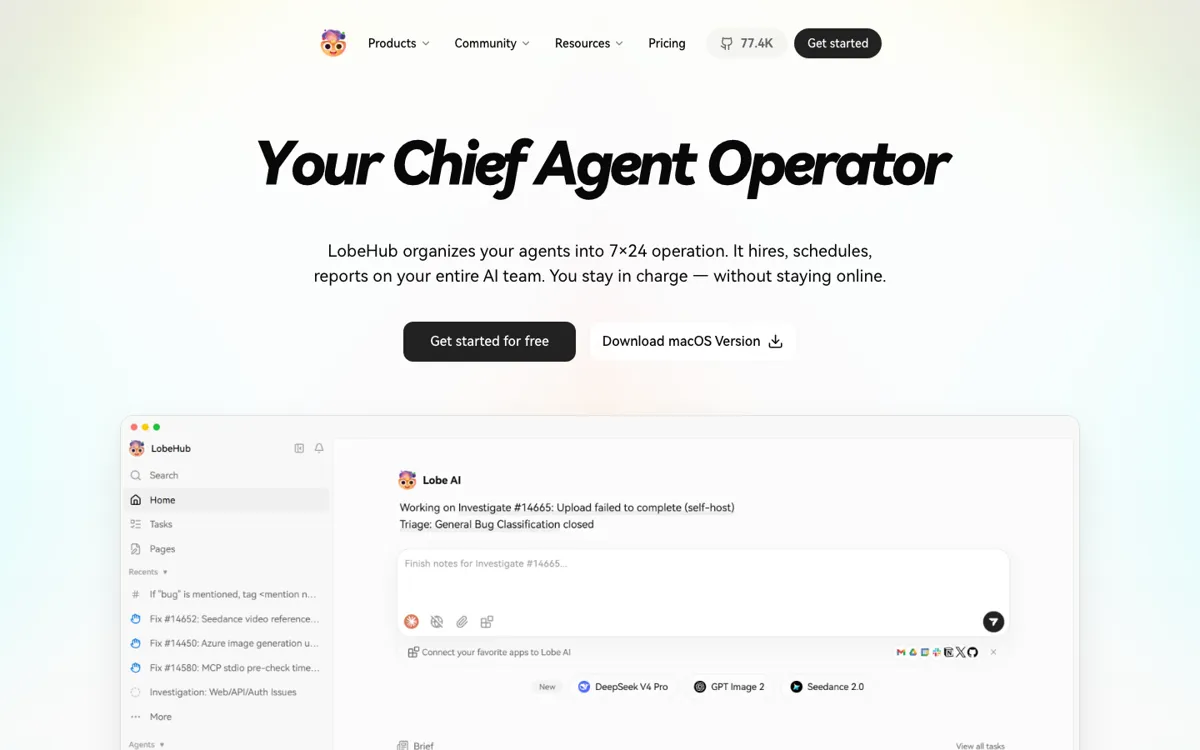
Official Website Snapshot Visit Site ↗

check_circle Pros

  • It tackles a real workflow mess, namely the manual handoff between separate agents, models, and windows once your setup gets beyond one prompt at a time.
  • The product shape is broader than a chat frontend, with projects, workspaces, memory, scheduled runs, and large skills plus MCP marketplaces already baked in.
  • You can start in the hosted version without setup, then move to the open-source self-hosted edition if you want more control over deployment and provider choice.

cancel Cons

  • The learning curve is higher than ordinary chat apps because you still need to think about agent structure, routing, credits, and when parallel work is actually worth it.
  • Its pricing is easy to read at the plan level, but real consumption still depends on model credit burn, which makes heavy usage harder to budget than a flat seat tool.
  • If you only need one strong assistant for ad hoc questions, much of the workspace, marketplace, and scheduling layer will feel like extra surface area rather than leverage.

Should you use it?

Best for: Running recurring AI jobs that already need more than one agent, more than one model, or more than one tool, especially when the real pain is handoffs between steps rather than generation itself.

Skip it if: Skip it if your main job is still single-threaded prompting, because a direct model app will get you to the answer faster with less setup and less operational overhead.

Is it worth the price?

Freemium Starts at $12.90 USD

The free entry is strong because you get monthly cloud credits and a self-hosted community path, but the moment LobeHub becomes a serious operator layer for daily work, you need to watch credit burn, not just headline subscription price.

The Free Tier

Free cloud plan includes 500,000 calculating credits refreshed monthly, and the community edition can be self-hosted for free.

Paid Upgrade
$12.9/month

Paid plans increase available calculating credits through Starter, Premium, and Ultimate tiers for heavier cloud usage.

One thing to know before you start

Treat LobeHub as an operator for recurring AI work, not as your first stop for every prompt. It gets more valuable once you define repeatable jobs, shared context, and clear handoff points between agents.

What people actually use it for

Running recurring multi-agent work without babysitting every step

LobeHub fits teams that already know a task should be split across specialist agents, but are tired of manually kicking each step forward. A research agent can gather sources, another can summarize, another can draft, and the system can bring back the parts that still need human judgment. That is more useful than a single chatbot when the real bottleneck is orchestration, not raw generation.

Keeping project context alive across scheduled runs and shared workspaces

It is a better fit when the same work comes back every week and context loss keeps wasting time. Instead of rebuilding the setup from scratch in a fresh chat, you can keep the job inside projects and workspaces, attach the same skills and servers again, and let scheduled runs surface only the decisions that need review. That matters more for ongoing operations than for one-off prompting.

What does LobeHub actually do?

Most agent products still behave like isolated prompt windows. You get a response, then you become the scheduler, the memory layer, and the handoff mechanism between one model and the next. LobeHub is trying to remove that manual coordination role. Its strongest angle is not just that it supports many models, but that it treats agents as work units inside projects, schedules, and shared workspaces. If you already feel the drag of fragmented AI workflows, that framing is immediately practical.

The ecosystem depth is a real advantage here. A large skills marketplace, tens of thousands of MCP servers, self-hosting, and broad device coverage make LobeHub feel more like an agent operating layer than a narrow assistant app. That matters because multi-agent products often fall apart once you try to connect them to real tools or share them with a team. LobeHub has enough surrounding structure to make those workflows more believable, especially for users who want cloud convenience first and self-hosting later.

The catch is that LobeHub asks you to think in systems. If you are not yet running repeatable workflows, the workspace, scheduling, and marketplace pieces can feel like overhead. Even the free and paid plans still lead back to credit management, so the product is easiest to justify when it is replacing daily coordination friction, not when it is just answering occasional questions. In short, it is compelling when you already need an operator layer, and overbuilt when you do not.

What you can do with it

Build and run multi-agent teams around one goal instead of juggling separate chats
Route work across models, skills, and MCP servers from one workspace
Schedule tasks, organize work by project, and keep shared context inside team workspaces
Use personal memory and continual learning so agents keep more context over time
Run it in the cloud or self-host the community edition, with desktop and mobile apps available

Technical details

platform
Web app plus desktop apps for macOS, Windows, and Linux, with iOS and Android apps also available
deployment
Hosted cloud product with monthly free credits, plus a self-hosted community edition deployable through Vercel, Docker, Zeabur, Sealos, or Alibaba Cloud
api_available
Connects external model providers and MCP servers, but the product itself is positioned as an agent workspace rather than an API-first service

Top Alternatives to LobeHub

If LobeHub is close but still misses the job, try one of these instead.

Key Questions

Is LobeHub just another ChatGPT-style interface?
No. Its main pitch is coordinating agent teams, schedules, shared workspaces, and tool ecosystems around a goal. If you only need one fast answer from one model, a standard chat app is the simpler choice.
Can you use LobeHub for free?
Yes. There is a free cloud path with monthly calculating credits, and the community edition can also be self-hosted. The real question is whether that free usage is enough once you start running heavier multi-agent jobs.
Who gets the most value from LobeHub?
People who already have recurring AI workflows with multiple steps, tools, or agent roles. If your work is still mostly single-prompt writing or Q and A, you will probably get more value from a simpler assistant.