Jenni Review

8.4/10

AI research workspace for reading, writing, and citing with traceable sources.

Review updated May 2026 By The AI Way Editorial Tested 262+ tools across the site 4 min read
Jenni Academic Citation Chrome Extension Grammar Checker Literature Review Multi-language PDF Analyzer Web-Based Writing Assistant Freemium from $12.00/mo

Our Verdict

Jenni makes the most sense when your writing bottleneck is not raw drafting speed but keeping citations, source notes, and claim checking in the same place. It is much more useful than a generic AI writer for literature-heavy work, but the free plan is narrow enough that regular paper writing quickly pushes you toward a paid tier.

Try it
Free to start, then pay when the limits stop you. Starts at $12.00 USD.
open_in_new Try Jenni

check_circle Pros

  • The source-linked workflow is the main differentiator, because you can move from paper library to draft to citation checking without rebuilding context in another tool.
  • Reviews adds a real pre-submission use case by flagging unsupported or overstated claims instead of only rewording sentences.
  • The web clipper removes a lot of desk-research friction if you routinely save papers from Scholar, PubMed, or publisher sites into one library.

cancel Cons

  • Free usage is restrictive, with daily or monthly caps on autocomplete, chat, edits, PDF uploads, and reviews, so it is easy to outgrow during a serious writing sprint.
  • If you mainly want a blank-page writer for blogs or marketing copy, much of Jenni's research workflow will feel heavier than necessary.
  • The public GitHub footprint does not add much confidence for technical buyers looking for a clear developer platform or deeper public documentation trail.

Should you use it?

Best for: Students, grad researchers, and academics who need to draft literature reviews, essays, or thesis sections while keeping citations and evidence checks attached to the writing process.

Skip it if: Skip it if your main job is general content writing or lightweight rewriting, because the value is tied to paper libraries, citation workflows, and academic review passes rather than fast generic copy output.

Is it worth the price?

Freemium Starts at $12.00 USD

The entry price is reasonable for someone writing papers every month, but the free tier feels more like a proof-of-workflow plan than a durable everyday option. If Reviews and unlimited library work are the reason you want Jenni, you should assume paid usage early.

The Free Tier

Free includes 10 AI autocompletes per day, 10 PDF uploads, 3 AI edits, 5 AI chat messages, and 3 reviews.

Paid Upgrade
$12/month

Plus unlocks 5,000 monthly autocompletes, unlimited PDF uploads, 500 edits and chat messages, 10 reviews, full export, and live chat support.

One thing to know before you start

Use the free tier to test one full paper workflow end to end, including source import, review scan, and export. If that loop already exceeds the caps, you have your answer on whether Plus is the real starting plan.

What people actually use it for

Drafting a literature review with source-backed claims

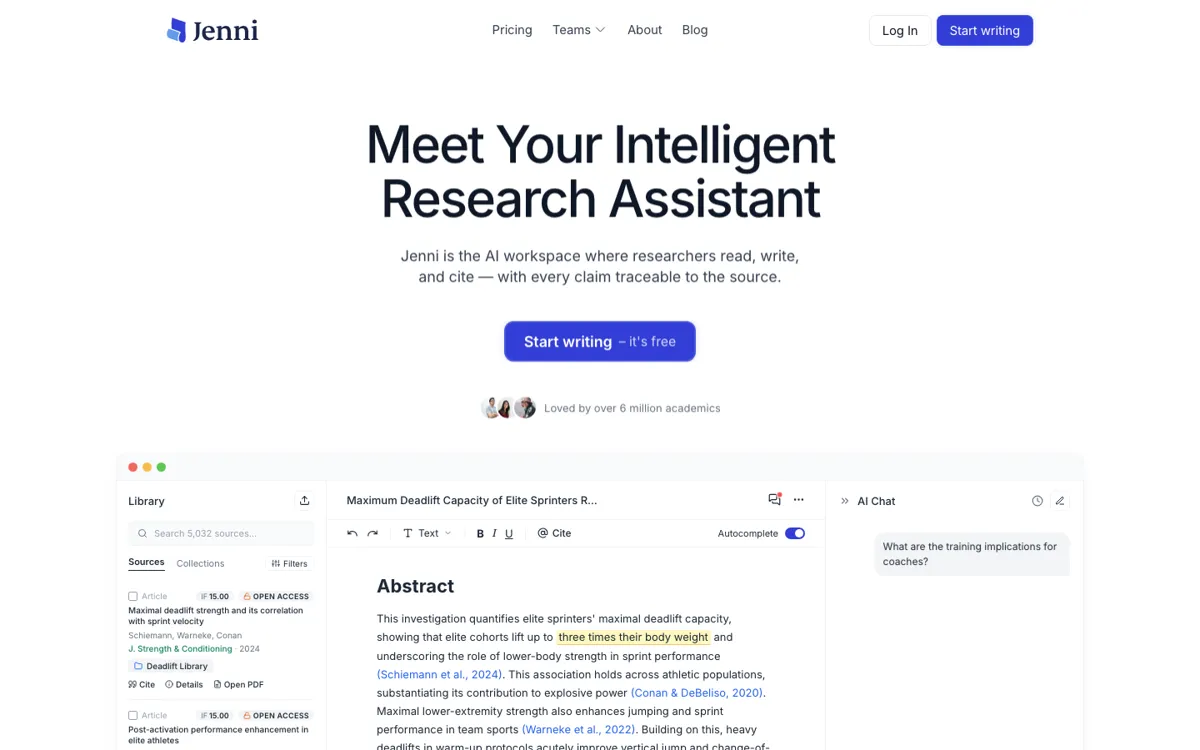
Jenni fits best when you are synthesizing several papers into a literature review and need the AI to stay anchored to uploaded sources. Instead of pulling text from a generic chatbot and manually backfilling references later, you can search your library, cite inline, and tighten the draft in one place. That matters most when the painful part is defending every paragraph, not just generating more words.

Pre-submission claim checking for a paper draft

The Reviews workflow is useful before supervisor feedback or journal submission, especially if you worry about unsupported claims, weak citations, or overstatements that make a draft look sloppy. It is not a substitute for subject-matter judgment, but it gives you a fast pass over risky statements that would otherwise require a slow manual reread against the literature.

Building a research library from web sources without tab chaos

If your normal process involves bouncing across Google Scholar, PubMed, Nature, and publisher pages, Jenni's web clipper can save time by pushing sources straight into your working library. The value is less about clipping for its own sake and more about reducing the friction between finding a paper, storing it, and using it inside an active draft with citations and AI assistance already available.

What does Jenni actually do?

Jenni is not trying to win as a general AI writer. Its strongest angle is that it treats academic writing as a chain of connected jobs: gathering papers, searching a source library, drafting paragraphs, inserting citations, and checking whether claims still hold up. That workflow matters because research writing usually breaks when those jobs live in separate tools. You can generate text anywhere, but once you have to prove where a statement came from, generic copilots become much less helpful. Jenni is more valuable when the hard part is keeping the reasoning attached to evidence while the document is still in motion.

The most useful part of the product is the layer beyond autocomplete. Reviews, claim confidence checks, and source-linked citation suggestions push it closer to a paper QA tool than a simple drafting assistant. That gives it a clearer role for theses, submissions, and long-form academic work where weak citations or overstated claims can create real risk. The tradeoff is that people who just want fast writing help may feel they are paying for a more structured environment than they need. Jenni earns its place when evidence handling is part of the task, not an afterthought.

Pricing makes the product easy to test but not easy to stay on for heavy use without upgrading. The free tier is generous enough to understand the interface and run a small workflow, yet the caps on autocomplete, edits, chat, uploads, and reviews arrive quickly if you are actively writing papers. That means Jenni works best for users who already know they write enough academic material to benefit from one dedicated workspace. If you only occasionally need help rewriting a paragraph or generating an outline, a broader writing tool may be the cheaper and simpler call.

What you can do with it

AI autocomplete and in-editor drafting for academic documents
Library search across uploaded papers with source-linked answers
Claim review that flags unsupported, contradicted, or weakly supported statements
Academic proofreading with inline fixes for tone, grammar, and transitions
Web clipper for saving sources from Scholar, PubMed, Nature, and similar sites

Technical details

platform
Web app with Chrome, Firefox, Edge, and Chromium web clipper support
deployment
Cloud-hosted academic writing workspace with uploaded PDF library, citation export, and browser capture flow
api_available
No public API surfaced on the official site pages reviewed

Top Alternatives to Jenni

If Jenni is close but still misses the job, try one of these instead.

Key Questions

Is Jenni better than a general AI writer for research papers?
Yes, if your problem is keeping writing tied to papers and citations instead of just producing text. The advantage shows up when you need source search, inline citations, and claim review in the same workflow, not when you only want rough drafting help.
Can you stay on Jenni's free plan for real academic work?
Only for light or trial use. The free plan is enough to test whether the workflow fits, but regular paper writing will run into caps on autocomplete, uploads, edits, chat, and reviews pretty quickly.
What makes Jenni different from a grammar checker?
A grammar checker mainly cleans language after the fact. Jenni is trying to cover the earlier research-writing loop too, including source collection, citation support, draft generation, and claim validation before the final polish stage.