Higgsfield Marketing Studio Review

7.9/10

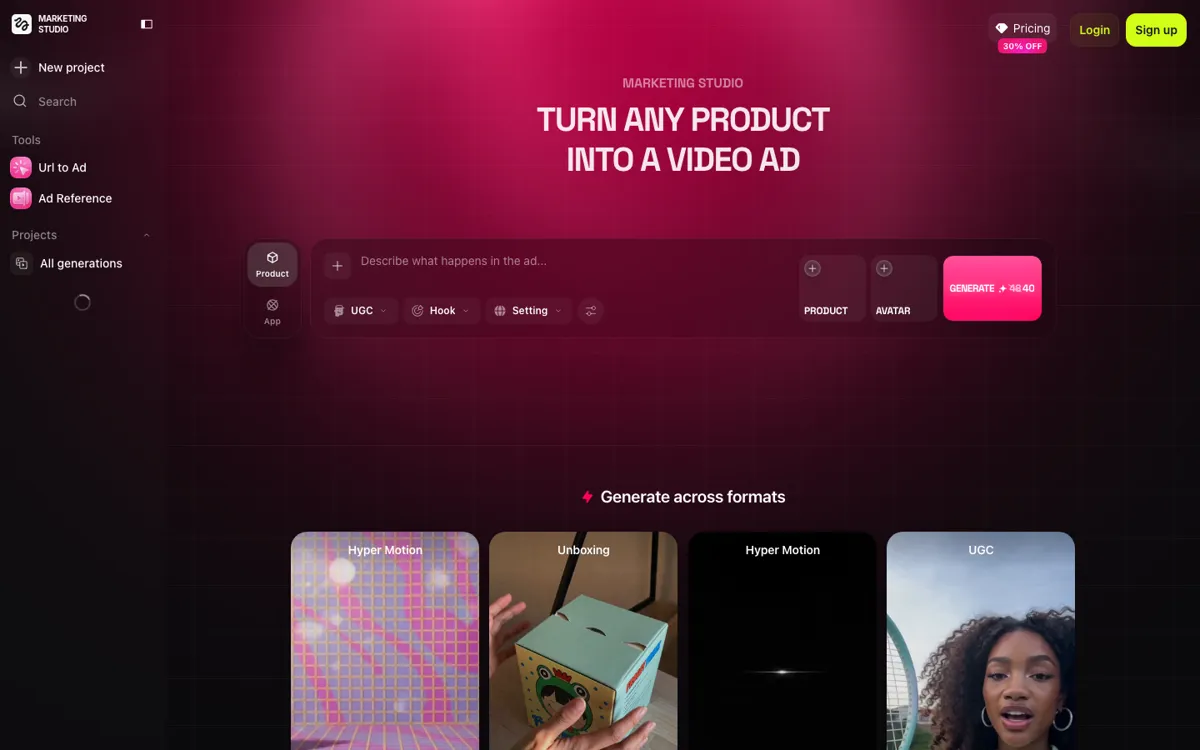
An AI ad generator for turning product assets into short-form marketing videos, hooks, and visual variants.

Review updated May 2026 By The AI Way Editorial Tested 181+ tools across the site 5 min read
Higgsfield Content Repurposing Production Workflows Text-to-Video Video Editing

Our Verdict

Higgsfield Marketing Studio is worth opening when the real job is not making a beautiful AI clip, but shipping more product ads without rebuilding every concept by hand. Its strongest move is that it narrows Higgsfield's broader visual AI stack into a commercial outcome marketers actually care about: ad creative. The tradeoff is that if you are not making product marketing content, much of the product's sharpness disappears.

Official Website Snapshot Visit Site ↗

check_circle Pros

  • The product has a much clearer commercial job than a generic AI video tool, because it is explicitly framed around ad generation instead of vague creativity.
  • It benefits from the broader Higgsfield ecosystem, so it can pull in apps, canvas-style creation, and cinema-oriented polish without losing the ad-production center.
  • The output story is easy to understand for marketing teams: more variants, more hooks, more campaign-ready visual experiments.

cancel Cons

  • The fetched official pages did not expose a clean pricing surface, so it is still hard to judge whether the workflow is cheap enough for broad everyday team use.
  • This product is much easier to justify for ad and growth teams than for general creators, which narrows the real user base even if the demos spread widely.
  • Because it sits inside a larger Higgsfield stack, some users may struggle to tell where Marketing Studio ends and the surrounding creative tooling begins.

Should you use it?

Best for: Best for product marketing, paid social, growth, and creative teams that need more ad variants, more hooks, and faster visual testing from existing product assets.

Skip it if: Skip this if you mainly want open-ended filmmaking, broad creative experimentation, or a general AI video toy. Marketing Studio pays off when the output has to become an ad, not just a cool clip.

Is it worth the price?

Right now the biggest missing piece is not the use case, but the pricing clarity. The workflow looks commercially useful, but until official pricing is captured, teams still cannot cleanly judge whether the speed gain beats the production cost.

One thing to know before you start

Judge this tool on whether it shortens your ad iteration loop, not on whether it can generate one impressive clip. One flashy result does not matter if the workflow still slows down campaign testing.

What people actually use it for

Turn product assets into paid-social creative faster

Marketing Studio makes sense when your bottleneck is not editing software skill, but the sheer volume of ad creative a campaign needs. If the team already has product shots, reference material, and campaign ideas, this product is built to convert that raw input into ad-ready variants faster than a manual concept-to-edit loop. That matters most when campaign velocity matters more than handcrafted perfection.

Test more hooks and visual directions without restarting from zero

A lot of ad production time gets burned on finding the right first seconds, angle, or motion treatment. Marketing Studio is useful when the goal is not one final masterpiece, but many plausible creative branches that can be tested, cut down, or swapped into a campaign. The product's value is tied to iteration volume. If you only need one polished hero video, the advantage is smaller.

Use one commercial layer on top of a broader visual AI stack

Because Higgsfield also exposes apps, canvas, and cinema-style creative surfaces, Marketing Studio works best as the commercial center of a larger creative workflow. That gives teams a clearer place to turn product context into ad output without pretending every adjacent tool is itself the main product. The gain is that ad production stays the governing job instead of getting lost inside a general visual playground.

What does Higgsfield Marketing Studio actually do?

Most AI video tools still sell possibility. They show a beautiful clip, a dramatic effect, or a cinematic transition and let you imagine how that might help the business later. Marketing Studio is more direct than that. The page is framed around ad generation, which is exactly why it matters. Product marketing teams do not need more abstract possibility. They need more usable variants, more hooks, and more creative throughput. That makes this product easier to evaluate than a lot of visually impressive AI tools, because the question is blunt: does it help turn product input into ad output faster than the current workflow?

What makes the entry more interesting is that it sits inside a broader Higgsfield stack without dissolving into it. The main Higgsfield brand talks about AI video infrastructure and spans image, video, audio, marketing studio, cinema studio, canvas, apps, and supercomputer. If that whole stack were flattened into one product record, it would become vague fast. Marketing Studio avoids that problem because it gives the ecosystem a commercial center. Apps, canvas, and cinema-oriented layers all make sense as supporting capability surfaces here, but the user-facing promise still resolves to one thing: make better ads faster.

The risk is that clear use case does not automatically mean broad adoption. This is still a specialist product. It is strongest for ad teams, growth teams, and creators whose output is directly tied to product marketing. It is weaker for general creators, educators, or teams whose video work is not campaign-shaped. There is also a practical unknown that matters a lot more than the demo quality: the pricing. The fetched pages did not expose a clean public pricing surface, so until that is verified, the product has a strong positioning story but not yet a fully proven buyability story.

What you can do with it

Turn product inputs into short-form ad creatives instead of starting from a blank timeline.
Generate multiple visual directions and campaign variants for product marketing workflows.
Recreate viral ad patterns around your own product instead of reverse-engineering them manually.
Push visual ideas toward UGC-style hooks, motion treatments, and performance-ready creative output.
Sit inside a broader AI video stack that is built around commercial content generation rather than generic chat.

Technical details

workflow_scope
Sits inside a broader Higgsfield visual AI stack that also includes apps, canvas, and cinema-oriented creative surfaces, while keeping ad creation as the governing job.
stack_orientation
Part of an AI video infrastructure brand whose homepage centers image, video, audio, marketing studio, cinema studio, canvas, apps, and supercomputer workflows.
ad_generation_focus
Positioned specifically as a product ad generator rather than a general-purpose video assistant.
creative_input_mode
Built around taking product assets or product context and turning them into ad-ready creative variations.

Top Alternatives to Higgsfield Marketing Studio

If Higgsfield Marketing Studio is close but still misses the job, try one of these instead.

Key Questions

Is Higgsfield Marketing Studio a general AI video editor?
Not really. The page positioning is much narrower than that. It is built around product ad generation, which is why it feels more commercially specific than a general AI video tool.
Why not just treat Higgsfield as one giant product instead of separating Marketing Studio?
Because Marketing Studio has a clear job on its own. The broader Higgsfield stack covers many visual AI surfaces, but this page resolves to one buyer outcome: make product ads faster. That is enough to stand alone.
Does this product replace the rest of the Higgsfield stack?
No. It sits inside that stack. Apps, canvas, and cinema-oriented layers support the workflow, but Marketing Studio is the commercial production surface this entry is actually about.
What is still missing before this is easy to buy?
Clear pricing. The use case is easy to understand, but the fetched pages did not surface enough pricing detail to judge cost against production savings yet.