ElevenLabs Review

8.5/10

Generate voices, dubbing, speech tools, and voice agents from one AI audio platform.

Review updated May 2026 By The AI Way Editorial Tested 99+ tools across the site 5 min read
ElevenLabs API Available Multi-language Transcription Video Translation Voice Cloning Web-Based Freemium from $6.00/mo

Our Verdict

ElevenLabs is the kind of tool people open when plain text to speech is too small for the job and they need voices, dubbing, transcription, or an agent stack in one place. Its real edge is that the same product can handle creator work and developer integration without forcing a separate audio vendor for each step. But it is not the cheapest way to just make a few voice clips, and the credit ladder starts to matter fast once you move from testing into regular production.

Try it
Free to start, then pay when the limits stop you. Starts at $6.00 USD.
open_in_new Try ElevenLabs
Official Website Snapshot Visit Site ↗

check_circle Pros

  • Covers voice generation, dubbing, transcription, music, and agents in one product instead of splitting those jobs across separate tools.
  • Gives developers a clear API path with official SDKs, model choices, and docs instead of hiding the serious features behind marketing pages.
  • The free tier is usable enough to test core workflows before committing to a paid plan.

cancel Cons

  • The platform is broad, so buyers who only need one narrow job can end up paying for a bigger stack than they actually use.
  • Credits are the main usage unit, which means ongoing cost is harder to eyeball than a simple unlimited subscription.
  • Some advanced features like commercial use, instant voice cloning, or larger project limits start behind paid plans.

Should you use it?

Best for: Best for turning scripts, recordings, or finished videos into production-ready audio in multiple languages, especially when you also need API access or voice automation later.

Skip it if: Skip this if you only need a cheap one-off narrator or you already know you want a single-purpose dubbing tool with simpler pricing. Also skip it if credit tracking is a dealbreaker for your team.

Is it worth the price?

Freemium Starts at $6.00 USD

The free plan is enough to hear the voice quality and test a few real flows. Once you need commercial rights, heavier monthly generation, or production-grade cloning and collaboration, the paid ladder stops being optional.

The Free Tier

Free plan includes 10k credits per month and 3 Studio projects.

Paid Upgrade
$6/month

Starter adds commercial license, instant voice cloning, more Studio projects, and 30k credits per month.

One thing to know before you start

Run one end-to-end test with your real script, target language, and export format. A single voice sample can sound great while hiding how quickly credits, project caps, or paid-only features become the real decision point.

What people actually use it for

Dub a finished video into more languages

If you already have a completed video and need more than subtitles, ElevenLabs is built for the heavier step after editing. You can bring the finished asset into the dubbing side of the platform, generate localized speech, and keep the work in the same product that handles voices and transcription. That is more useful than a plain TTS tool when the job is not writing the script but shipping language variants people can actually watch. The catch is that this starts to matter only when you have repeat localization work, not one throwaway upload.

Build text-to-speech or transcription into a product

For a team that needs audio features inside an existing app, the docs make the developer route concrete. ElevenLabs exposes REST APIs, official Python and TypeScript SDKs, and model choices that trade off latency against expressiveness. That means a product team can wire speech generation, transcription, or voice cloning into a real workflow instead of bouncing between no-code tools. It is a better fit when you already know where the audio step lives in your product, because the API strength matters less if you just want occasional manual exports.

Produce voice-heavy content without stitching tools together

If your workflow jumps between narration, podcasts, voiceovers, cloned voices, and cleanup tasks, ElevenLabs is appealing because the site positions those jobs inside one audio stack. You can start from text, a recording, or a voice concept and move toward speech, sound effects, or music without switching vendors every time the format changes. That saves more coordination time than a basic voice generator when content production is recurring. It is less compelling if you already have a settled stack for editing and only need a narrow voice layer.

What does ElevenLabs actually do?

A lot of audio AI tools look impressive in a five second demo but fall apart once the job gets bigger than one voice clip. The real work usually starts after that first sample: a creator needs to narrate an audiobook chapter, a media team has to turn one finished video into several language versions, or a product team wants speech generation and transcription inside its own app. At that point, hopping between a voice generator, a dubbing tool, a transcription service, and an API vendor becomes the slow part. ElevenLabs is clearly trying to solve that bigger workflow problem, not just the front-end demo, by grouping creator tools, agents, and APIs under one platform with shared credits and models.

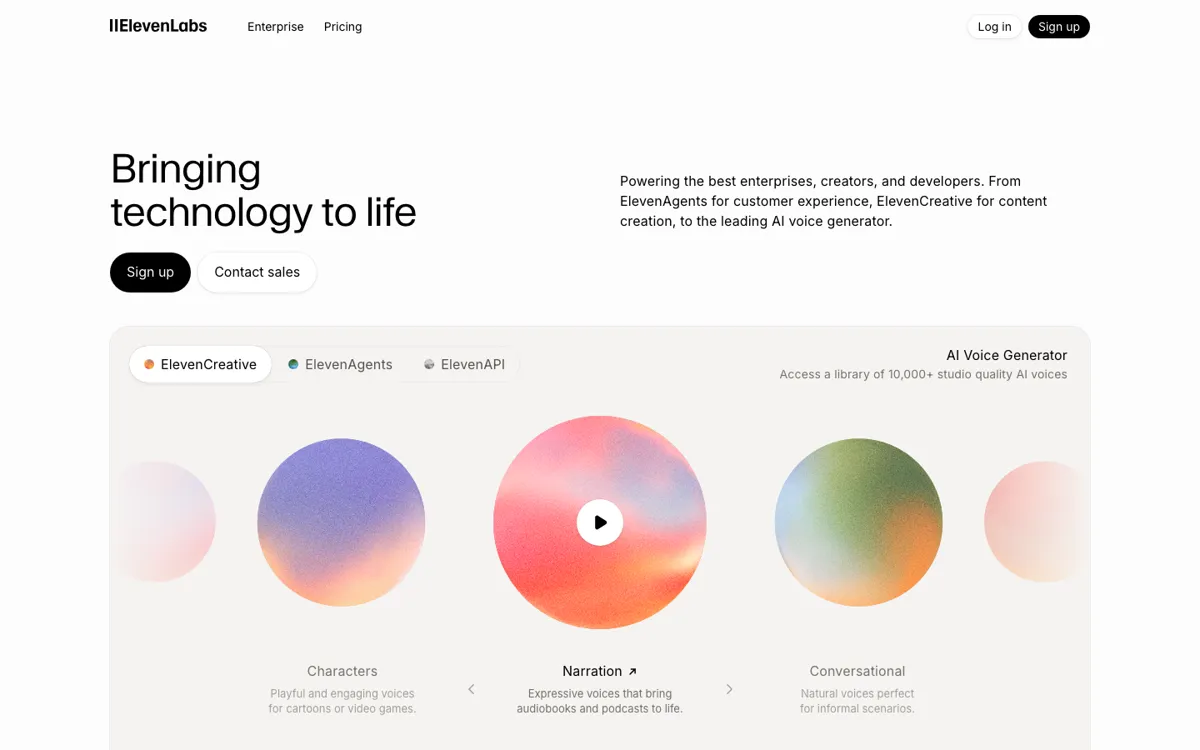
The strongest part of ElevenLabs is not one isolated feature but how the official site connects them. The homepage pushes studio-quality voices, voice cloning, speech to text, sound effects, music, image and video generation, and conversational agents, while the docs explain exactly how developers reach the same stack through REST APIs and official SDKs. The pricing page then turns that breadth into a practical ladder, from a free tier with 10k monthly credits to paid plans that unlock commercial rights, instant voice cloning, larger project limits, and team seats. That combination makes the product easier to defend for recurring production work because you are not buying one narrow audio widget that needs two more vendors beside it.

The limitation is that platform breadth does not automatically mean simple buying. Credits reset monthly, some capabilities that matter in real production appear higher up the ladder, and the product can feel oversized if all you wanted was an occasional narrator voice. The biggest risk is not poor output quality, because the public reputation and official positioning both lean heavily on natural sounding voices, but overbuying the stack before you know which lane you actually need. If your main requirement is cost certainty, narrow-purpose dubbing, or minimal feature sprawl, ElevenLabs can be more tool than you need even when the output itself is strong.

What you can do with it

Turn text into controllable speech with model options for expressive delivery or low latency.
Dub audio and video into other languages from the same platform.
Transcribe speech with speaker diarization, timestamps, and language detection.
Clone a voice from recordings or generate a new one from a text description.
Build voice or chat agents that can listen, respond, and take actions across channels.
Use the same stack through a web app, REST API, and official SDKs.

Technical details

platform
Web app with REST API, plus official Python and TypeScript SDKs
deployment
Cloud
api_available
Yes

Top Alternatives to ElevenLabs

If ElevenLabs is close but still misses the job, try one of these instead.

Key Questions

Is the free plan enough to test ElevenLabs properly?
Yes for evaluation, because the free tier includes 10k monthly credits and access to core product areas. No for serious rollout, because commercial rights, bigger project limits, and stronger production features begin on paid plans.
Does ElevenLabs only do text to speech?
No. The platform also covers speech to text, voice cloning, dubbing, sound effects, music, and conversational agents, so it is positioned as a broader audio stack rather than a single TTS widget.
Can developers integrate ElevenLabs without using the web app?
Yes. The docs state that the capabilities are available through a REST API with official Python and TypeScript SDKs, so teams can build audio features directly into their own products.
What makes the paid plans different from the free tier?
The paid ladder mainly adds more credits and unlocks production features. On the entry paid plan, the most immediate changes are commercial licensing, instant voice cloning, more Studio projects, and a higher monthly credit allowance.