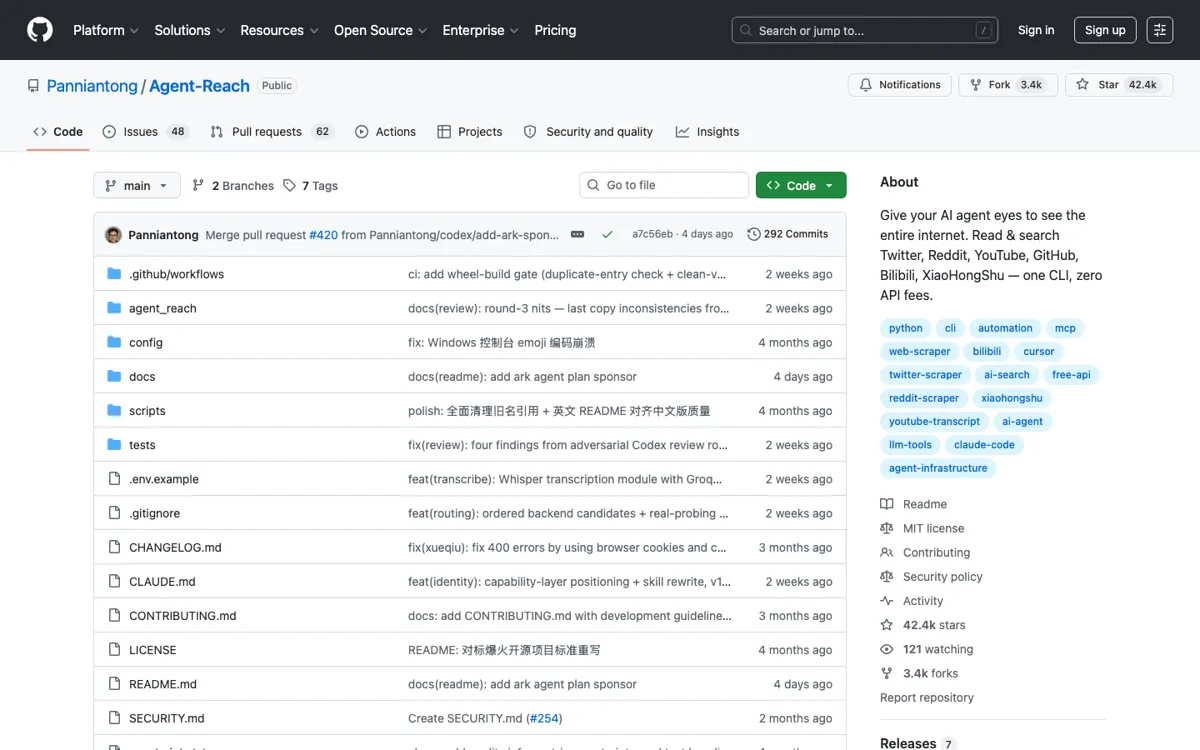
Agent Reach Review

8.0/10

Give an AI agent working routes into web, social, video, GitHub, RSS, and search from one CLI.

Review updated July 2026 By The AI Way Editorial 3 min read
Panniantong AI Agents AI Search CLI Tool Open Source Free

Read this first

If you cannot trust agent shell access and local cookies, stop here. That is the whole gate.

Our Verdict

Agent Reach is a strong pick when an agent keeps getting stuck on Twitter, Reddit, Bilibili, or other hard-to-read sources. The value is not one connector. It is having maintained routes plus health checks before the agent starts work. The cost is still real: shell installs, cookies, and brittle upstream tools come with it.

Official site
Free to start.
open_in_new Try Agent Reach
Official Website Snapshot Visit Site ↗

check_circle Pros

  • Turns scattered research sources into channels an agent can actually call from the terminal.
  • The doctor command shows which connector failed instead of hiding the broken step.
  • Fallback routing matters when a platform changes access rules overnight.

cancel Cons

  • It only fits environments where agent shell access and local tool installs are acceptable.
  • Cookie-heavy channels still create a trust and account-risk decision.
  • Open issues show the usual rough edges: channel mismatches, Cloudflare blocks, and cleanup bugs.

Should you use it?

agents that repeatedly need Twitter, Reddit, YouTube, GitHub, Bilibili, RSS, and web search access

Skip it if: you need a visual browser operator for a non-technical workflow, not a shell-first capability layer

Is it worth the price?

Free

There is no subscription decision because the project is free and open source. The real cost shows up later in cookie upkeep, optional proxies, and the time spent keeping fragile channels alive.

The Free Tier

Free and open source; optional proxy cost is separate.

One thing to know before you start

Start with the zero-config channels first. If web, GitHub, YouTube, RSS, and Bilibili already cover the job, you may not need the cookie-heavy parts.

What people actually use it for

Give a coding agent current public context

This is the strongest fit when the agent needs repo context, public pages, search results, tutorial transcripts, or community threads before it writes code or makes a product call. The gain is simple: the agent can fetch the source itself instead of waiting for someone to paste it in.

Research sentiment across social and niche platforms

It helps when product research lives on Twitter, Reddit, Xiaohongshu, Bilibili, YouTube, V2EX, or RSS and the same manual setup keeps repeating. The real question is whether you are comfortable carrying the cookie and login burden that comes with those channels.

Keep fragile platform access maintainable

This is useful for teams already running agents locally or on servers and tired of rebuilding connectors every time a platform changes. Primary-plus-fallback routing turns breakage into a repair job instead of a fresh integration project.

What does Agent Reach actually do?

The core decision is whether the agent keeps hitting the same platform walls often enough to justify setup. Twitter search wants cookies, Reddit blocks anonymous paths, Xiaohongshu often wants a live browser session, and Bilibili has already forced route changes once. If that happens every week, Agent Reach saves real time. If it is a one-off scrape, the install surface can feel heavier than the payoff.

This feels more like operating an agent toolkit than opening a consumer app. Installation can pull in Python tools, Node tools, MCP routes, browser-session helpers, and a local skill file that tells the agent which upstream tool to call. The doctor command is the practical center of the product because it shows what works, what failed, and which backend is active. That is why the project lands better with technical operators than with casual browser users.

What you can do with it

Install working routes for web, YouTube, GitHub, RSS, search, and several social platforms.
Switch between primary and fallback backends when a platform path breaks.
Run `agent-reach doctor` to see active backends and broken channels.
Keep cookie-based access local instead of sending credentials to a hosted tool.
Work with agents that can run shell commands, including Claude Code and OpenClaw.

Technical details

channel_mix
Zero-config web, GitHub, RSS, YouTube, V2EX, Bilibili plus optional login-gated channels
health_check
`agent-reach doctor` reports channel status and active backend
install_mode
Shell-based local install with optional safe and dry-run modes
auth_boundary
Cookie and browser-session access stays on the user's machine
routing_model
Primary plus fallback backends per platform

Top Alternatives to Agent Reach

If Agent Reach is close but still misses the job, try one of these instead.

Key Questions

Is Agent Reach free?
Yes. The core tool is free and open source; a server proxy can still add a small outside cost in some deployments.
Does Agent Reach replace browser automation?
No. It works better as an internet-reading and channel-routing layer for agents, not as a visual browser-control product.
Which platforms work without extra setup?
Web reading, YouTube, RSS, public GitHub, V2EX, and Bilibili basics are the lower-friction paths. Twitter/X, Reddit, Xiaohongshu, LinkedIn, Xueqiu, and some podcast workflows need cookies, login, API keys, or extra setup.
What is the biggest risk with Agent Reach?
The biggest risk is operational trust. Shell access, local cookies, and browser sessions need to be acceptable before it belongs in an agent environment.