adamsreview Review

6.9/10

Multi-stage PR review plugin for Claude Code with parallel agents, validation gates, and an auto-fix loop.

Review updated May 2026 By The AI Way Editorial Tested 181+ tools across the site 5 min read
adamsreview Auto Debugging CLI Tool GitHub Copilot Rival Open Source Repo Awareness Paid

Our Verdict

adamsreview is worth a look if your problem is not getting one more AI opinion, but getting a review pipeline that can fan out checks, keep state, and turn approved findings into fixes without trusting one raw model pass. Its upside is depth and auditability across stages. Its cost is ceremony, token spend, and the fact that you still need enough review discipline to judge whether the machine is catching real bugs or just producing more output.

Try it
Paid product.
open_in_new Visit adamsreview

check_circle Pros

  • It turns review into a staged workflow, so you can review, inject extra findings, walk unclear items, then fix from the same artifact instead of restarting context every time.
  • The fix loop is more careful than most AI review helpers because it re-reviews generated patches and can revert regressions before commit.
  • It gives teams a way to compare Claude-led and Codex-led review passes in the same overall flow, which is useful when one model tends to miss a class of issue.

cancel Cons

  • This is not a lightweight drop-in review assistant. Even interested HN users called out the amount of ceremony, which matters if your PRs are usually small.
  • Cost is a real consideration. The author said small PRs can consume around 500k tokens and larger ones 2 to 3 million total tokens across stages.
  • The quality claim is still mostly anecdotal, and HN commenters pushed for stronger benchmark evidence instead of self-reported wins over other review tools.

Should you use it?

Best for: Reviewing non-trivial pull requests in Claude Code when you want multiple review lenses, a persistent finding artifact, and a controlled path from findings to grouped auto-fixes.

Skip it if: Skip it if you mainly want a fast second opinion on small diffs, or if your team will not read and challenge AI findings before accepting fixes.

Is it worth the price?

Paid

There is no clean public SaaS price card here. The practical cost is your Claude Code plan plus sizable token usage across review stages, so the product only makes sense if deeper review saves more engineering time than that burn.

Paid Upgrade
No public starting price listed

Lets Claude Code users run deeper staged PR review and fix workflows without buying a separate review SaaS.

One thing to know before you start

Use this on PRs where the cost of a missed issue is higher than the cost of an extra review stage. On tiny changes, the overhead is likely to dominate the benefit.

What people actually use it for

Review a risky PR before merge

Run adamsreview when a pull request is large enough that one AI pass feels shallow, but still small enough that grouped fixes are practical. The useful part is not just detection. It is the ability to keep findings in one artifact, validate them, then promote only the ones you actually want fixed.

What does adamsreview actually do?

Most AI review tools break down at the point where a developer needs more than a list of comments. adamsreview is built around that exact gap. It splits review into separate commands so the output can survive across sessions, be enriched with outside findings, and later become a fix plan instead of a dead-end review note. That matters if your usual frustration is not lack of analysis, but losing state between passes or having to rerun everything after one context reset.

Its strongest differentiator is the path from finding to action. The plugin can run multiple review lenses, dedupe and validate findings, walk a human through ambiguous calls, then dispatch grouped fix agents and review their work again before commit. That is a more serious workflow than a basic diff review command. The tradeoff is obvious: more setup, more moving pieces, and more tokens. If your review culture is already loose, adding more AI stages may create a larger pile of outputs without creating better decisions.

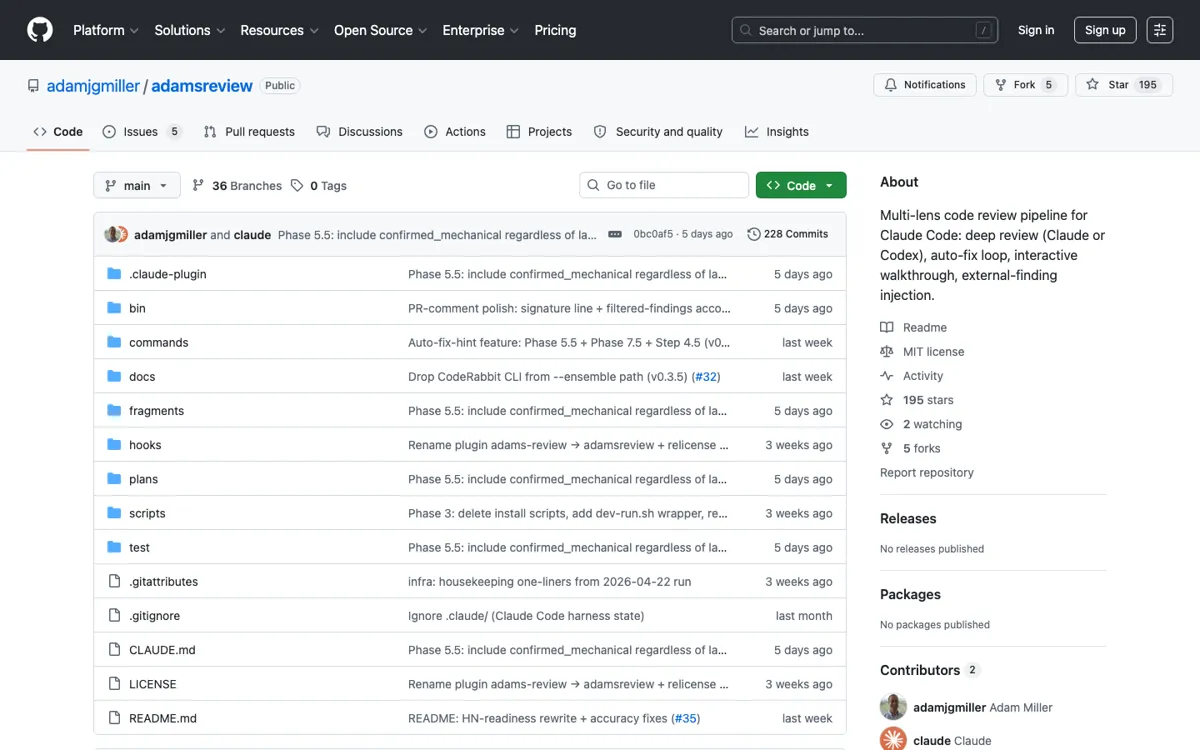
The product is early enough that proof still matters. The repository is active and open source, but public claims about better bug catch rates are still backed more by author experience than by formal evals. That does not kill the value, because many teams are buying process before benchmarks. But it does define the boundary. This is easier to justify as a workflow upgrade for developers already experimenting with Claude Code than as a universally proven replacement for human review or established PR tools.

What you can do with it

Runs multi-lens PR review with parallel sub-agents instead of a single reviewer pass.
Stores review state in JSON artifacts so review, add, walkthrough, and fix can happen across separate sessions.
Supports a walkthrough mode for borderline findings that need human judgment before promotion.
Can dispatch grouped auto-fix agents, then re-review and revert regressions before committing survivors.
Adds optional Codex ensemble review on top of Claude-based review stages.

Technical details

platform
Claude Code plugin for terminal-based PR review workflows; state persists under ~/.adams-reviews per repo and branch.
deployment
Open-source local plugin, MIT licensed, implemented mainly in Shell and Python with runtime dependencies including uv, jq, gh, git, and bash.
api_available
No public API product is exposed; operation is through slash commands inside Claude Code, with optional GitHub CLI and Codex CLI integration.

Top Alternatives to adamsreview

If adamsreview is close but still misses the job, try one of these instead.

Key Questions

Is adamsreview a general coding copilot?
No. Its center of gravity is pull request review, validation, and fix orchestration inside Claude Code. If you want broad everyday code generation and editing help first, a general copilot is a better starting point.
Does it look cheap to run?
No. The author said small PRs can use around 500k tokens and large ones 2 to 3 million across stages. That only pays off when missed review issues are more expensive than the extra usage.
What makes it different from one-shot AI review?
It keeps findings in a persistent artifact, supports multiple review lenses, and lets you move from review to walkthrough to grouped fixes without throwing state away. That is the real distinction, not just that it uses more than one agent.