Writesonic Review

8.0/10

Track how AI search engines talk about your brand, then push fixes through content, audits, and agent-led actions.

Review updated May 2026 By The AI Way Editorial Tested 204+ tools across the site 5 min read
Writesonic Agent Monitoring AI Search API Available No Credit Card Required SaaS SEO Optimized Team Collaboration Web-Based Freemium from $79.00/mo

Our Verdict

Writesonic makes the most sense for marketing teams that now care about AI search visibility as a reporting line, not just as a content experiment. The big sell is that it does not stop at showing missed mentions in ChatGPT or Google AI Overviews, it also bundles content, audits, and action workflows that try to close the gap. The catch is simple: if you only need an AI writer or a cheap rank tracker, this stack is broader and pricier than you need.

Try it
Free to start, then pay when the limits stop you. Starts at $79.00 USD.
open_in_new Try Writesonic
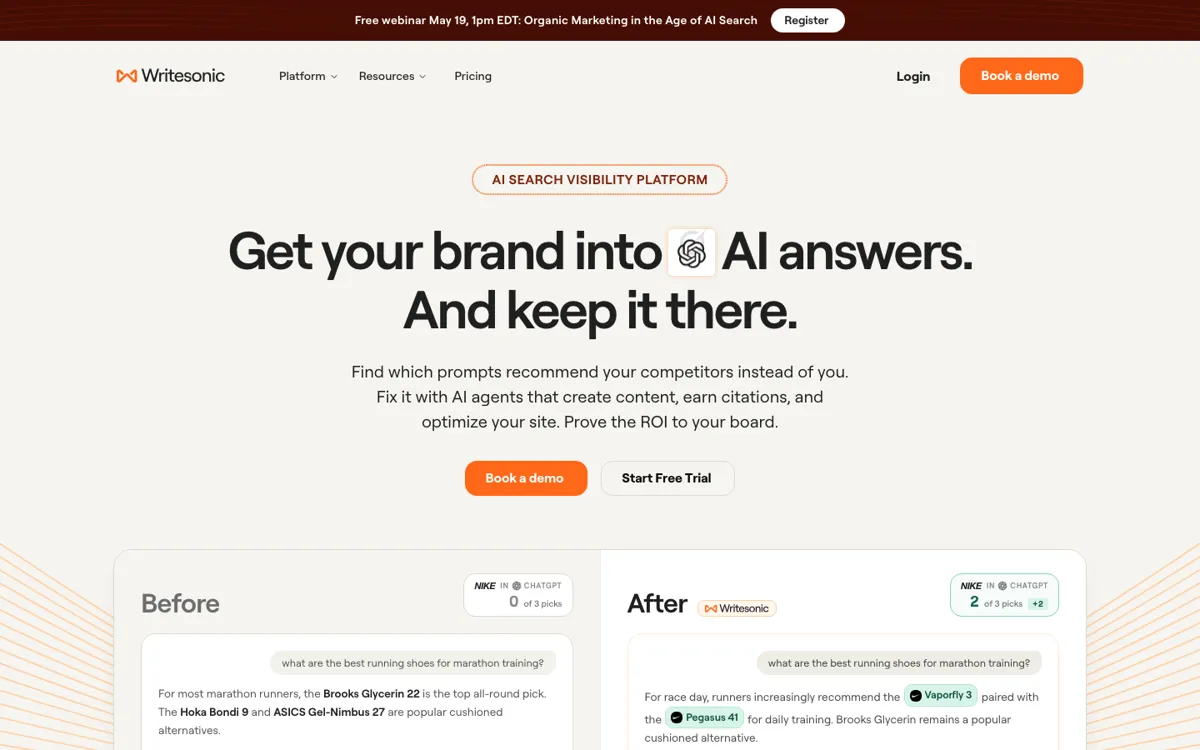
Official Website Snapshot Visit Site ↗

check_circle Pros

  • It ties tracking and execution together, so you can move from a missed prompt or weak citation profile into audits, content work, and action tasks without switching tools.
  • The pricing page is unusually concrete about prompt limits, answers tracked per day, article quotas, audit quotas, user seats, and when sentiment or Action Center unlocks.
  • The product guide is deep enough to cover region tracking, competitor setup, citations, sentiment themes, site audits, and platform volatility, which makes this feel like an operating workflow instead of a thin GEO add-on.
  • There is a documented API path, which helps teams pull GEO data into internal dashboards or reporting workflows instead of keeping everything trapped in the app.

cancel Cons

  • The useful GEO workflow starts well above impulse-buy territory. The $79 entry plan only tracks ChatGPT and caps you at 50 prompts and 50 answers a day.
  • Several execution-heavy pieces are gated. Sentiment, Action Center access, and deeper agentic workflows only open up properly on higher plans or enterprise.
  • The brand story still spans writer, GEO platform, audits, and agents, so buyers who came for a focused single-purpose tool may need extra time to map what they are actually purchasing.
  • Public review snippets still show some trust scar tissue around older lifetime-deal expectations and upgrade pressure, which is worth noting if long-term plan stability matters to you.

Should you use it?

Best for: In-house SEO leads, content heads, and agencies that need to monitor AI answer visibility by prompt, compare brand share against competitors, and then push content or technical fixes from the same platform.

Skip it if: Skip it if your main job is just drafting blog posts or ad copy. You will pay for monitoring, audits, prompt tracking, and workflow layers that do not matter if you only need text generation.

Is it worth the price?

Freemium Starts at $79.00 USD

The free entry is enough to test the interface, not enough to run serious brand monitoring. Real adoption starts when you can afford recurring prompt coverage across more than ChatGPT, and that pushes most teams toward Basic or Growth rather than the headline free trial.

The Free Tier

Free trial available with no credit card. Entry plan also includes limited trial runs for agentic workflows.

Paid Upgrade
$79/month billed annually

Paid plans unlock larger prompt and answer quotas, broader platform coverage beyond ChatGPT, more AI articles and audits, team seats, and deeper action or workflow access.

One thing to know before you start

Before buying, list the exact prompts and regions you need to monitor every week. That makes it much easier to see whether the answer caps and platform coverage on Starter or Basic are enough, or whether you will be forced into Growth in the first month.

What people actually use it for

Track competitor mentions inside AI answers

A brand team can load priority prompts, watch which competitors appear in ChatGPT or Google AI Overviews, and see where its own citations are missing. That is the core use case if your reporting problem is no longer just rankings, but whether AI systems name the wrong vendor when buyers ask purchase-intent questions.

Turn visibility gaps into content and audit work

The platform fits teams that do not want a separate monitor and a separate execution stack. Prompt gaps, weak citations, and site issues can roll into article generation, audits, and action workflows, which is useful when the real pain is not spotting the problem but getting someone to fix it consistently.

Run agency reporting across brands and markets

Agency users get the most value when they need to compare multiple brands, topics, regions, and languages, then show trend movement over time. The appeal here is less about one-off content output and more about turning AI visibility into a client-facing reporting and optimization service.

What does Writesonic actually do?

Writesonic has shifted into a product for teams that treat AI answers like a new search surface they cannot afford to ignore. Instead of asking whether a page ranks on Google, the platform pushes you to ask whether ChatGPT, Gemini, Claude, or AI Overviews mention your brand, cite your pages, or hand the win to a competitor. That matters most for companies already spending on SEO and content, because the problem is no longer just traffic acquisition. It is whether buyer research is getting intercepted upstream by machine-generated recommendations. If that framing does not already match how your team thinks, Writesonic will feel like overkill.

The product is more convincing than a typical GEO dashboard because it shows a loop, not just a scorecard. You monitor prompts, competitors, citations, and sentiment, then move into site audits, AI-generated content, and action workflows. That makes the platform easier to defend inside a marketing team, since it can be tied to execution rather than passive reporting. The weak point is that the fuller version of that loop is gated by plan. The cheap tier proves the concept, but it does not give a broad enough slice of the workflow for a serious multi-platform program.

The buying decision comes down to whether you want an AI-search operating layer or a narrower writing tool. Teams that only need draft generation will find cheaper tools that get to the point faster. Teams already juggling SEO software, reporting demands, and pressure to show up inside AI answers may accept the higher price because Writesonic packages monitoring, audits, and content response in one place. That does not remove the need for human judgment, especially around what prompts matter and what actions deserve effort, but it does reduce the friction between spotting an AI visibility loss and assigning work against it.

What you can do with it

Tracks brand visibility across ChatGPT, Claude, Gemini, and Google AI Overviews
Surfaces prompt-level gaps, citations, sentiment shifts, and competitor wins
Includes AI article generation and site audits to close visibility gaps
Offers agentic workflows and Action Center steps on higher plans
Supports API access for GEO data and platform workflows

Technical details

api_access
Yes. The GEO API runs on api.writesonic.com and requires an X-API-KEY header, with API activation and key retrieval handled from the account dashboard.
workflow_limits
Plan limits are explicit: prompt quotas, daily answer tracking caps, article quotas, site-audit allowances, user seats, and gated Action Center or workflow access all vary by tier.
platform_coverage
Starter tracks ChatGPT only, while higher plans expand into Gemini and Google AI Overviews, and enterprise extends tracking across 10 AI platforms.
data_inputs_and_integrations
The product docs include setup paths for Cloudflare, WordPress, Vercel, Drupal, Fastly, custom log drains, CloudFront, and Looker Studio reporting.

Top Alternatives to Writesonic

If Writesonic is close but still misses the job, try one of these instead.

Key Questions

Is Writesonic still mainly an AI writer?
Not really. It still includes AI article generation, but the current product is much more about AI search visibility, prompt tracking, citations, audits, and action workflows. If you only want writing help, you are paying for a larger system than you need.
Can the cheapest paid plan handle serious GEO monitoring?
Only for a narrow setup. Starter is useful for proving the workflow, but it tracks ChatGPT only and gives limited daily prompt coverage. If you need wider platform coverage or ongoing monitoring for a brand program, you will outgrow it quickly.
Who gets the most value from Writesonic?
Teams already accountable for SEO performance and brand visibility in AI answers. The product makes the most sense when someone has to track competitors, report movement, and turn missed mentions into content or technical work, not when the only need is faster copywriting.