Hello History Review

7.1/10

Chat with AI versions of historical figures to explore events, ideas, and arguments from a first-person angle.

Review updated May 2026 By The AI Way Editorial Tested 278+ tools across the site 6 min read
Hello History Android App iOS App Lesson Planning Multi-language Freemium

Our Verdict

Hello History is strongest when the real goal is to make history feel conversational instead of static. It gives teachers, students, and curious readers a fast way to interrogate a figure or period from a first-person angle without building the whole setup themselves. The cost is accuracy risk and message economics: it is better for engagement and debate than for anything that needs clean sourcing.

Try it
Free to start, then pay when the limits stop you.
open_in_new Try Hello History
Official Website Snapshot Visit Site ↗

What people actually use it for

Start a classroom discussion faster than a lecture intro

Hello History works best when a teacher wants students talking before the room goes flat. Picking Napoleon, Darwin, or Cleopatra and asking a pointed question is a much quicker way to start debate than explaining the whole chapter first. The value is not that the AI becomes the textbook. The value is that it gives students something to react to, challenge, and unpack.

Stress-test your understanding of a historical figure or idea

For self-study, the app is useful when you want to see whether you can ask sharper questions than a standard quiz would force. You can bounce between philosophy, science, literature, and political history and keep the exchange framed around one persona instead of one flat encyclopedia voice. That makes it better for curiosity and perspective-taking than for memorizing facts.

Add an interactive layer to museums, fairs, or research projects

The product line stretches beyond the phone app. The same historical-figure format can also be shaped into archive-based museum experiences, online or offline visitor interactions, and academic work around bias, accuracy, and narrative generation. That makes the product more flexible than a consumer-only novelty app.

check_circle Pros

  • Turns a chapter, thinker, or historical event into a live Q&A format fast, which is much easier to use as a lesson hook than a plain summary page.
  • Has a sharper niche than a generic chatbot because the figure selection and persona framing are already built into the product.
  • Does more than the consumer app alone: the same product line also has education, research, and exhibition paths instead of stopping at novelty chat.
  • Limited free messages let you test the format before deciding whether the subscription is worth repeated use.

cancel Cons

  • The chats can sound convincing while still getting details wrong, so you cannot treat them as a clean historical source.
  • Public pricing is still fuzzy: subscriptions clearly exist, but the product still does not give you a clean public starting price to compare quickly.
  • The consumer experience is mainly built around mobile app use, so people wanting a normal desktop study workflow will feel pushed toward the separate education setup.
  • If you only want broad factual answers, the historical-persona layer can slow you down instead of helping.

Should you use it?

Best for: Turning history, philosophy, or science topics into short first-person Q&A sessions for class hooks, revision prompts, or curiosity-driven browsing.

Skip it if: Skip it if you need citation-grade answers, fully reliable dates and claims, or a broad assistant that handles work tasks outside the historical-figure format.

Is it worth the price?

Freemium

The free allowance is enough to tell whether asking questions through a historical persona feels more engaging than reading a summary. You move into paid once repeated lessons, long back-and-forth chats, or regular personal use start burning through the limited free messages. If you are counting remaining messages before the discussion is over, the free layer has already stopped being enough.

The Free Tier

The homepage advertises a limited free message allowance before subscription, with visible sections mentioning 20 or 30 free messages.

Paid Upgrade

Subscriptions unlock extra messages to historical figures and can reach up to 10,000 messages per month.

One thing to know before you start

Use it to generate friction, not final answers. Ask the figure to defend one decision or compare two historical moments, then verify names, dates, and claims in a second source before treating the chat as classroom truth.

What does Hello History actually do?

Most AI chat apps start from a blank box and make you decide who the bot is supposed to be, what tone it should use, and why you are even talking to it. Hello History removes that setup cost. The product already assumes the draw is a historical persona, so the first useful action is obvious: pick a figure and ask a question. That makes it unusually easy to use as an entry point for people who do not want to learn prompt tricks just to make history feel alive. The app is narrow on purpose, and that narrowness is its best feature.

The other reason the product matters is that it is not framed only as entertainment. The education pages show a more serious path where teachers can use AI tutors, generate class material, and share chats through links without forcing every student to sign up first. Researchers can request an academic license, and the exhibitions offering pushes the same idea into museums, fairs, and galleries. That wider shape gives Hello History more staying power than a pure curiosity app because it can be used for teaching, visitor engagement, and study design as well as casual browsing.

The limits are also clear if you read the product honestly. The historical figure framing can be vivid without being dependable enough for citation, so this works better as a discussion tool than as a final authority. Pricing is another boundary. Free starter messages make it easy to test, but heavier use is clearly pushed toward subscription, and the public pricing story still is not clean enough to compare plans quickly. In practice, that means Hello History is easy to try, but you should treat it as a learning catalyst first and a trusted answer engine second.

What you can do with it

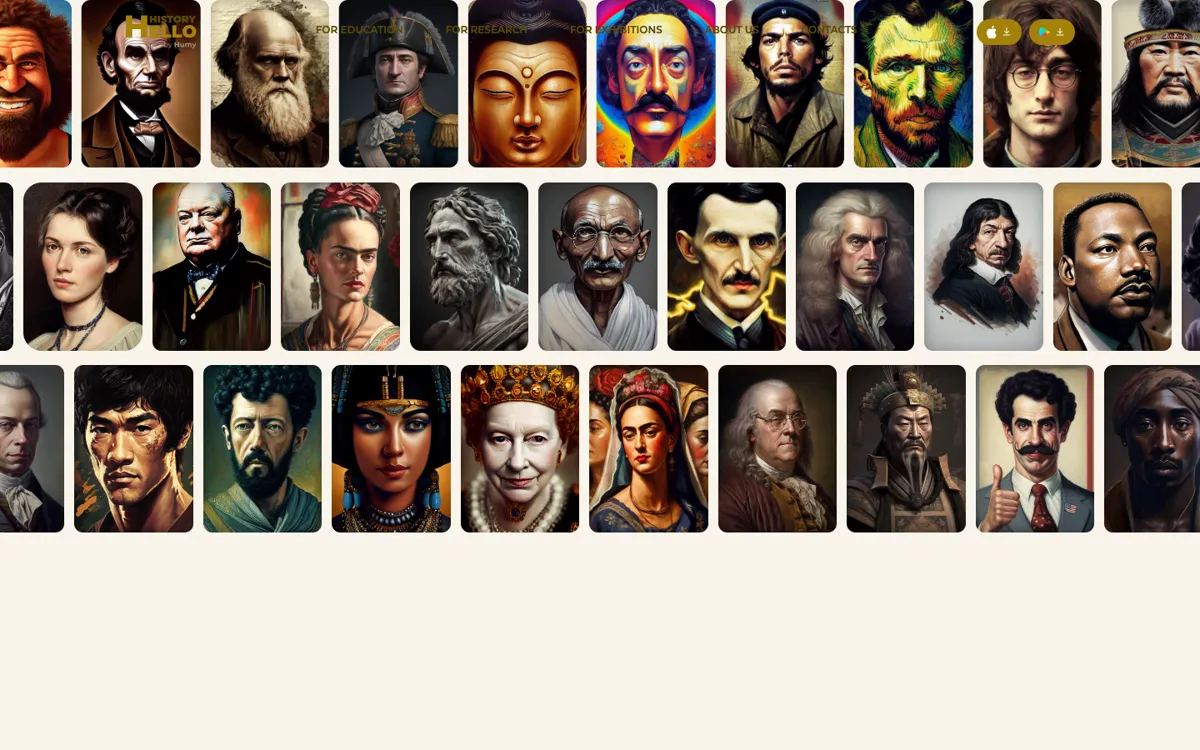
Choose from a library of 400+ historical figures and hold one-on-one AI chats with them.
Ask questions, debate topics, or explore art, science, philosophy, literature, technology, and history through persona-based conversations.
Use the education version to create interactive assignments, AI tutors, and lesson-plan support for classes.
Share school AI chats by web link so students can use them without creating their own account.
Apply for a research license if you are studying bias, accuracy, or historical narrative generation.
Deploy tailor-made historical figures for exhibitions with archive-trained content, adjustable reading levels, and online or offline access.

Technical details

platform
The consumer product is phone-first with official iOS and Android distribution, while the school-facing version runs through Humy's web platform instead of the mobile app shell.
deployment
Hosted service rather than a self-hosted package; the exhibitions offering is sold as a custom deployment that can be available online or offline.
api_available
figure_catalog
Current official stats put the catalog above 400 historical characters and total usage above 5 million messages, so this is a curated roster product rather than a blank character builder.
message_metering
Education usage is metered by credits tied to model choice, and paid consumer subscriptions expand monthly message volume up to 10,000.
accuracy_boundary
The product draws a hard line between engaging dialogue and verified history: consumer chats need fact-checking, while museum-style deployments are positioned as archive-trained and historian-verified.
education_controls
Teachers can share AI chats by link without requiring student accounts, while admins can control access, oversee usage, and view chat history.
language_and_access
The exhibition variant can run in 50 languages, adjust reading level, and work through on-site QR codes or website access, with online or offline delivery.

Top Alternatives to Hello History

If Hello History is close but still misses the job, try one of these instead.

Key Questions

Can Hello History actually work in a classroom, or is it just a novelty app?
Yes, it has a real classroom path. The education version adds AI tutors, class-content support, and link sharing so students can use chats without opening their own account. The catch is that you still need to verify factual claims instead of treating the output like a textbook.
Is Hello History only a mobile app?
Mostly for the consumer version, yes. The public app is distributed through iPhone and Android stores, while the school-focused version runs through Humy's web platform. If you want a normal browser workflow, that usually means using the education setup instead of the consumer app alone.
How many historical figures does it actually cover?
There are more than 400 historical characters in the current roster. That gives you enough spread to move across history, science, philosophy, literature, and art without getting stuck with the same few names.
How reliable are the answers?
Useful for perspective and discussion, not reliable enough to trust blindly. The safest way to use it is as a question generator or discussion partner, then cross-check the claims elsewhere before treating the answer as fact.