Shannon Review

8.0/10

Autonomous AI pentesting for web apps and APIs, with real exploit validation instead of theoretical findings.

Review updated May 2026 By The AI Way Editorial Tested 204+ tools across the site 4 min read
Keygraph BYO Key CLI Tool Open Source Security Self-Hosted Paid

Our Verdict

Shannon is interesting because it tries to solve the part most AppSec tools still fumble: proving exploitability instead of flooding teams with theoretical findings. If you need a tool that can read code, attack the running app, and hand developers something closer to a real pentest result, it stands out fast. If you mainly want a lightweight scanner with minimal setup, this is probably heavier than you need.

Try it
Paid product.
open_in_new Visit Shannon
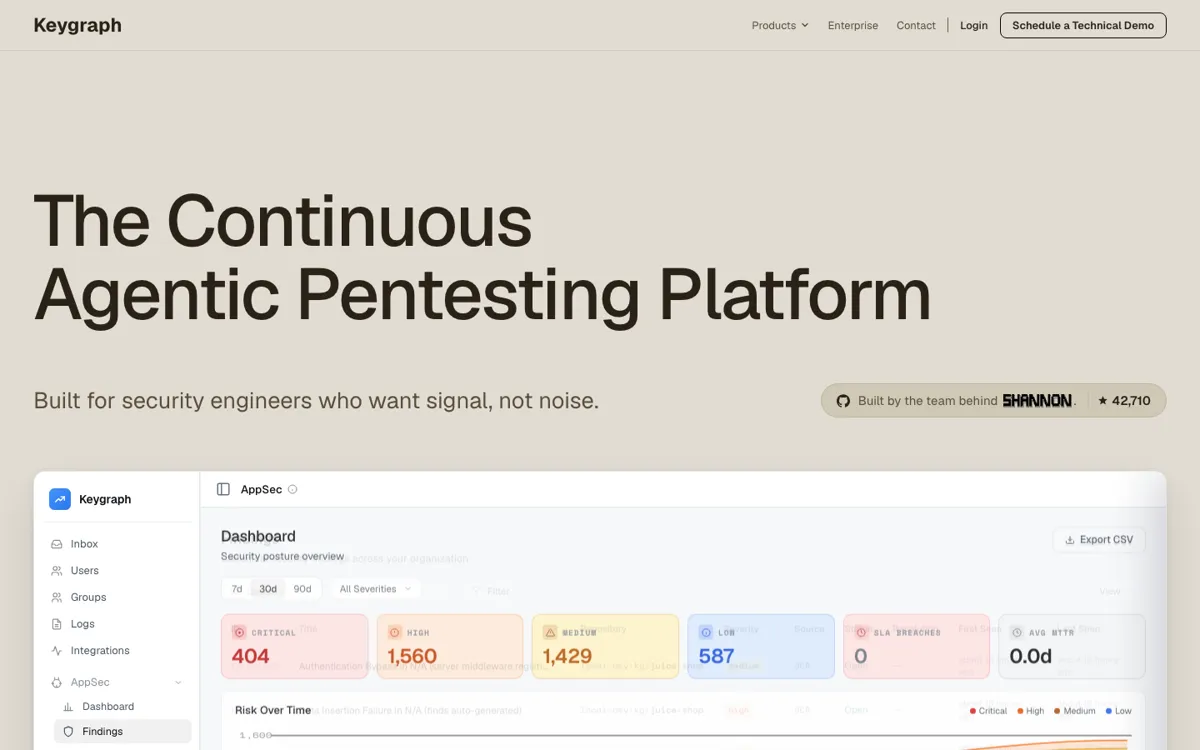
Official Website Snapshot Visit Site ↗

check_circle Pros

  • The strongest value is exploit validation. Shannon is built to prove a vulnerability works before it lands in the report, which is a better handoff model than shipping a huge list of maybe-problems to engineering.
  • It covers the high-friction security gap between static review and live pentesting, especially for teams shipping continuously and no longer comfortable waiting for an annual outside assessment.
  • The trust story is stronger than average for an AI security product, because self-hosting, bring-your-own API keys, read-only defaults, and in-perimeter deployment are all part of the core pitch rather than an afterthought.

cancel Cons

  • This is not a casual plug-in scanner. Shannon Lite expects source access, repository context, Docker, Node, and a running target, so the setup burden is real.
  • The product is easiest to justify for mature AppSec teams, which means smaller teams may admire the idea more than they actually operationalize it.
  • Public pricing is still sales-led and opaque on the enterprise side, so a buyer trying to estimate total rollout cost cannot get to a clean budget answer from the marketing materials alone.

Should you use it?

Best for: Security engineers and AppSec teams that want white-box pentest automation against their own web apps or APIs, especially when they need proof-backed findings tied to source code and developer workflows.

Skip it if: Skip it if you only need a fast black-box scan or a lightweight vulnerability checker, because Shannon asks for source access, environment setup, and a more serious AppSec workflow than a simple scanner replacement.

Is it worth the price?

Paid

The real buying motion here is enterprise, not self-serve. Shannon Lite gives teams a way to test the core idea without an upfront license, but the full platform still lives behind demos and sales conversations. That makes evaluation easier than budgeting, especially if you are trying to price a broader rollout before you know how much internal process change the product will trigger.

The Free Tier

Shannon Lite is available as AGPL-3.0 open-source software for testing your own applications, while the broader production platform is commercial and demo-led.

Paid Upgrade
Contact for pricing

Commercial access expands the pentester into a full AppSec platform with correlated findings, enterprise deployment controls, integrations, and remediation workflows.

One thing to know before you start

Use Shannon on one high-risk internal app first, not your whole portfolio. That shows quickly whether your team can handle the setup, triage, and remediation loop that makes the product worth its overhead.

What people actually use it for

Run proof-backed pentests during release cycles instead of waiting for annual assessments

A security team shipping weekly can point Shannon at a running internal application, let it read the code, and get back only issues that were actually exploitable. That matters most when engineering is already exhausted by false positives and you need findings that survive contact with real developer review.

What does Shannon actually do?

Shannon matters because it is trying to close a very specific AppSec gap. Teams ship code continuously, but pentesting still often happens as a yearly event, which leaves a long stretch where exploitable flaws can move through the pipeline untouched. Shannon's answer is to combine source-aware analysis with live attack execution so the result looks less like a theoretical scan and more like a machine-driven pentest. That makes the product far more compelling for organizations that are already frustrated by noisy static tools and weak prioritization.

The product gets more interesting once you separate Shannon Lite from the broader Keygraph platform. Lite is the autonomous white-box pentester in open-source CLI form, aimed at testing your own applications with real repository access and a running target. The commercial side expands that into an AppSec platform with agentic SAST, business logic testing, secrets scanning, container and IaC coverage, correlated findings, Jira workflows, and verified patch generation. That split is important because it explains both the product's appeal and its complexity. You can trial the core idea through Lite, but the bigger operational promise lives in the commercial platform around it.

The biggest adoption risk is not whether Shannon sounds smart. It is whether your team can actually support the workflow it assumes. This tool expects source access, testable environments, Docker-based execution, and enough internal discipline to route proven findings into remediation. If that machinery already exists, Shannon can look like a serious upgrade over scanners that produce endless suspicion without proof. If it does not, the product may feel like overkill, because its best feature only pays off once your security and engineering process is mature enough to use it properly.

What you can do with it

Read source code, identify attack paths, and execute live exploits against web apps and APIs
Prove exploitability before reporting a finding instead of stopping at pattern matches
Handle white-box pentesting, agentic SAST, business logic testing, and verified remediation in one security workflow
Run inside your own cloud perimeter with self-hosted deployment and bring-your-own-key inference controls

Technical details

deployment
Shannon Lite runs through a Docker and Node.js based CLI workflow, while Keygraph Enterprise can be deployed entirely inside the customer's AWS, GCP, or Azure environment.
integrations
Public enterprise materials name GitHub, GitLab, Azure DevOps, Jira, Slack, Docker Hub, GHCR, Amazon ECR, and Google Artifact Registry.
analysis_mode
White-box pentesting that reads source code, maps attack paths, and validates exploits against the running app instead of reporting static suspicion alone.
security_controls
Supports bring-your-own API keys, read-only scans by default, ephemeral source processing, and self-hosted operation with no external data plane required.

Key Questions

Is Shannon a scanner or a real pentesting tool?
It is closer to an automated pentesting workflow than a simple scanner. The core promise is that it does not stop at suspicious patterns. It tries to validate exploitability against the running application before reporting the issue.