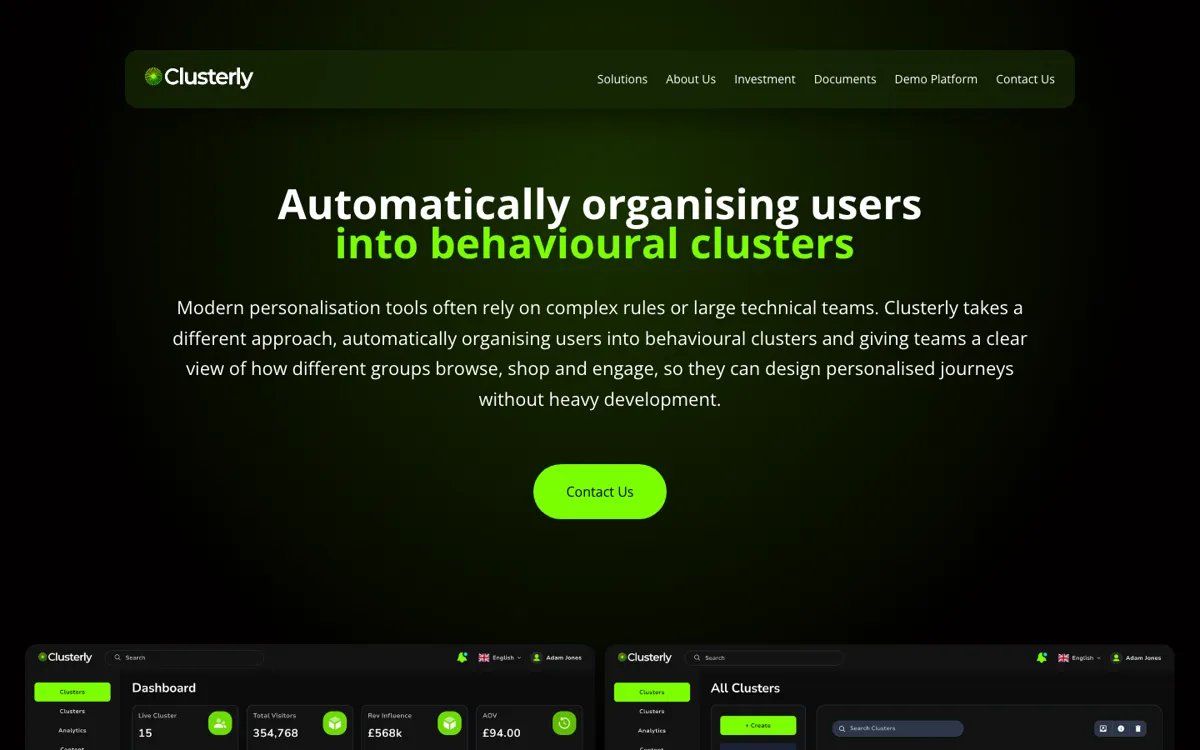
What does Clusterly actually do?
Clusterly is trying to solve a real ecommerce problem that many personalisation vendors describe but few make easy to operationalise. Stores want more relevant journeys, but the work often turns into endless segmentation rules, engineering dependencies, and cross-team confusion. Clusterly's answer is to cluster users automatically based on what they browse, prefer, and engage with, then use those clusters as the basis for more tailored experiences. That idea is attractive because it shifts the burden away from manually designing every audience up front.
The strongest signal in Clusterly's favour is that it is aimed at teams with enough traffic and organisational complexity for personalisation to matter commercially. The investment page clearly points toward brands with real ecommerce scale, in-house teams, and an appetite for experimentation. That makes the positioning more credible than a vague AI-personalisation pitch for everyone. The weaker signal is that too much of the actual product remains hidden. A locked demo and protected documents mean a buyer cannot inspect the controls, workflow depth, or reporting experience from the public site alone.