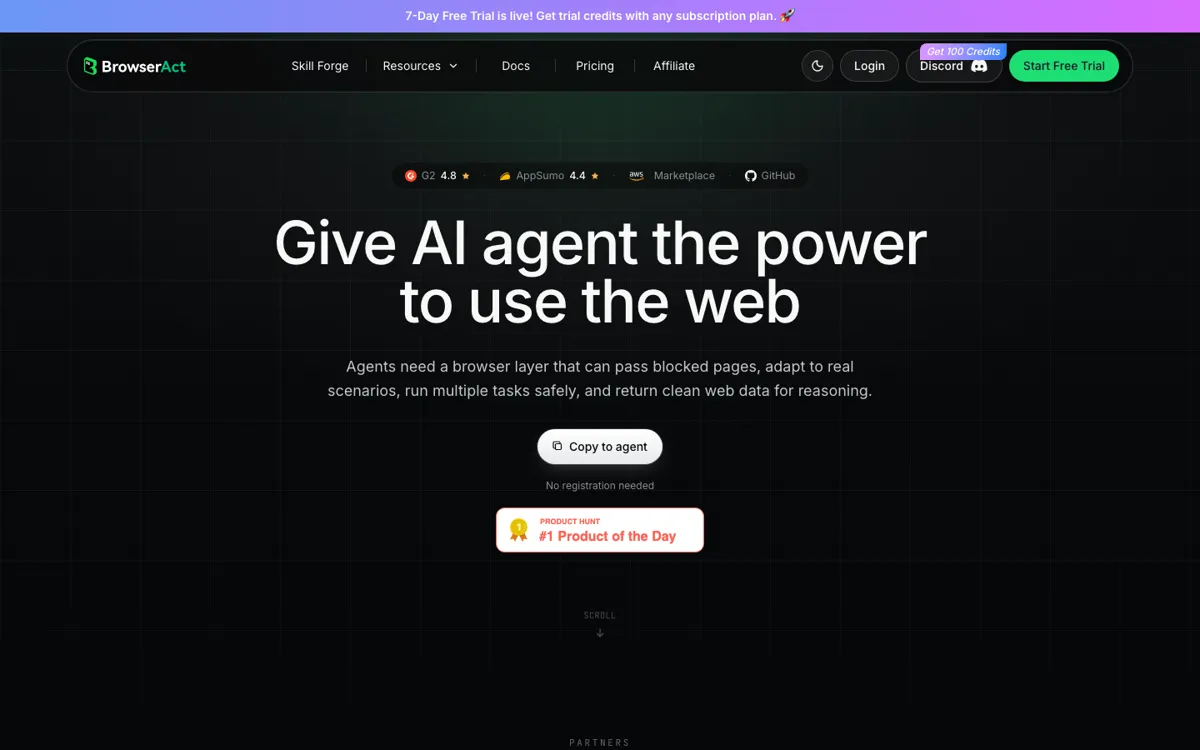
BrowserAct Review

7.6/10

Make browser-based agent work survive logins, verification, parallel sessions, and messy page data.

Review updated June 2026 By The AI Way Editorial 4 min read
BrowserAct AI Agents API Available Browser Automation CLI Tool Freemium

Our Verdict

BrowserAct earns its keep when the agent plan is fine and the browser is the thing failing. It is strongest on logins, CAPTCHAs, uploads, and parallel sessions. It is a weak buy when an API or simple fetch would solve the same task with less compliance risk.

Official site
A free plan is listed; verify current limits before upgrading.
open_in_new Try BrowserAct

What people keep saying about it

The appeal is obvious for agent builders: cleaner data, isolated sessions, and a fallback when a site fights back. The hesitation is just as practical: CAPTCHA drift, stale DOM references, site rules, and who pays when human help is needed.

Official Website Snapshot Visit Site ↗

check_circle Pros

  • Targets the failure point that usually kills agent runs: login state, verification, and dynamic pages.
  • Separate browser state makes parallel runs safer than sharing one profile.
  • Human assist gives blocked sessions a cleaner fallback than pretending every site can be automated.

cancel Cons

  • CAPTCHA success can decay when anti-bot vendors change their checks.
  • Protected sites still need a clear permission call before automation is worth the risk.
  • Cloud browser pricing is still unclear, so long-running remote usage is hard to budget.

Should you use it?

Agent teams whose workflows fail at login, verification, uploads, scraping, or parallel browser state.

Skip it if: the task already has a stable API, only needs a one-off public scrape, or depends on sites you should not automate

Is it worth the price?

Freemium

The free profiles are enough to test whether session isolation fixes the blocker. Real cost shows up later in proxy traffic, workflow steps, CAPTCHA fallback, and human assist.

The Free Tier

First 5 browser profiles are free.

Paid Upgrade
Usage-based credits

Paid usage adds workflow steps, proxy traffic, and broader browser infrastructure.

One thing to know before you start

Test one workflow that already dies after login, CAPTCHA, upload, or output cleanup. If that blocker clears without a cost surprise, the product has a real case.

What people actually use it for

Recover failing browser-agent runs

Use it when the plan is fine but the run dies on login, verification, upload, or messy extracted data.

Scrape pages that break simple HTML fetchers

Useful when a plain fetch never reaches the real page state and the blocker is browser access.

Run multiple browser jobs without state collisions

Best when cookies, accounts, or progress from one browser job would corrupt another.

What does BrowserAct actually do?

The first question is simple: is the browser the thing breaking? If the failure shows up at login, verification, waiting, clicking, or data extraction, BrowserAct is aimed at the right layer. The cleanest example is a job that has to pass a verification page, extract product data, and export a CSV from a site that was never built like an API.

State control is the detail that matters most in testing. Local login reuse helps when the credentials already exist, stealth private mode helps scraping, and fixed identity helps multi-account work. The real test is whether that clears the blocker without creating a bigger one around cost, stale selectors, or site permissions.

What you can do with it

Reuse local logins or switch between stealth private and fixed-identity browser sessions.
Handle CAPTCHA blocks, proxy routing, and remote human assist when runs get stuck.
Keep parallel browser jobs isolated so cookies and account state do not collide.
Return cleaner text, indexed actions, and structured page data instead of raw DOM noise.
Package repeatable browser jobs for scraping, form fills, uploads, and exports.

Technical details

output_format
Returns indexed actions, cleaner text, and structured page data.
session_modes
Local login reuse, stealth private mode, and fixed-identity sessions.
block_handling
Supports CAPTCHA solving plus remote human assist for hard stops.
execution_scope
Local browser now; cloud browser is listed but still not priced.

Key Questions

Is BrowserAct a normal web scraper?
No. It is closer to a browser execution layer for AI agents, useful when the job needs session state, clicks, verification handling, and structured output from real pages.
Does BrowserAct have a free option?
Yes. The first 5 fingerprint browser profiles are free, and there is also a 7-day free trial with trial credits.
What is the main production risk?
Verification and permission are the hard parts. CAPTCHA handling, fingerprint checks, and target-site rules can change, so a real workflow and a clear access policy matter more than a clean demo.
Who should try BrowserAct first?
Teams already building AI agents that need to browse, click, fill forms, upload files, or extract data from sites where simple API calls are not enough.