Braintrust Review

8.3/10

Trace AI outputs, run evals, and catch regressions before they hit production.

Review updated May 2026 By The AI Way Editorial Tested 204+ tools across the site 4 min read
Braintrust API Available B2B Free Forever Production Workflows Web-Based Freemium

Our Verdict

Braintrust is worth a hard look if your team already ships LLM features and the painful part is no longer generating outputs, it is proving they still behave after every prompt, model, or routing change. Its real value is pulling traces, evals, datasets, and regression checks into one review loop. The tradeoff is that this is infrastructure for serious product teams, not a lightweight playground for someone just testing prompts on weekends.

Try it
Free to start, then pay when the limits stop you.
open_in_new Try Braintrust
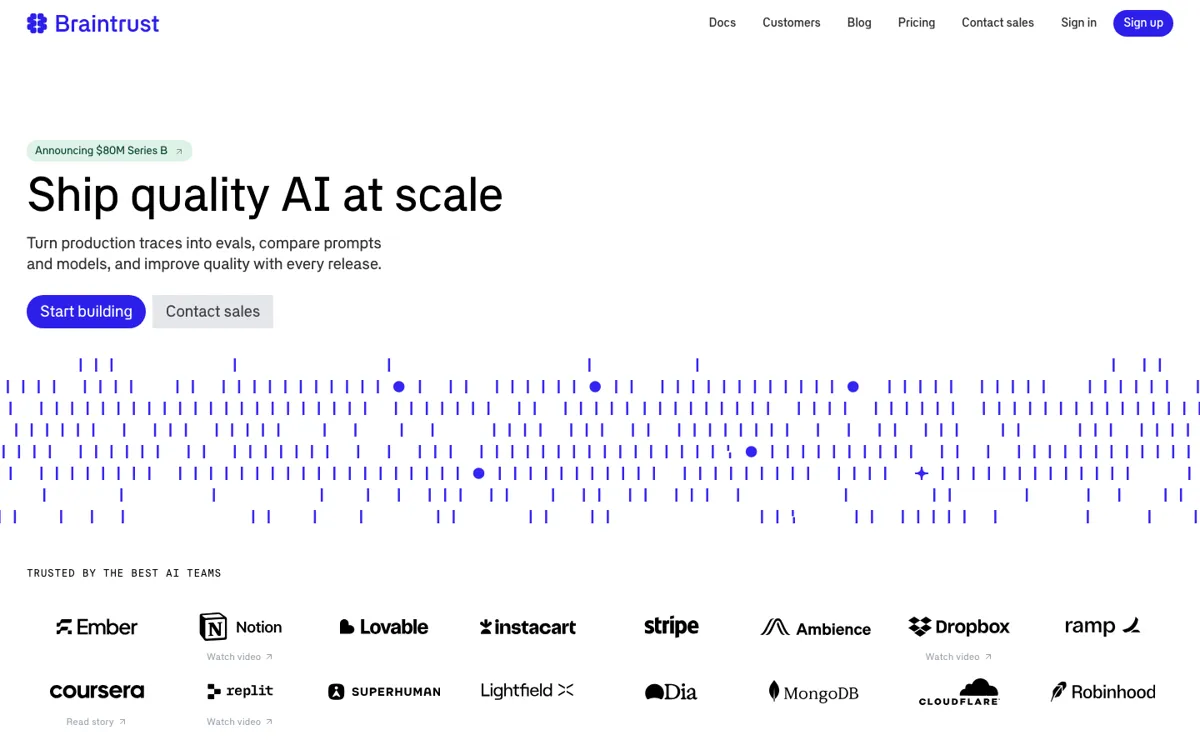
Official Website Snapshot Visit Site ↗

check_circle Pros

  • The product is built around the exact failure mode most AI teams hit after launch: outputs drift, regressions sneak in, and nobody can quickly explain what changed.
  • The free tier is usable enough to test the workflow because it includes processed data, scoring, retention, and unlimited users and projects instead of hiding the core product behind a demo wall.
  • Braintrust has stronger credibility than many eval tools because the public stack extends beyond a landing page, with SDKs, proxy tooling, examples, and a widely starred Autoevals repo.

cancel Cons

  • Pricing moves fast once you have real traffic, because usage is metered on processed data and scores even before you get into enterprise requirements.
  • This is not beginner-friendly if you are still figuring out whether you even need structured evals, since the workflow assumes datasets, traces, scoring logic, and release discipline.
  • Teams handling sensitive production traffic may end up needing enterprise deployment, which means the clean self-serve story stops once privacy and retention demands get serious.

Should you use it?

Best for: Teams shipping LLM features into production and needing one place to trace failures, run evals before release, and watch regression risk after prompt or model changes.

Skip it if: Skip it if your main need is a simple chat playground or one-off prompt testing, because Braintrust pays off only when you are managing repeated eval runs, production traces, and team review across a real AI product lifecycle.

Is it worth the price?

Freemium

The free tier is good enough to prove whether your team will actually use evals and tracing together. After that, Braintrust stops being cheap hobby tooling and starts behaving like production infrastructure, so the spend only makes sense if failed model changes already cost you real time or real trust.

The Free Tier

Starter includes 1 GB processed data, 10K scores, 14 days retention, and unlimited users/projects/datasets/playgrounds/experiments.

Paid Upgrade
$249/month

Pro raises included usage to 5 GB processed data, 50K scores, 30 days retention, and adds custom topics, charts, environments, and priority support.

One thing to know before you start

Use the free plan on one production path that already breaks in annoying ways. If Braintrust still cannot tell you why a prompt or model change went sideways there, rolling it out wider will just add process without reducing mistakes.

What people actually use it for

Catch prompt regressions before rollout

A product team can keep a dataset of representative prompts, run evals before each prompt or model change, and stop bad releases before support tickets become the first alert. This is the cleanest Braintrust use case because the tool is strongest when you already know which behavior you need to preserve.

What does Braintrust actually do?

The strongest reason to use Braintrust is that it treats AI quality work like release engineering instead of vibe checking. Once a team has real users hitting prompts, the problem is not getting one good answer in a playground. The problem is proving the system still behaves after a prompt rewrite, model swap, new tool call, or routing change. Braintrust gives those teams a shared place to inspect traces, keep datasets, run evals, compare outputs, and review failures without stitching the process together from spreadsheets, notebooks, and app logs.

Its pricing and product shape make the target buyer pretty clear. Starter is generous enough to validate the workflow, but the real product assumes you are handling enough AI traffic to care about processed data, scoring volume, retention windows, and eventually RBAC or private deployment. That means Braintrust is not a casual prompt playground. It is closer to the layer a company adds after the first exciting demo, when leadership starts asking whether the AI feature is reliable enough to ship broadly and keep improving.

The catch is that Braintrust only shines when the surrounding team is ready for structured evaluation. If nobody owns datasets, nobody reviews regressions, and prompt changes still go out based on gut feel, this product can become expensive ceremony. But if you already feel the pain of debugging flaky outputs across multiple models and releases, Braintrust is one of the clearer bets in the eval-and-observability category because it is built around that exact operational mess instead of pretending better prompts alone will solve it.

What you can do with it

Trace live AI interactions and inspect failures in one place
Run evals against datasets to catch regressions before release
Version prompts and compare outputs over time
Build custom views and score workflows for team review

Technical details

platform
Web app with docs, SDKs, and hosted workspace for AI observability workflows.
deployment
Hosted by default, with enterprise options for on-prem or hosted deployment when teams need custom retention, export, RBAC, or privacy controls.
api_available
Yes. Braintrust exposes SDKs and API-oriented tooling, including JavaScript, Python, Go, Java, Ruby, and proxy-related repos.

Key Questions

Is Braintrust for developers only?
Mostly yes. You do not need to be a model researcher, but you do need a team that can wire up traces, define eval checks, and respond when those checks fail. If you just want a cleaner place to try prompts, this is too much machinery for the job.